## Histogram and Autocorrelation Plot: Residual Analysis and Temporal Correlation
### Overview
The image contains two subplots:
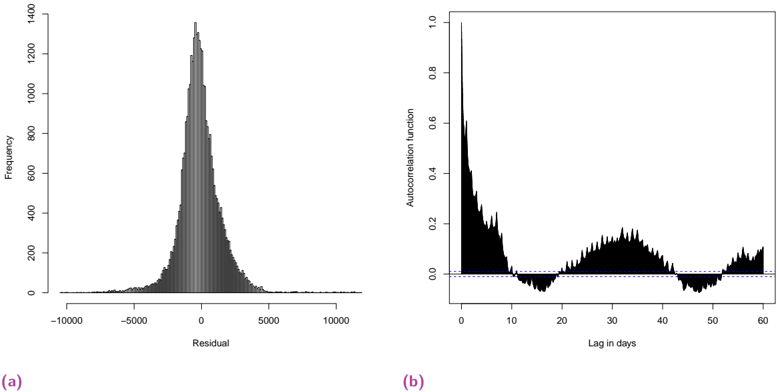
**(a)** A histogram of residuals with a bell-shaped distribution.
**(b)** An autocorrelation function (ACF) plot showing temporal correlation decay over lag days.
---
### Components/Axes
#### Subplot (a): Histogram
- **X-axis**: "Residual" (values: -10,000 to 10,000, approximately).
- **Y-axis**: "Frequency" (values: 0 to 1,400, approximately).
- **Key Feature**: Bell-shaped curve peaking near 0.
#### Subplot (b): Autocorrelation Function
- **X-axis**: "Lag in days" (values: 0 to 60, approximately).
- **Y-axis**: "Autocorrelation function" (values: -1 to 1, approximately).
- **Dashed Line**: Horizontal reference at 0.1 (dashed, gray).
---
### Detailed Analysis
#### Subplot (a): Histogram
- **Distribution**: Symmetric, bell-shaped curve centered at 0.
- **Peak Frequency**: Approximately 1,200 (highest bar near 0).
- **Tails**: Rapidly decreasing frequency as residuals move away from 0.
- **Uncertainty**: Approximate values due to lack of gridlines; peak frequency could range from 1,000–1,400.
#### Subplot (b): Autocorrelation Function
- **Initial Value**: Sharp peak at lag 0 (~0.8–0.9).
- **Decay**: Rapid decline to ~0.2 by lag 10.
- **Oscillations**:
- First trough: ~-0.2 at lag 10.
- Second peak: ~0.3 at lag 20.
- Third trough: ~-0.1 at lag 30.
- Fourth peak: ~0.15 at lag 40.
- Final trough: ~-0.05 at lag 50.
- **Significance Threshold**: Dashed line at 0.1; values above this are statistically significant.
---
### Key Observations
1. **Residual Distribution**: Residuals are approximately normally distributed (bell shape), suggesting no systematic bias in the model.
2. **Autocorrelation Decay**: Correlation weakens rapidly after lag 10, but periodic oscillations persist (e.g., peaks at lags 20 and 40).
3. **Significance**: Only the initial peak (lag 0) and lag 20 exceed the 0.1 significance threshold.
---
### Interpretation
- **Residual Analysis**: The normal distribution of residuals implies the model’s errors are randomly distributed, supporting its validity.
- **Autocorrelation Patterns**:
- The decay after lag 10 suggests no strong short-term dependence.
- Oscillations (e.g., lag 20, 40) may indicate seasonal or cyclical patterns in the data.
- The lack of sustained correlation beyond lag 10 implies the data is likely stationary.
- **Practical Implications**:
- The model’s residuals are well-behaved, but the autocorrelation oscillations warrant further investigation for hidden temporal dependencies.
- The 0.1 threshold helps identify significant lags, but the sparse significant values suggest minimal long-term memory in the data.
---
**Note**: All values are approximate due to the absence of gridlines or exact numerical labels. The analysis assumes standard statistical conventions (e.g., ACF significance at 0.1).