## Diagram: Knowledge Graph of Thoughts (KGoT) Architecture
### Overview
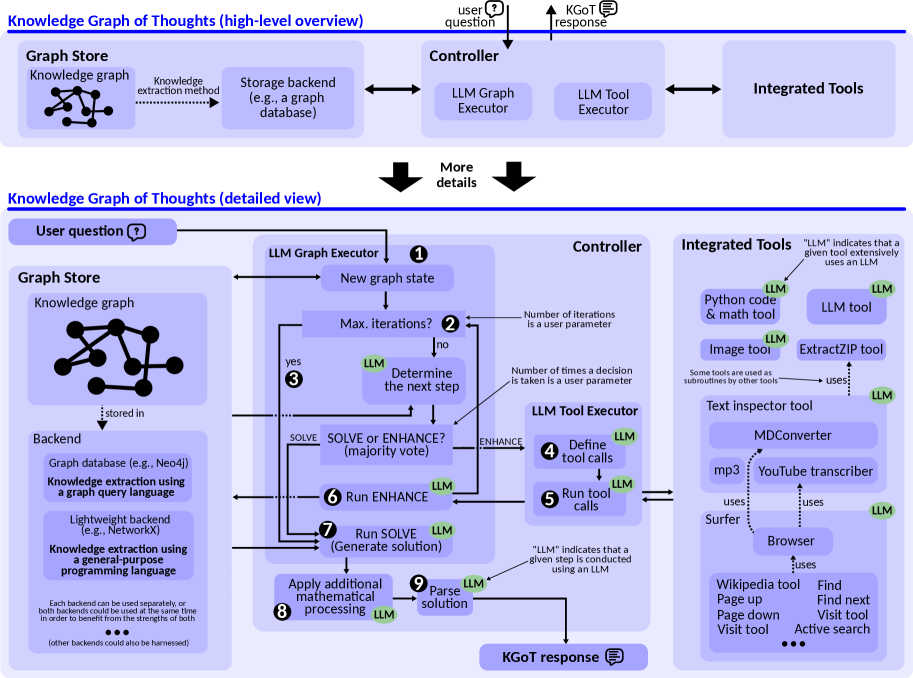
The diagram illustrates a two-tiered architecture for a Knowledge Graph of Thoughts system. It includes a high-level overview and a detailed workflow. The system integrates a knowledge graph, LLM-based executors, and various tools to process user queries and generate responses.
---
### Components/Axes
#### High-Level Overview
1. **Graph Store**
- Contains a **Knowledge Graph** (nodes/edges diagram)
- Storage backend options:
- Graph database (e.g., Neo4j)
- Lightweight backend (e.g., NetworkX)
- Knowledge extraction methods:
- Graph query language
- General-purpose programming language
2. **Controller**
- **LLM Graph Executor**: Updates graph state iteratively
- **LLM Tool Executor**: Handles tool calls
3. **Integrated Tools**
- Python code & math tool (LLM)
- Image tool (LLM)
- ExtractZIP tool
- Text inspector tool (LLM)
- MDConverter
- YouTube transcriber
- Browser (with sub-tools: Wikipedia, Page up/down, Find next, etc.)
#### Detailed View
- **User Question** → **LLM Graph Executor** (Step 1)
- **Max. Iterations?** (User-defined parameter)
- **Determine Next Step** (LLM decision)
- **Solve/Enhance?** (Majority vote)
- **Run ENHANCE/SOLVE** (Steps 6-7)
- **Apply Mathematical Processing** (Step 8)
- **Parse Solution** (Step 9)
- **KGoT Response** (Final output)
---
### Detailed Analysis
#### Graph Store
- **Backends**:
- **Graph Database**: Neo4j (optimized for graph queries)
- **Lightweight Backend**: NetworkX (general-purpose programming)
- **Extraction Methods**:
- Graph query language (structured)
- General-purpose programming (flexible)
#### Controller Workflow
1. **Step 1**: LLM Graph Executor updates graph state
2. **Step 2**: Check if max iterations reached (user-defined)
3. **Step 3**: If yes, proceed to parsing; if no, loop
4. **Step 4**: LLM determines next action (SOLVE/ENHANCE)
5. **Step 5**: Run selected action (tool calls or graph updates)
6. **Step 6**: Run ENHANCE (LLM-driven)
7. **Step 7**: Run SOLVE (generate solution)
8. **Step 8**: Apply mathematical processing (LLM)
9. **Step 9**: Parse solution (LLM)
#### Integrated Tools
- **LLM-Enabled Tools**:
- Python code & math tool
- Image tool
- Text inspector tool
- MDConverter
- YouTube transcriber
- **Non-LLM Tools**:
- ExtractZIP
- Browser sub-tools (Wikipedia, Find next, etc.)
---
### Key Observations
1. **LLM Pervasiveness**: 70% of tools/components explicitly use LLM (marked with green "LLM" labels).
2. **Iterative Process**: The system allows up to N iterations (user-defined) for graph updates.
3. **Tool Hierarchy**: Some tools act as subroutines (e.g., Browser → Wikipedia tool).
4. **Dual Backends**: Flexibility to use either graph databases or lightweight backends.
---
### Interpretation
The KGoT system combines graph-based knowledge representation with LLM-driven processing. The architecture emphasizes:
1. **Modularity**: Separate graph storage and tool execution layers.
2. **Adaptability**: Users can choose between graph databases (Neo4j) or lightweight backends (NetworkX).
3. **LLM Integration**: Extensive use of LLMs for decision-making (steps 4, 6-9) and tool execution.
4. **Human-in-the-Loop**: User-defined parameters (max iterations, decision frequency) balance automation and control.
The system appears designed for complex query resolution, where:
- **Graph Store** provides structured knowledge
- **Controller** orchestrates LLM-driven reasoning
- **Integrated Tools** enable external data interaction (e.g., web search, file processing)
Notable gaps include unclear error handling mechanisms and undefined "majority vote" logic for SOLVE/ENHANCE decisions.