\n
## Diagram: Cognitive Architecture Model
### Overview
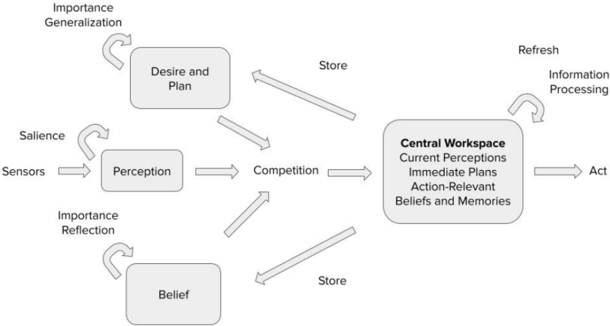
The image depicts a cognitive architecture model illustrating the flow of information between different cognitive components. It's a diagram showing how sensory input is processed, how desires and beliefs are formed, and how actions are generated. The diagram uses boxes to represent cognitive modules and arrows to represent the flow of information or influence between them.
### Components/Axes
The diagram consists of the following components:
* **Sensors:** Input source.
* **Perception:** Processes sensory input.
* **Belief:** Stores and maintains beliefs.
* **Desire and Plan:** Generates desires and plans.
* **Central Workspace:** Integrates information and drives action. Contains: Current Perceptions, Immediate Plans, Action-Relevant Beliefs and Memories.
* **Act:** Output/Action.
The following processes/connections are labeled:
* **Salience:** From Sensors to Perception.
* **Importance Generalization:** From Desire and Plan to itself (feedback loop).
* **Importance Reflection:** From Perception to Belief (feedback loop).
* **Competition:** From Perception and Belief to Central Workspace.
* **Store:** From Desire and Plan and Belief to Central Workspace.
* **Refresh:** From Central Workspace to Information Processing.
* **Information Processing:** To Act.
### Detailed Analysis / Content Details
The diagram shows a cyclical flow of information.
1. **Sensors** provide input, which is processed by **Perception**. The strength of this input is indicated by "Salience".
2. **Perception** feeds into both the **Central Workspace** (via "Competition") and the **Belief** module (via "Importance Reflection").
3. **Belief** also feeds into the **Central Workspace** (via "Competition") and stores information.
4. **Desire and Plan** receives input from the **Central Workspace** (via "Store") and also has a self-referential feedback loop labeled "Importance Generalization".
5. The **Central Workspace** integrates information from **Perception**, **Belief**, and **Desire and Plan** and generates an "Act". It is refreshed by "Information Processing".
6. The **Central Workspace** contains "Current Perceptions", "Immediate Plans", "Action-Relevant Beliefs and Memories".
The arrows indicate the direction of influence. Thicker arrows suggest a stronger or more significant influence. Curved arrows represent feedback loops.
### Key Observations
* The **Central Workspace** is positioned centrally, indicating its role as the core integration point.
* The feedback loops ("Importance Generalization" and "Importance Reflection") suggest a dynamic and adaptive system.
* The diagram emphasizes the interplay between perception, belief, desire, and action.
* The diagram does not contain any numerical data or quantitative measurements.
### Interpretation
This diagram represents a cognitive architecture, likely a model of how the human mind processes information and generates behavior. It illustrates a system where sensory input is filtered and interpreted (Perception), combined with existing knowledge (Belief), and used to formulate goals and plans (Desire and Plan). The Central Workspace acts as a "conscious" area where these elements are integrated, leading to action.
The feedback loops suggest that the system is not simply a linear flow of information but a dynamic process where beliefs and desires can influence perception, and vice versa. The "Importance" labels suggest that the system prioritizes information based on its relevance to goals and beliefs.
The diagram is a high-level conceptual model and does not specify the underlying mechanisms or algorithms. It's a representation of the *relationships* between cognitive components rather than a detailed implementation. The diagram is a simplified representation of a complex system, and it's likely that many other factors and processes are involved in actual human cognition.