## Diagram: Cognitive Architecture Flowchart
### Overview
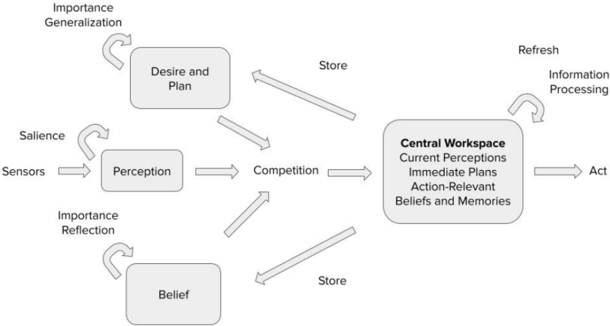
The image displays a flowchart illustrating a cognitive architecture model. It depicts the flow of information from sensory input through various cognitive modules (Perception, Belief, Desire and Plan) that compete for access to a Central Workspace, which integrates information to produce action. The diagram emphasizes feedback loops for storage and refresh processes.
### Components/Axes
The diagram is composed of labeled rectangular boxes (modules) connected by directional arrows indicating information flow. There are no traditional chart axes. The primary components are:
1. **Input Modules (Left Side):**
* **Sensors:** An external input source.
* **Salience:** A process with a self-referential (curved) arrow pointing to the **Perception** module.
* **Importance Generalization:** A process with a self-referential arrow pointing to the **Desire and Plan** module.
* **Importance Reflection:** A process with a self-referential arrow pointing to the **Belief** module.
2. **Processing Modules (Center-Left):**
* **Perception:** Receives input from **Sensors** and is influenced by **Salience**.
* **Belief:** Influenced by **Importance Reflection**.
* **Desire and Plan:** Influenced by **Importance Generalization**.
3. **Integration & Output (Center-Right to Right):**
* **Competition:** A central junction receiving arrows from **Perception**, **Desire and Plan**, and **Belief**.
* **Central Workspace:** The core integration module. It contains the following internal text:
* Current Perceptions
* Immediate Plans
* Action-Relevant Beliefs and Memories
* **Act:** The final output, indicated by an arrow from the **Central Workspace**.
4. **Feedback Loops:**
* **Store:** Two arrows originate from the **Central Workspace** and point back to the **Desire and Plan** and **Belief** modules, respectively.
* **Refresh / Information Processing:** A curved, self-referential arrow loops from the top of the **Central Workspace** back into itself, labeled with these two terms.
### Detailed Analysis
The flow of information is structured as follows:
1. **Input Pathways:** External data from **Sensors** enters the **Perception** module. Concurrently, internal processes (**Salience**, **Importance Generalization**, **Importance Reflection**) modulate the three primary cognitive modules.
2. **Convergence:** The outputs of **Perception**, **Desire and Plan**, and **Belief** all feed into a **Competition** stage. This suggests a bottleneck or selection mechanism where different cognitive streams vie for access to conscious processing.
3. **Central Integration:** The winner(s) of the **Competition** populate the **Central Workspace**. This workspace holds a dynamic, integrated model of the present situation ("Current Perceptions"), future goals ("Immediate Plans"), and relevant past knowledge ("Action-Relevant Beliefs and Memories").
4. **Action & Feedback:** The integrated information in the **Central Workspace** leads to an **Act**ion. Simultaneously, the system updates itself:
* **Short-term:** The **Refresh / Information Processing** loop indicates continuous updating of the workspace contents.
* **Long-term:** The **Store** pathways send information back to update the foundational **Desire and Plan** and **Belief** modules, suggesting learning or memory consolidation.
### Key Observations
* **Symmetry in Modulation:** The three input modules (**Perception**, **Desire and Plan**, **Belief**) are each paired with a specific modulatory process (**Salience**, **Importance Generalization**, **Importance Reflection**).
* **Central Bottleneck:** The **Competition** module is a critical choke point, implying that not all processed information can reach the **Central Workspace** simultaneously.
* **Bidirectional Flow:** While the primary flow is left-to-right (input to action), significant feedback loops (**Store**, **Refresh**) create a dynamic, recurrent system.
* **Workspace Composition:** The **Central Workspace** is explicitly defined as containing a blend of present, future, and past-oriented information, highlighting its role in integrated, context-aware decision-making.
### Interpretation
This diagram represents a **Global Workspace Theory** or **Limited Capacity Consciousness** model of cognition. The core idea is that multiple specialized, unconscious processes (Perception, Belief, Desire) operate in parallel. Their outputs compete for access to a single, limited-capacity "Central Workspace" (akin to conscious awareness). Once information enters this workspace, it is globally broadcast, enabling integrated thought and deliberate action (**Act**).
The **Store** and **Refresh** loops are crucial for explaining learning and cognitive continuity. The **Store** function allows the outcomes of conscious processing to update our long-term beliefs and plans. The **Refresh** function explains how we maintain a coherent stream of thought. The model elegantly accounts for how a brain with parallel, distributed processing can produce unified, sequential behavior. The presence of **Competition** suggests mechanisms for attention and selection, explaining why we are only aware of a fraction of our sensory and cognitive processing at any given moment.