## Flowchart: Cognitive Processing System Architecture
### Overview
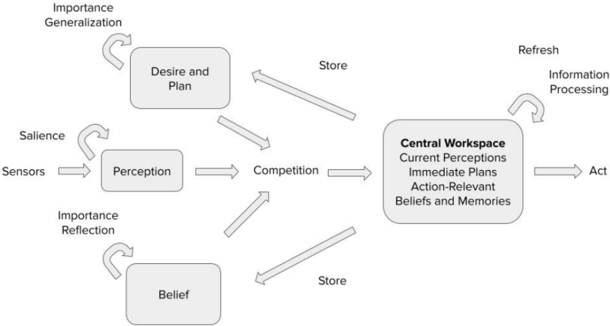
The diagram illustrates a cognitive processing system with interconnected components representing perception, decision-making, memory, and action. Arrows indicate directional flow and feedback loops between elements.
### Components/Axes
**Key Elements:**
1. **Central Workspace**
- Contains:
- Current Perceptions
- Immediate Plans
- Action-Relevant Beliefs and Memories
2. **Input/Output Pathways**
- **Sensors → Perception → Competition → Central Workspace**
- **Desire and Plan → Central Workspace**
- **Belief → Central Workspace**
- **Central Workspace → Information Processing → Act**
- **Act → Refresh → Central Workspace**
3. **Feedback Mechanisms**
- **Perception → Salience → Perception** (loop)
- **Importance Generalization → Desire and Plan**
- **Importance Reflection → Belief**
**Arrows/Labels:**
- "Store" (multiple instances)
- "Competition"
- "Refresh"
- "Information Processing"
### Detailed Analysis
**Flow Structure:**
1. **Sensory Input:**
- Sensors feed into Perception, which loops back via Salience (self-reinforcement).
- Perception data enters Competition before reaching the Central Workspace.
2. **Decision-Making:**
- Desire and Plan (driven by Importance Generalization) and Belief (via Importance Reflection) directly influence the Central Workspace.
3. **Action Execution:**
- Central Workspace outputs to Information Processing, which triggers Action.
- Action results in Refresh, feeding back into the Central Workspace.
**Critical Connections:**
- **Competition** acts as a gatekeeper for perceptual data entering the Central Workspace.
- **Refresh** creates a closed-loop system, enabling adaptive updates based on action outcomes.
### Key Observations
- **Central Workspace** is the hub for integrating diverse inputs (perception, desires, beliefs).
- **Feedback loops** (Salience, Refresh) suggest dynamic, self-regulating processes.
- **Competition** introduces a filtering mechanism for perceptual data.
### Interpretation
This architecture models a hierarchical cognitive system where:
1. **Sensory data** is processed and filtered (via Competition) before influencing decisions.
2. **Desires and beliefs** (shaped by importance assessments) directly impact planning and memory retrieval.
3. **Action outcomes** (via Refresh) create a feedback loop, allowing the system to adapt to environmental changes.
The diagram emphasizes **integration** (Central Workspace) and **adaptation** (feedback loops), aligning with theories of embodied cognition and dynamic memory systems. The absence of explicit numerical data suggests a conceptual rather than quantitative model.