## Heatmap: Mean and Standard Deviation of Conductance
### Overview
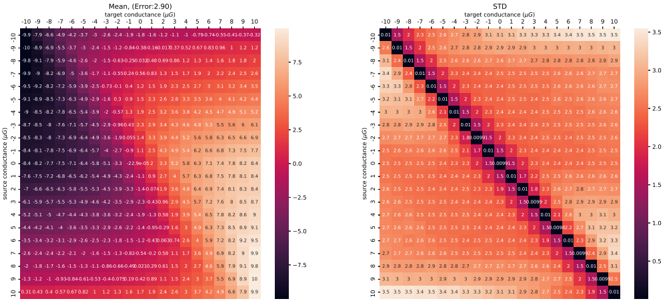
The image presents two heatmaps side-by-side. The left heatmap displays the mean conductance with an error of 2.90, while the right heatmap shows the standard deviation (STD) of conductance. Both heatmaps have the same axes: "source conductance (µG)" on the vertical axis and "target conductance (µG)" on the horizontal axis, both ranging from -10 to 10. The color intensity in each heatmap represents the magnitude of the mean or standard deviation value.
### Components/Axes
**Left Heatmap (Mean):**
* **Title:** Mean, (Error: 2.90)
* **X-axis:** target conductance (µG), ranging from -10 to 10 in integer increments.
* **Y-axis:** source conductance (µG), ranging from -10 to 10 in integer increments.
* **Color Scale:** Ranges from approximately -7.5 (dark purple) to 10 (light orange).
**Right Heatmap (STD):**
* **Title:** STD
* **X-axis:** target conductance (µG), ranging from -10 to 10 in integer increments.
* **Y-axis:** source conductance (µG), ranging from -10 to 10 in integer increments.
* **Color Scale:** Ranges from approximately 0.0 (dark purple) to 3.5 (light orange).
### Detailed Analysis
**Left Heatmap (Mean):**
The heatmap shows the mean conductance values for different combinations of source and target conductance.
* **Trend:** The values generally increase as both source and target conductance increase. The lower-left corner (negative source and target conductance) has the lowest values (dark purple), while the upper-right corner (positive source and target conductance) has the highest values (light orange).
* **Specific Values:**
* (-10, -10): -8.9
* (10, 10): 7.9
* (-10, 10): -0.31
* (10, -10): -2.6
**Right Heatmap (STD):**
The heatmap shows the standard deviation of conductance values for different combinations of source and target conductance.
* **Trend:** The highest standard deviation values are concentrated along the diagonal, where source and target conductance are equal. The values decrease as you move away from the diagonal.
* **Specific Values:**
* (-10, -10): 0.01
* (10, 10): 0.01
* (-10, -9): 1.5
* (-9, -10): 1.5
* (0, 0): 0.000099
* (1, 1): 0.01
* (2, 2): 0.01
* (3, 3): 0.01
* (4, 4): 0.01
* (5, 5): 0.01
* (6, 6): 0.01
* (7, 7): 0.01
* (8, 8): 0.01
* (9, 9): 0.01
* (10, 10): 0.01
### Key Observations
* The mean conductance values are strongly influenced by both source and target conductance, with higher values observed when both are positive.
* The standard deviation is highest when the source and target conductances are equal, indicating greater variability in these conditions.
### Interpretation
The heatmaps provide insights into the relationship between source and target conductance. The mean heatmap suggests a direct correlation between the two, where increasing either leads to a higher average conductance. The STD heatmap highlights the variability in conductance, which is most pronounced when source and target conductances are matched. This could indicate that the system is more sensitive or unstable under these conditions. The error value of 2.90 associated with the mean suggests that the mean values should be interpreted with caution, as there is a significant level of uncertainty. The very low STD values along the diagonal suggest a high degree of precision when the target and source conductances are equal.