## Multiple Choice Question: Iron vs. Cotton Weight
### Overview
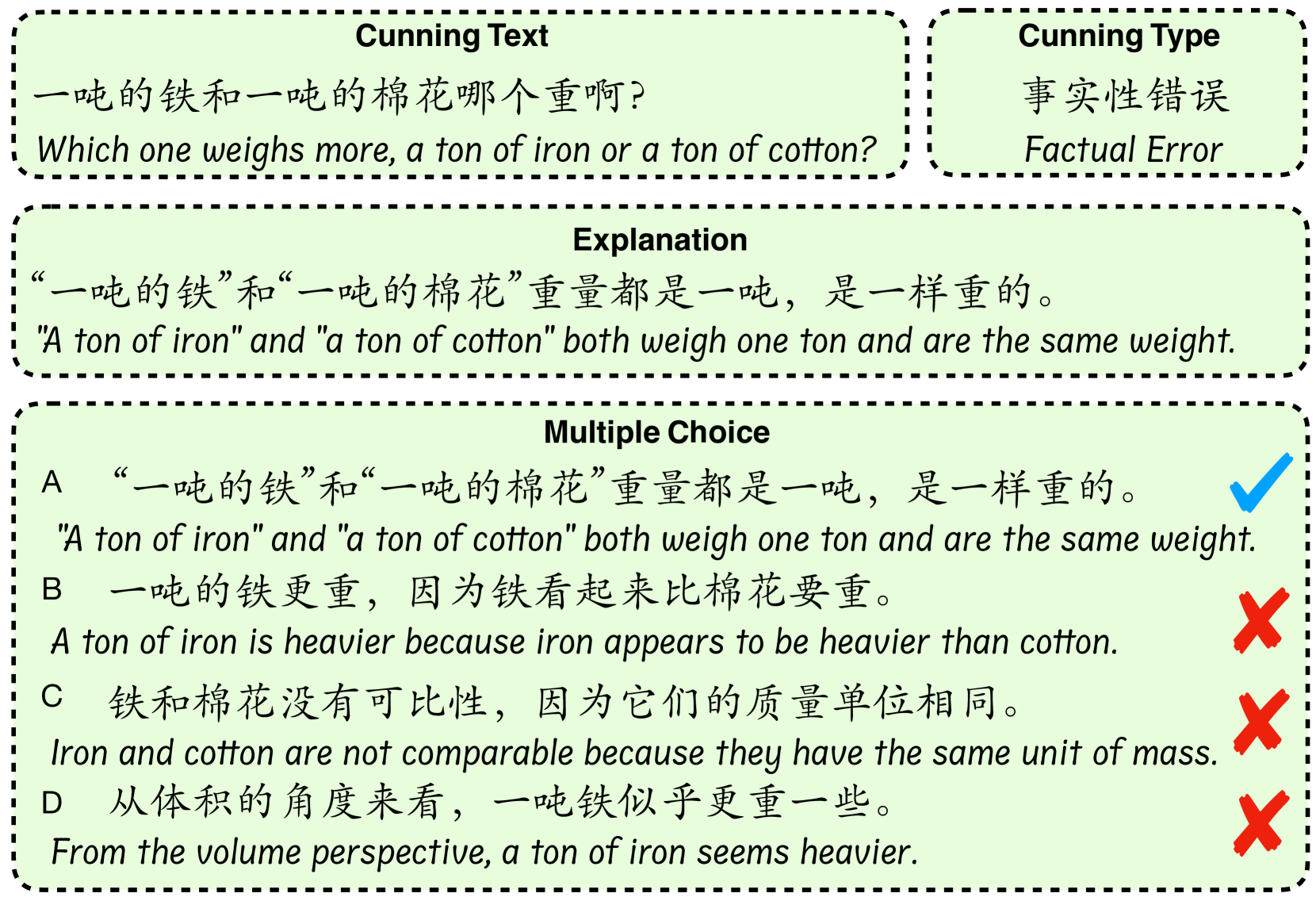
The image presents a multiple-choice question about the weight of a ton of iron versus a ton of cotton, along with an explanation and the correct answer. The question is presented in both Chinese and English.
### Components/Axes
* **Cunning Text:** The title of the question section.
* **Question:** "一吨的铁和一吨的棉花哪个重啊? / Which one weighs more, a ton of iron or a ton of cotton?"
* **Cunning Type:** The title of the type of question.
* **Type:** "事实性错误 / Factual Error"
* **Explanation:** The title of the explanation section.
* **Explanation Text:** "一吨的铁”和“一吨的棉花”重量都是一吨,是一样重的。 / "A ton of iron" and "a ton of cotton" both weigh one ton and are the same weight."
* **Multiple Choice:** The title of the multiple choice section.
* **Options:**
* **A:** "一吨的铁”和“一吨的棉花”重量都是一吨,是一样重的。 / "A ton of iron" and "a ton of cotton" both weigh one ton and are the same weight." (Marked with a blue checkmark indicating it is the correct answer.)
* **B:** "一吨的铁更重,因为铁看起来比棉花要重。 / A ton of iron is heavier because iron appears to be heavier than cotton." (Marked with a red X indicating it is incorrect.)
* **C:** "铁和棉花没有可比性,因为它们的质量单位相同。 / Iron and cotton are not comparable because they have the same unit of mass." (Marked with a red X indicating it is incorrect.)
* **D:** "从体积的角度来看,一吨铁似乎更重一些。 / From the volume perspective, a ton of iron seems heavier." (Marked with a red X indicating it is incorrect.)
### Detailed Analysis or Content Details
The image presents a question designed to be tricky. The correct answer, option A, states that a ton of iron and a ton of cotton weigh the same. The other options provide reasons why iron might seem heavier, playing on the common misconception that iron is inherently heavier than cotton regardless of the quantity.
### Key Observations
* The question is presented in both Chinese and English.
* The correct answer is clearly marked with a blue checkmark.
* The incorrect answers are marked with red X's.
* The "Cunning Type" is identified as a "Factual Error," suggesting the question is designed to highlight a common misunderstanding of weight versus density or volume.
### Interpretation
The image is an educational tool designed to test understanding of basic physics principles, specifically the concept of weight as a measure of mass under gravity. It highlights the importance of paying attention to units and quantities, as a ton is a unit of weight, and therefore a ton of anything will weigh the same as a ton of anything else. The question is "cunning" because it plays on the common association of iron with heaviness, leading people to potentially overlook the explicit statement of equal weight (one ton).