## Educational Material: Factual Error Identification
### Overview
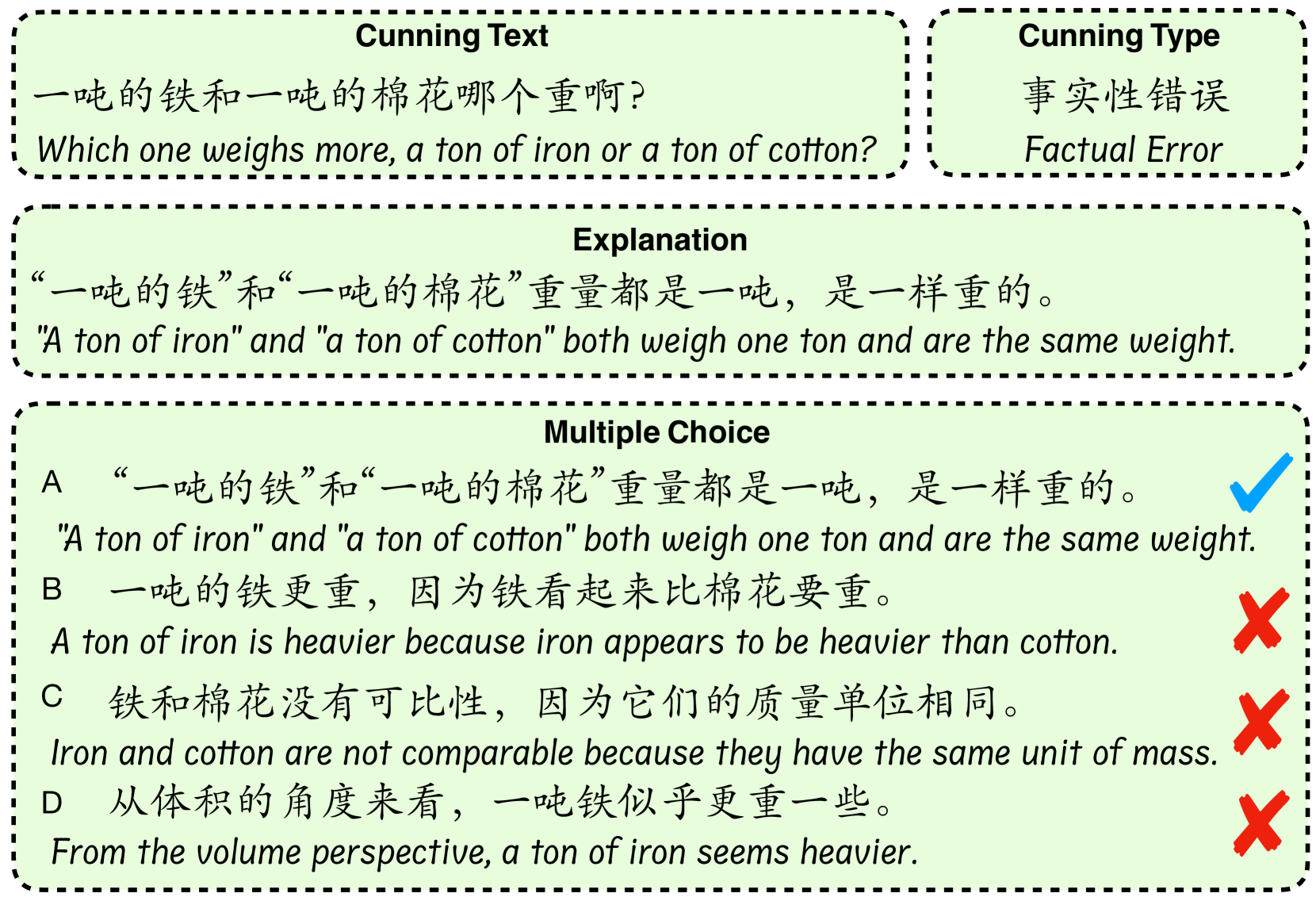
The image presents an educational example of a factual error, formatted as a multiple-choice question. It aims to test understanding of mass vs. perceived weight/volume. The question is presented in both Chinese and English, followed by an explanation and multiple-choice answers with indicators of correctness (checkmarks) and incorrectness (crosses).
### Components/Axes
The image is divided into four main sections:
1. **Cunning Text:** Contains the question in both Chinese and English.
* Chinese: 一吨的铁和一吨的棉花哪个更重吗?
* English: Which one weighs more, a ton of iron or a ton of cotton?
* Label: "Cunning Text" (top-left)
* Label: "事实性错误" (Chinese for "Factual Error")
* Label: "Cunning Type" (top-right)
2. **Explanation:** Provides the correct answer and reasoning in both Chinese and English.
* Chinese: “一吨的铁”和“一吨的棉花”重量都是一吨,是一样重的。
* English: "A ton of iron" and "a ton of cotton" both weigh one ton and are the same weight.
* Label: "Explanation" (center)
3. **Multiple Choice:** Presents four answer options, each with a corresponding Chinese and English translation.
* A: “一吨的铁”和“一吨的棉花”重量都是一吨,是一样重的。 / "A ton of iron" and "a ton of cotton" both weigh one ton and are the same weight. (Correct - marked with a blue checkmark)
* B: 一吨的铁更重,因为铁看起来比棉花变重。 / A ton of iron is heavier because iron appears to be heavier than cotton. (Incorrect - marked with a red cross)
* C: 铁和棉花没有可比性,因为它们的质量单位相同。 / Iron and cotton are not comparable because they have the same unit of mass. (Incorrect - marked with a red cross)
* D: 从体积的角度来看,一吨铁似乎更重一些。 / From the volume perspective, a ton of iron seems heavier. (Incorrect - marked with a red cross)
* Label: "Multiple Choice" (center)
4. **Visual Indicators:** Checkmarks and crosses denote the correctness of each multiple-choice option.
### Detailed Analysis or Content Details
The core concept revolves around understanding that "a ton" is a unit of mass. Therefore, a ton of iron and a ton of cotton have the same mass, despite differences in volume and perceived weight. The incorrect answers highlight common misconceptions related to density and visual perception.
* **Question:** The question directly asks about weight, aiming to trigger the misconception that iron is heavier due to its density.
* **Correct Answer (A):** Reiterates the fundamental principle that a ton is a unit of mass, and therefore equal masses weigh the same.
* **Incorrect Answer (B):** Appeals to visual perception – iron *looks* heavier. This is a common error.
* **Incorrect Answer (C):** Misdirects by stating that iron and cotton are incomparable due to having the same unit of mass, which is incorrect. They *are* comparable because they are both measured in the same unit.
* **Incorrect Answer (D):** Introduces the concept of volume, which is a distractor. While iron has a smaller volume for the same mass, this doesn't change the weight.
### Key Observations
The image effectively demonstrates a common factual error related to mass, weight, and density. The use of both Chinese and English makes it accessible to a wider audience. The visual cues (checkmarks and crosses) clearly indicate the correct and incorrect answers.
### Interpretation
This educational material is designed to challenge intuitive but incorrect assumptions about weight and mass. It highlights the importance of understanding units of measurement and distinguishing between mass, weight, and density. The question is a classic example used to illustrate how our perceptions can be misleading when it comes to physical properties. The inclusion of both languages suggests a focus on cross-cultural understanding of scientific concepts. The format is suitable for self-study or classroom instruction, promoting critical thinking and conceptual clarity. The use of "Cunning Text" suggests a playful approach to learning, framing the error as a "trick" to be identified.