## Screenshot: Multiple-Choice Question on Weight Comparison
### Overview
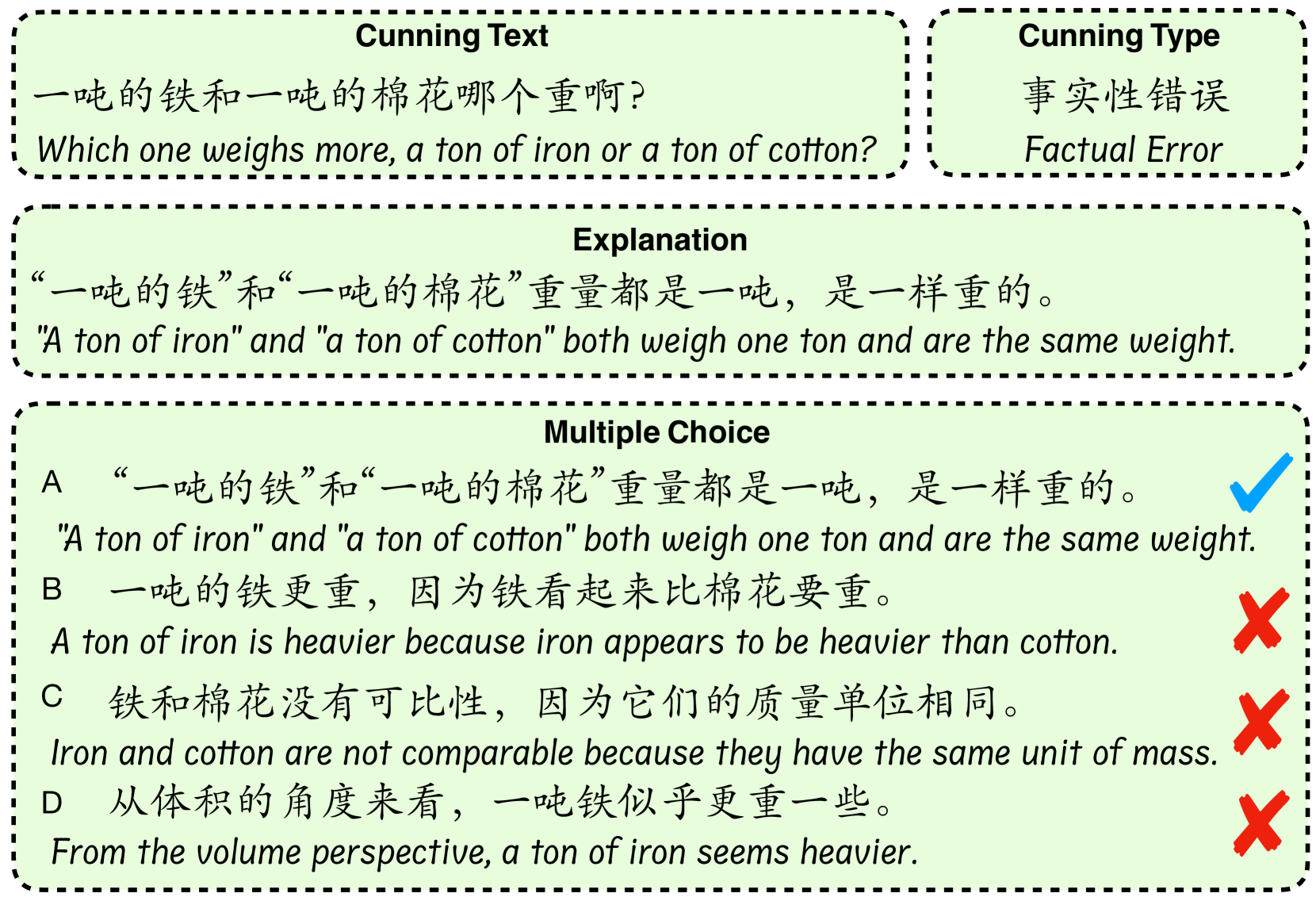
The image shows a multiple-choice question in Chinese with an English translation, focusing on a factual error in weight comparison. The question asks which weighs more: a ton of iron or a ton of cotton. The correct answer is provided with explanations and distractors.
### Components/Axes
- **Labels**:
- **Question Text**: Chinese text "一吨的铁和一吨的棉花哪个重啊?" (Which one weighs more, a ton of iron or a ton of cotton?) and its English translation.
- **Error Type**: Chinese text "事实性错误" (Factual Error) and its English translation.
- **Explanation**: Chinese text explaining that "一吨的铁" and "一吨的棉花" both weigh one ton and are the same weight.
- **Multiple Choice**: Options A–D with Chinese text and English translations.
- **Textual Content**:
- **Question**: "一吨的铁和一吨的棉花哪个重啊?" (Which one weighs more, a ton of iron or a ton of cotton?)
- **Explanation**: "一吨的铁”和“一吨的棉花”重量都是一吨,是一样重的。 ("A ton of iron" and "a ton of cotton" both weigh one ton and are the same weight.)
- **Options**:
- **A**: "一吨的铁”和“一吨的棉花”重量都是一吨,是一样重的。 (Correct answer, marked with a blue checkmark.)
- **B**: 一吨的铁更重,因为铁看起来比棉花要重。 (A ton of iron is heavier because iron appears to be heavier than cotton.)
- **C**: 铁和棉花没有可比性,因为它们的质量单位相同。 (Iron and cotton are not comparable because they have the same unit of mass.)
- **D**: 从体积的角度来看,一吨铁似乎更重一些。 (From the volume perspective, a ton of iron seems heavier.)
### Key Observations
- The question tests understanding of mass vs. volume perception.
- Distractors B and D rely on visual bias (iron "appears" heavier) or irrelevant volume comparisons.
- Option C incorrectly claims incomparability due to shared mass units.
### Interpretation
The question highlights a common cognitive bias where density (iron) is conflated with mass. While a ton of iron occupies less volume than a ton of cotton, their masses are identical. The correct answer (A) emphasizes that weight depends solely on mass, not material properties or volume. Distractors B and D reflect real-world perceptual errors, while C introduces a flawed logical premise. This aligns with the "Factual Error" category, as the question’s premise (comparing weights) is valid, but the distractors mislead by introducing irrelevant factors.