## Network Diagram: Complex Interconnections
### Overview
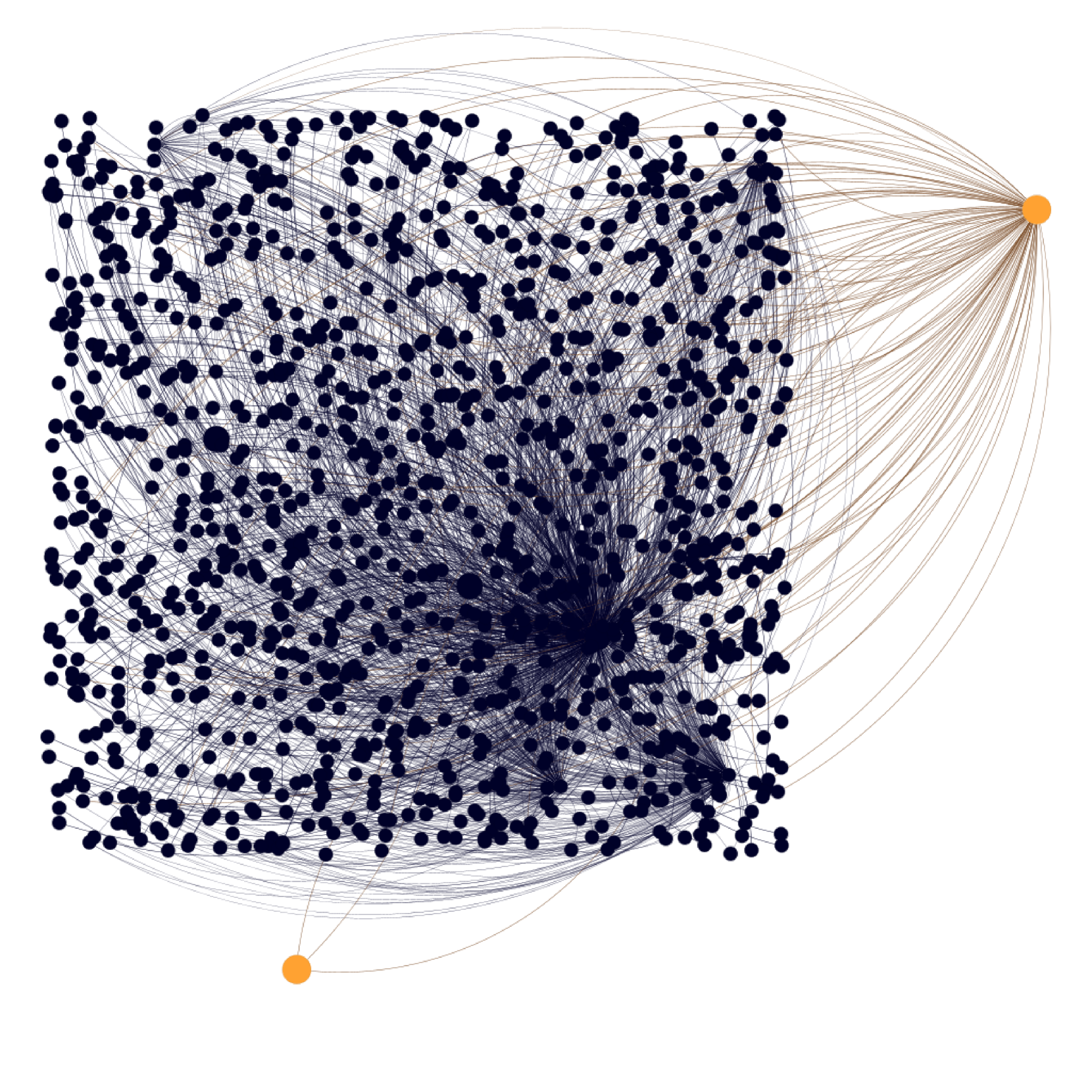
The image is a network diagram illustrating complex interconnections between numerous nodes. The diagram features a large cluster of densely interconnected dark blue nodes, with connections extending to two distinct orange nodes located outside the main cluster. The density of connections varies, with some nodes acting as central hubs and others having fewer links.
### Components/Axes
* **Nodes:** Represented by dark blue and orange circles. The majority of nodes are dark blue, forming a dense cluster. Two nodes are orange and located outside the main cluster.
* **Edges:** Represented by thin lines connecting the nodes. The lines are primarily dark blue within the main cluster and transition to a tan color as they connect to the orange nodes.
* **Layout:** The main cluster of dark blue nodes is positioned towards the left and center of the image. The two orange nodes are located on the right and bottom-left of the image, respectively.
### Detailed Analysis
* **Dark Blue Nodes:** There are approximately 500-700 dark blue nodes. These nodes are densely interconnected, forming a central network. The connections within this cluster appear to be relatively uniform, with some nodes having a slightly higher degree of connectivity than others.
* **Orange Nodes:** There are two orange nodes. One is located on the right side of the diagram, and the other is located on the bottom-left. These nodes are connected to the main cluster via tan-colored edges.
* **Edges:** The edges within the main cluster are dark blue, matching the color of the nodes. As the edges extend from the main cluster to the orange nodes, they transition to a tan color. The orange node on the right has a significantly higher number of connections compared to the orange node on the bottom-left. The edges connecting to the right orange node are more concentrated, indicating a stronger relationship or higher frequency of interaction.
### Key Observations
* **Central Cluster:** The dark blue nodes form a highly interconnected central cluster, suggesting a strong degree of interaction or relationship among these entities.
* **Peripheral Nodes:** The orange nodes act as peripheral nodes, connected to the main cluster but distinct from it. The orange node on the right appears to be a significant point of interaction with the central cluster, while the orange node on the bottom-left has fewer connections.
* **Color Coding:** The color transition of the edges from dark blue to tan suggests a change in the nature of the relationship or interaction as it extends from the central cluster to the peripheral nodes.
### Interpretation
The network diagram likely represents a system where a large group of entities (dark blue nodes) are closely interconnected and interact frequently. The two orange nodes represent external entities that interact with the central cluster, but to varying degrees. The orange node on the right is a major point of interaction, potentially representing a key external partner or influence. The orange node on the bottom-left has a weaker connection, suggesting a less significant or less frequent interaction. The color change in the edges could indicate a different type of relationship or interaction between the central cluster and the peripheral nodes compared to the interactions within the central cluster itself. The diagram could be used to visualize social networks, communication networks, or any system where entities are interconnected and interact with each other.