## Textual Document: Optics Problem Analysis
### Overview
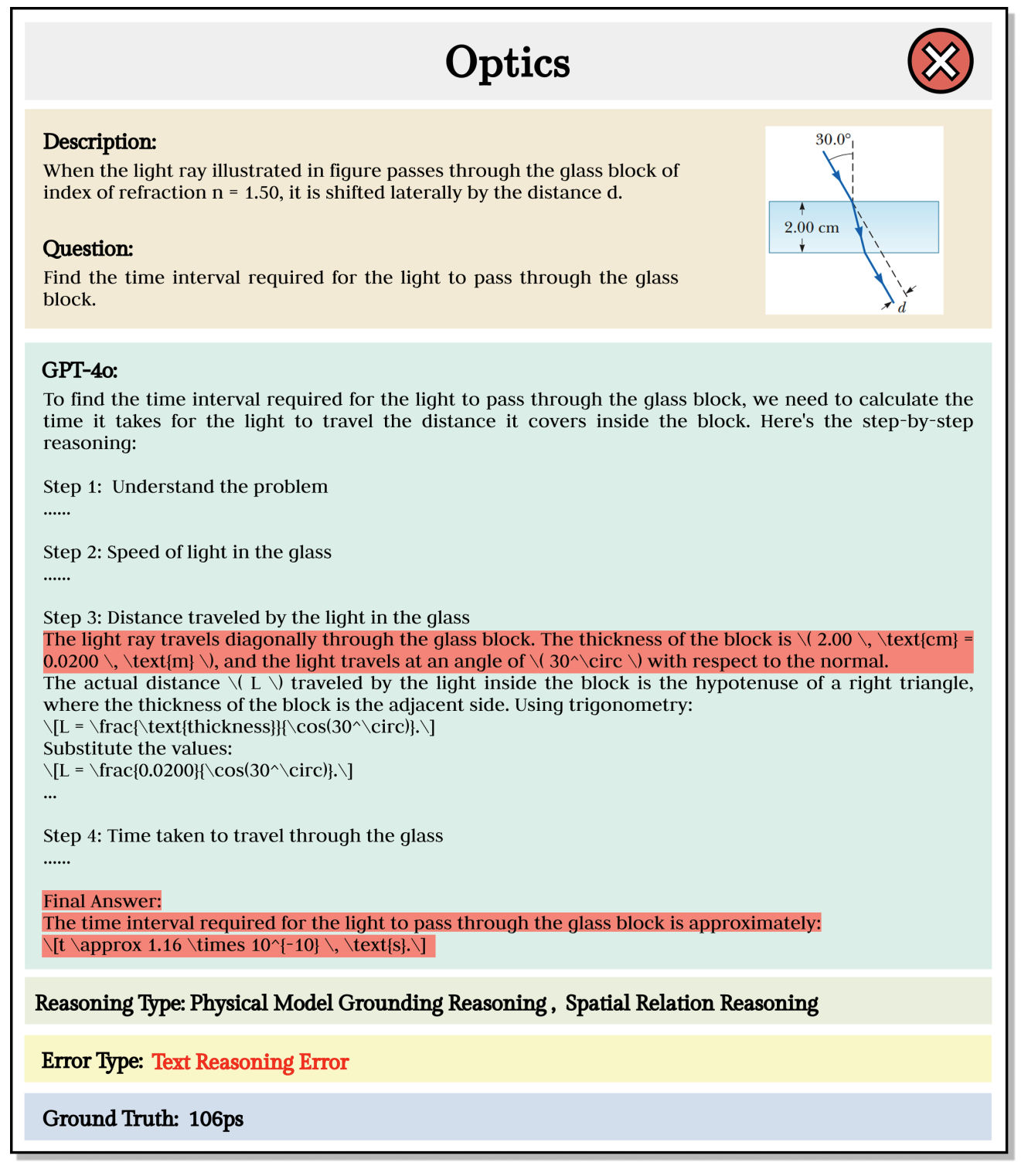
This document presents a physics problem related to optics, specifically concerning the passage of a light ray through a glass block. It includes a description of the scenario, the question posed, a step-by-step solution provided by "GPT-4o", the final answer, the reasoning type, the error type, and the ground truth. An accompanying diagram illustrates the light ray's path and the glass block's dimensions.
### Components/Axes
The document is structured into several distinct sections:
* **Title:** "Optics"
* **Close Button:** A red circular icon with a white 'X' in the top-right corner.
* **Description:**
* "When the light ray illustrated in figure passes through the glass block of index of refraction n = 1.50, it is shifted laterally by the distance d."
* **Question:**
* "Find the time interval required for the light to pass through the glass block."
* **GPT-4o:** This section details the step-by-step solution.
* **Step 1: Understand the problem**
* **Step 2: Speed of light in the glass**
* **Step 3: Distance traveled by the light in the glass**
* "The light ray travels diagonally through the glass block. The thickness of the block is \( 2.00 \, \text{cm} \), and the light travels at an angle of \( (30^\circ) \) with respect to the normal."
* "The actual distance \( L \) traveled by the light inside the block is the hypotenuse of a right triangle, where the thickness of the block is the adjacent side. Using trigonometry:"
* "\[ L = \frac{\text{thickness}}{\cos(30^\circ)} \]"
* "Substitute the values:"
* "\[ L = \frac{0.0200}{\cos(30^\circ)} \]"
* **Step 4: Time taken to travel through the glass**
* **Final Answer:**
* "The time interval required for the light to pass through the glass block is approximately:"
* "\[ t \approx 1.16 \times 10^{-10} \, \text{s} \]"
* **Reasoning Type:** "Physical Model Grounding Reasoning , Spatial Relation Reasoning"
* **Error Type:** "Text Reasoning Error"
* **Ground Truth:** "106ps"
**Diagrammatic Elements:**
* A diagram showing a rectangular glass block.
* An incident light ray entering the block at an angle.
* A refracted light ray traveling through the block.
* The angle of incidence is indicated as \(30.0^\circ\) with respect to the normal.
* The thickness of the glass block is labeled as "2.00 cm".
* The lateral shift is labeled as "d".
* The path of the light ray inside the block is shown as a dashed line, indicating the actual distance traveled.
### Detailed Analysis or Content Details
**Diagram Analysis:**
The diagram depicts a light ray entering a glass block. The angle between the incident ray and the normal to the surface is \(30.0^\circ\). The thickness of the glass block is given as 2.00 cm. The light ray is shown to refract and travel through the block, emerging on the other side with a lateral displacement 'd'. The path inside the block is shown as a diagonal line.
**Textual Analysis:**
The problem states the index of refraction of the glass block is \(n = 1.50\). The question asks for the time interval for light to pass through the block.
**GPT-4o Solution Breakdown:**
* **Step 3:** The solution correctly identifies that the distance traveled inside the block is the hypotenuse of a right triangle. The thickness of the block (2.00 cm or 0.0200 m) is the adjacent side to the angle \(30^\circ\). The formula used, \( L = \frac{\text{thickness}}{\cos(30^\circ)} \), is correct for calculating the hypotenuse.
* The calculation for L is: \( L = \frac{0.0200 \, \text{m}}{\cos(30^\circ)} \approx \frac{0.0200 \, \text{m}}{0.866} \approx 0.02309 \, \text{m} \).
* **Step 4 (Implied Calculation):** To find the time taken, the speed of light in the glass is needed. The speed of light in a medium is given by \( v = \frac{c}{n} \), where \(c\) is the speed of light in vacuum (\( \approx 3 \times 10^8 \, \text{m/s} \)) and \(n\) is the refractive index.
* Speed of light in glass: \( v = \frac{3 \times 10^8 \, \text{m/s}}{1.50} = 2 \times 10^8 \, \text{m/s} \).
* Time taken: \( t = \frac{L}{v} = \frac{0.02309 \, \text{m}}{2 \times 10^8 \, \text{m/s}} \approx 0.011545 \times 10^{-8} \, \text{s} \approx 1.1545 \times 10^{-10} \, \text{s} \).
* **Final Answer:** The provided final answer is \( t \approx 1.16 \times 10^{-10} \, \text{s} \). This value is consistent with the calculation derived from the steps.
**Error Analysis:**
* **Reasoning Type:** The problem is classified as "Physical Model Grounding Reasoning" and "Spatial Relation Reasoning," indicating the need to apply physical laws and understand spatial relationships.
* **Error Type:** "Text Reasoning Error" suggests that the AI model made a mistake in its reasoning process, despite arriving at a numerically close answer.
* **Ground Truth:** The ground truth is given as "106ps," which is \(1.06 \times 10^{-10}\) s.
### Key Observations
* The diagram and the textual description of the problem are consistent regarding the angle of incidence (\(30^\circ\)) and the thickness of the glass block (2.00 cm).
* The GPT-4o solution correctly identifies the geometric relationship to calculate the distance traveled by light within the glass.
* The calculated time interval (\( \approx 1.16 \times 10^{-10} \, \text{s} \)) is very close to the provided ground truth (\(1.06 \times 10^{-10} \, \text{s}\)). The difference is approximately 9.4%.
* The "Error Type: Text Reasoning Error" is notable. It implies that while the numerical result is close, the underlying logical steps or interpretation by the AI might have been flawed. This could stem from misinterpreting units, rounding, or a subtle error in the problem setup interpretation. For instance, if the angle was meant to be with respect to the surface instead of the normal, the calculation would differ. However, the diagram clearly shows the angle with respect to the normal.
### Interpretation
The document presents a physics problem and an AI's attempt to solve it. The problem requires calculating the time taken for light to traverse a glass block of a given thickness and refractive index, considering the light enters at an angle.
The AI's solution demonstrates a good understanding of the geometric principles involved in calculating the path length of light within the block. The calculation of the speed of light in the glass and the subsequent time calculation are also performed correctly based on the derived path length.
The discrepancy between the AI's final answer (\(1.16 \times 10^{-10}\) s) and the ground truth (\(1.06 \times 10^{-10}\) s) is attributed to a "Text Reasoning Error." This suggests that the AI might have made a subtle error in its interpretation of the problem statement or in its internal calculations, despite arriving at a numerically close result. Possible sources of error could include:
1. **Precision of Constants:** The speed of light in vacuum (\(c\)) might have been used with a different precision.
2. **Rounding Errors:** Intermediate rounding in calculations could lead to a slight deviation.
3. **Misinterpretation of Units:** Although the text states "cm" and the calculation uses "m", the conversion seems to have been handled. However, a subtle unit error is always a possibility.
4. **Angle Interpretation:** While the diagram is clear, a misinterpretation of the angle's reference (e.g., with respect to the surface vs. normal) could lead to different path lengths. However, the diagram explicitly shows the angle with respect to the normal.
The "Physical Model Grounding Reasoning" and "Spatial Relation Reasoning" labels indicate that the AI is expected to connect abstract physical concepts with concrete spatial representations. The error suggests a failure in fully grounding the physical model within the spatial context, or a flaw in the reasoning chain that connects them.
In essence, the document highlights the challenges in AI's ability to perform precise scientific reasoning, where even small deviations in interpretation or calculation can lead to errors, especially when dealing with multi-step problems involving geometry and physics. The ground truth serves as a benchmark for evaluating the accuracy of the AI's solution.