\n
## Diagram: Light Ray Through Glass Block - Time Interval Calculation
### Overview
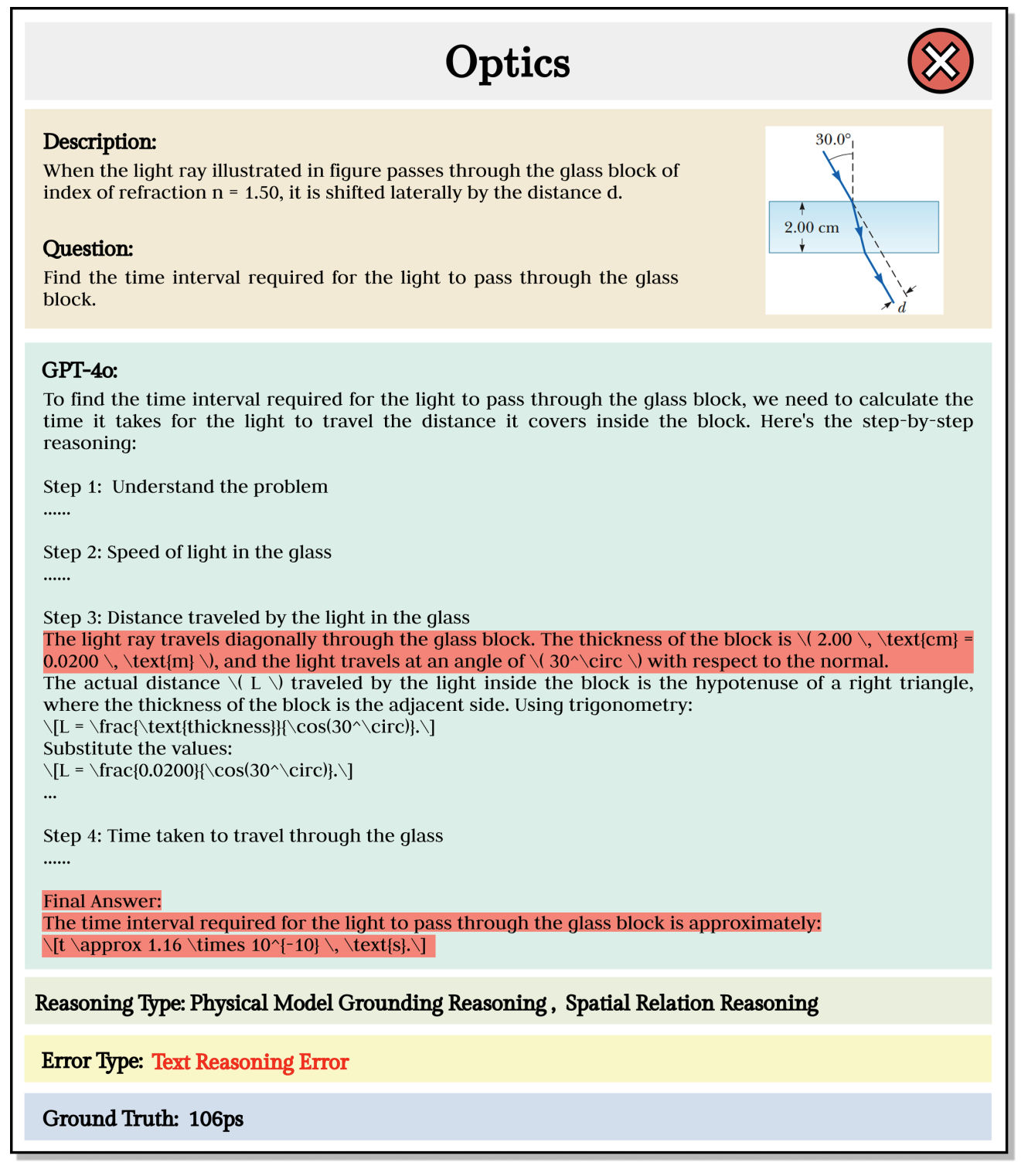
This document presents a physics problem concerning the time it takes for a light ray to pass through a glass block with an index of refraction of 1.50. It includes a diagram illustrating the light ray's path, a textual description of the problem, a step-by-step reasoning process generated by "GPT-4o", and a final answer with an estimated time interval. The document also includes metadata about the reasoning type, error type, and ground truth.
### Components/Axes
* **Diagram:** Shows a light ray entering a rectangular glass block at an angle.
* Angle of incidence: 30.0° (labeled on the diagram)
* Thickness of the glass block: 2.00 cm (labeled on the diagram)
* Lateral displacement: 'd' (labeled on the diagram)
* Light ray path: Illustrated as a diagonal line through the glass block.
* **Textual Description:** "When the light ray illustrated in figure passes through the glass block of index of refraction n = 1.50, it is shifted laterally by the distance d."
* **Question:** "Find the time interval required for the light to pass through the glass block."
* **GPT-4o Reasoning:** A step-by-step breakdown of the solution process.
* Step 1: Understand the problem
* Step 2: Speed of light in the glass
* Step 3: Distance traveled by the light in the glass
* Step 4: Time taken to travel through the glass
* **Final Answer:** "Time interval required for the light to pass through the glass block is approximately: 1.16 approx times 10^-10 \text{[s]}."
* **Metadata:**
* Reasoning Type: Physical Model Grounding Reasoning, Spatial Relation Reasoning
* Error Type: Text Reasoning Error
* Ground Truth: 106ps (picoseconds)
### Detailed Analysis or Content Details
The diagram depicts a light ray entering a glass block. The angle of incidence is 30.0 degrees. The thickness of the glass block is given as 2.00 cm. The GPT-4o reasoning outlines the following steps:
1. **Understanding the problem:** This step is not detailed.
2. **Speed of light in the glass:** This step is not detailed.
3. **Distance traveled by the light in the glass:** The light travels diagonally through the glass block. The thickness is given as 2.00 cm. The light travels at an angle of 30° with respect to the normal. The actual distance (L) traveled by the light inside the block is calculated using trigonometry: L = thickness / cos(30°). Substituting the values: L = 0.0200m / cos(30°).
4. **Time taken to travel through the glass:** This step is not detailed.
The final answer states that the time interval required for the light to pass through the glass block is approximately 1.16 x 10^-10 seconds.
### Key Observations
* The provided "Ground Truth" of 106ps (1.06 x 10^-10 s) is very close to the GPT-4o's calculated answer of 1.16 x 10^-10 s.
* The document identifies a "Text Reasoning Error," suggesting the GPT-4o's reasoning process may have contained a flaw despite arriving at a numerically close answer.
* The diagram is a simplified representation of the physics problem, focusing on the key geometric relationships.
### Interpretation
The document demonstrates a problem-solving approach to calculating the time it takes for light to travel through a medium with a different refractive index. The GPT-4o attempts to break down the problem into logical steps, utilizing trigonometry to determine the actual distance the light travels within the glass block. The close proximity of the calculated answer to the ground truth suggests the core reasoning is sound, despite the identified "Text Reasoning Error." The error likely resides in the detailed explanation or intermediate calculations not shown. The document highlights the importance of both accurate calculations and clear, error-free reasoning in physics problem-solving. The lateral displacement 'd' is mentioned in the description but is not used in the calculation, suggesting it might be relevant to a different aspect of the problem or a follow-up calculation.