## Line Graphs: Error (MAE) and Number of Spikes vs ΔT
### Overview
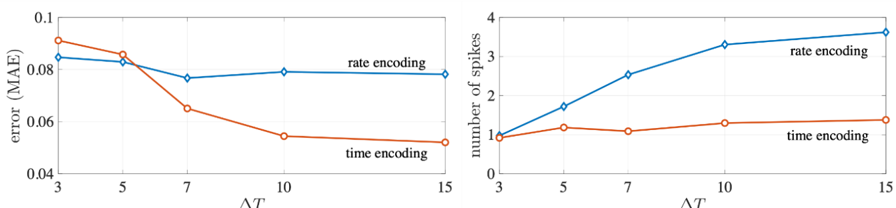
The image contains two side-by-side line graphs comparing the performance of "rate encoding" and "time encoding" across varying ΔT values (3 to 15). The left graph measures error (MAE), while the right graph tracks the number of spikes. Both graphs use distinct color-coded lines for the two encoding methods.
### Components/Axes
- **Left Graph (Error - MAE)**:
- **X-axis**: ΔT (values: 3, 5, 7, 10, 15)
- **Y-axis**: Error (MAE) ranging from 0.04 to 0.10
- **Legend**:
- Blue line: "rate encoding"
- Orange line: "time encoding"
- **Right Graph (Number of Spikes)**:
- **X-axis**: ΔT (same values as left graph)
- **Y-axis**: Number of spikes (0 to 4)
- **Legend**:
- Blue line: "rate encoding"
- Orange line: "time encoding"
### Detailed Analysis
#### Left Graph (Error - MAE)
- **Rate Encoding (Blue)**:
- ΔT=3: ~0.085
- ΔT=5: ~0.082
- ΔT=7: ~0.075
- ΔT=10: ~0.078
- ΔT=15: ~0.078
- **Trend**: Gradual decline until ΔT=7, then plateaus.
- **Time Encoding (Orange)**:
- ΔT=3: ~0.090
- ΔT=5: ~0.085
- ΔT=7: ~0.070
- ΔT=10: ~0.060
- ΔT=15: ~0.055
- **Trend**: Steeper decline than rate encoding, stabilizing at lower values.
#### Right Graph (Number of Spikes)
- **Rate Encoding (Blue)**:
- ΔT=3: ~1.0
- ΔT=5: ~1.5
- ΔT=7: ~2.5
- ΔT=10: ~3.5
- ΔT=15: ~4.0
- **Trend**: Linear increase with ΔT.
- **Time Encoding (Orange)**:
- ΔT=3: ~1.0
- ΔT=5: ~1.1
- ΔT=7: ~1.1
- ΔT=10: ~1.2
- ΔT=15: ~1.2
- **Trend**: Minimal increase, remaining near baseline.
### Key Observations
1. **Error Reduction**: Time encoding achieves lower MAE than rate encoding across all ΔT values, with a more pronounced improvement at higher ΔT.
2. **Spike Count**: Rate encoding correlates with a linear increase in spikes, while time encoding maintains a near-constant low spike count.
3. **Trade-off**: Time encoding reduces error significantly but does not increase spikes, suggesting efficiency. Rate encoding sacrifices error reduction for higher spike counts.
### Interpretation
The data suggests that time encoding is more effective at minimizing error (MAE) without increasing computational spikes, making it preferable for applications prioritizing accuracy. Rate encoding, while less efficient in error reduction, may be necessary in scenarios where higher spike counts are tolerable or beneficial. The divergence in trends highlights a potential design choice between accuracy and resource utilization.