## Chart Type: Comparative Bar Charts of Model Performance
### Overview
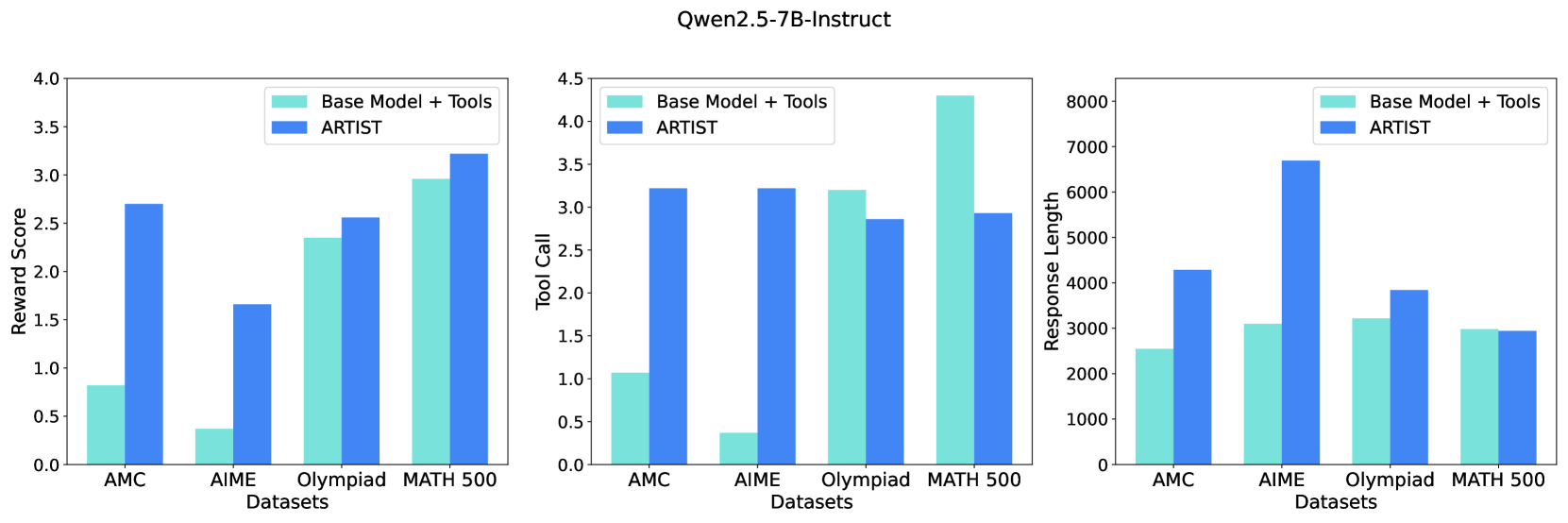
This image presents three comparative bar charts, arranged horizontally, evaluating the performance of two models, "Base Model + Tools" and "ARTIST", across four different datasets: AMC, AIME, Olympiad, and MATH 500. The charts measure three distinct metrics: "Reward Score", "Tool Call", and "Response Length". The overall title for these evaluations is "Qwen2.5-7B-Instruct".
### Components/Axes
The image is composed of a main title at the top-center and three sub-charts arranged side-by-side.
**Main Title:**
* "Qwen2.5-7B-Instruct"
**Common Elements across all three charts:**
* **Legend (positioned at the top-right of each chart area):**
* Light blue/cyan bar: "Base Model + Tools"
* Dark blue bar: "ARTIST"
* **X-axis Label (bottom-center of each chart):**
* "Datasets"
* **X-axis Categories (from left to right for each chart):**
* "AMC"
* "AIME"
* "Olympiad"
* "MATH 500"
**Chart 1 (Left): Reward Score**
* **Y-axis Label (left side):** "Reward Score"
* **Y-axis Scale:** Ranges from 0.0 to 4.0, with major tick marks at 0.0, 0.5, 1.0, 1.5, 2.0, 2.5, 3.0, 3.5, 4.0.
**Chart 2 (Middle): Tool Call**
* **Y-axis Label (left side):** "Tool Call"
* **Y-axis Scale:** Ranges from 0.0 to 4.5, with major tick marks at 0.0, 0.5, 1.0, 1.5, 2.0, 2.5, 3.0, 3.5, 4.0, 4.5.
**Chart 3 (Right): Response Length**
* **Y-axis Label (left side):** "Response Length"
* **Y-axis Scale:** Ranges from 0 to 8000, with major tick marks at 0, 1000, 2000, 3000, 4000, 5000, 6000, 7000, 8000.
### Detailed Analysis
The data is presented as grouped bar charts, comparing "Base Model + Tools" (light blue) and "ARTIST" (dark blue) for each dataset.
**Chart 1: Reward Score**
* **Trend:** ARTIST consistently achieves a higher Reward Score than Base Model + Tools across all datasets. The difference is most pronounced for AMC and AIME.
* **Data Points:**
* **AMC:**
* Base Model + Tools (light blue): Approximately 0.8
* ARTIST (dark blue): Approximately 2.7
* **AIME:**
* Base Model + Tools (light blue): Approximately 0.4
* ARTIST (dark blue): Approximately 1.7
* **Olympiad:**
* Base Model + Tools (light blue): Approximately 2.3
* ARTIST (dark blue): Approximately 2.5
* **MATH 500:**
* Base Model + Tools (light blue): Approximately 3.0
* ARTIST (dark blue): Approximately 3.2
**Chart 2: Tool Call**
* **Trend:** For AMC and AIME, ARTIST makes significantly more tool calls. For Olympiad, ARTIST makes slightly fewer tool calls. For MATH 500, Base Model + Tools makes substantially more tool calls than ARTIST.
* **Data Points:**
* **AMC:**
* Base Model + Tools (light blue): Approximately 1.0
* ARTIST (dark blue): Approximately 3.2
* **AIME:**
* Base Model + Tools (light blue): Approximately 0.4
* ARTIST (dark blue): Approximately 3.2
* **Olympiad:**
* Base Model + Tools (light blue): Approximately 3.2
* ARTIST (dark blue): Approximately 2.9
* **MATH 500:**
* Base Model + Tools (light blue): Approximately 4.3
* ARTIST (dark blue): Approximately 2.9
**Chart 3: Response Length**
* **Trend:** For AMC, AIME, and Olympiad, ARTIST generates longer responses. For MATH 500, the response lengths are very similar, with Base Model + Tools being marginally longer.
* **Data Points:**
* **AMC:**
* Base Model + Tools (light blue): Approximately 2500
* ARTIST (dark blue): Approximately 4300
* **AIME:**
* Base Model + Tools (light blue): Approximately 2100
* ARTIST (dark blue): Approximately 6700
* **Olympiad:**
* Base Model + Tools (light blue): Approximately 2200
* ARTIST (dark blue): Approximately 2900
* **MATH 500:**
* Base Model + Tools (light blue): Approximately 2000
* ARTIST (dark blue): Approximately 1950
### Key Observations
* **ARTIST's Superior Reward Score:** ARTIST consistently outperforms Base Model + Tools in Reward Score across all four datasets, indicating better overall problem-solving capability. The improvement is most dramatic for AMC and AIME.
* **Varied Tool Call Behavior:** ARTIST's tool call frequency is higher for AMC and AIME, but lower than Base Model + Tools for Olympiad and significantly lower for MATH 500. This suggests ARTIST adapts its tool usage strategy or is more efficient in its tool application depending on the dataset.
* **Response Length Correlation:** Generally, higher Reward Scores for ARTIST correlate with longer responses, especially for AMC and AIME. However, for MATH 500, ARTIST achieves a higher Reward Score with a similar or slightly shorter response length and fewer tool calls, highlighting efficiency.
* **Dataset-Specific Performance:** The magnitude of ARTIST's advantage varies by dataset. The most substantial gains in Reward Score, Tool Call, and Response Length are observed in AMC and AIME, suggesting these datasets might benefit most from ARTIST's approach.
### Interpretation
The data suggests that the "ARTIST" model, when applied to the "Qwen2.5-7B-Instruct" base, generally leads to superior performance in terms of "Reward Score" across a range of mathematical reasoning datasets. This improvement is not uniformly achieved through the same mechanism across all datasets, indicating adaptive or more sophisticated problem-solving strategies by ARTIST.
For datasets like AMC and AIME, ARTIST's higher reward scores are accompanied by a substantial increase in both "Tool Call" frequency and "Response Length". This implies that for these more complex or open-ended problems, ARTIST leverages tools more extensively and generates more elaborate or detailed responses, which contributes to better outcomes. The "Base Model + Tools" struggles significantly on these datasets, suggesting it either fails to identify opportunities for tool use or uses them ineffectively, leading to low reward scores and short responses.
Conversely, for the Olympiad and especially the MATH 500 datasets, ARTIST achieves a higher "Reward Score" with either a slightly lower or significantly lower "Tool Call" count compared to "Base Model + Tools". For MATH 500, ARTIST also maintains a similar "Response Length" despite fewer tool calls and a higher reward. This is a critical insight: it suggests that ARTIST is not merely "doing more" (more tool calls, longer responses) but is potentially "doing smarter." It might be making more precise, relevant, or effective tool calls, or integrating the results of those calls more efficiently into its reasoning, leading to better rewards without necessarily increasing computational overhead (as implied by fewer tool calls and similar response lengths). This efficiency is particularly evident in MATH 500, where ARTIST's ability to achieve better results with less apparent effort (fewer tool calls) points to a qualitative improvement in its problem-solving approach.
In summary, ARTIST appears to be a more capable and efficient problem-solver than the "Base Model + Tools," demonstrating both increased effort (more tool calls/longer responses) when beneficial (AMC, AIME) and increased efficiency (fewer tool calls for similar or better results) when appropriate (Olympiad, MATH 500). This adaptability and efficiency are key to its superior "Reward Score" performance.