## Bar Chart: Annual Publication Count (2018-2025)
### Overview
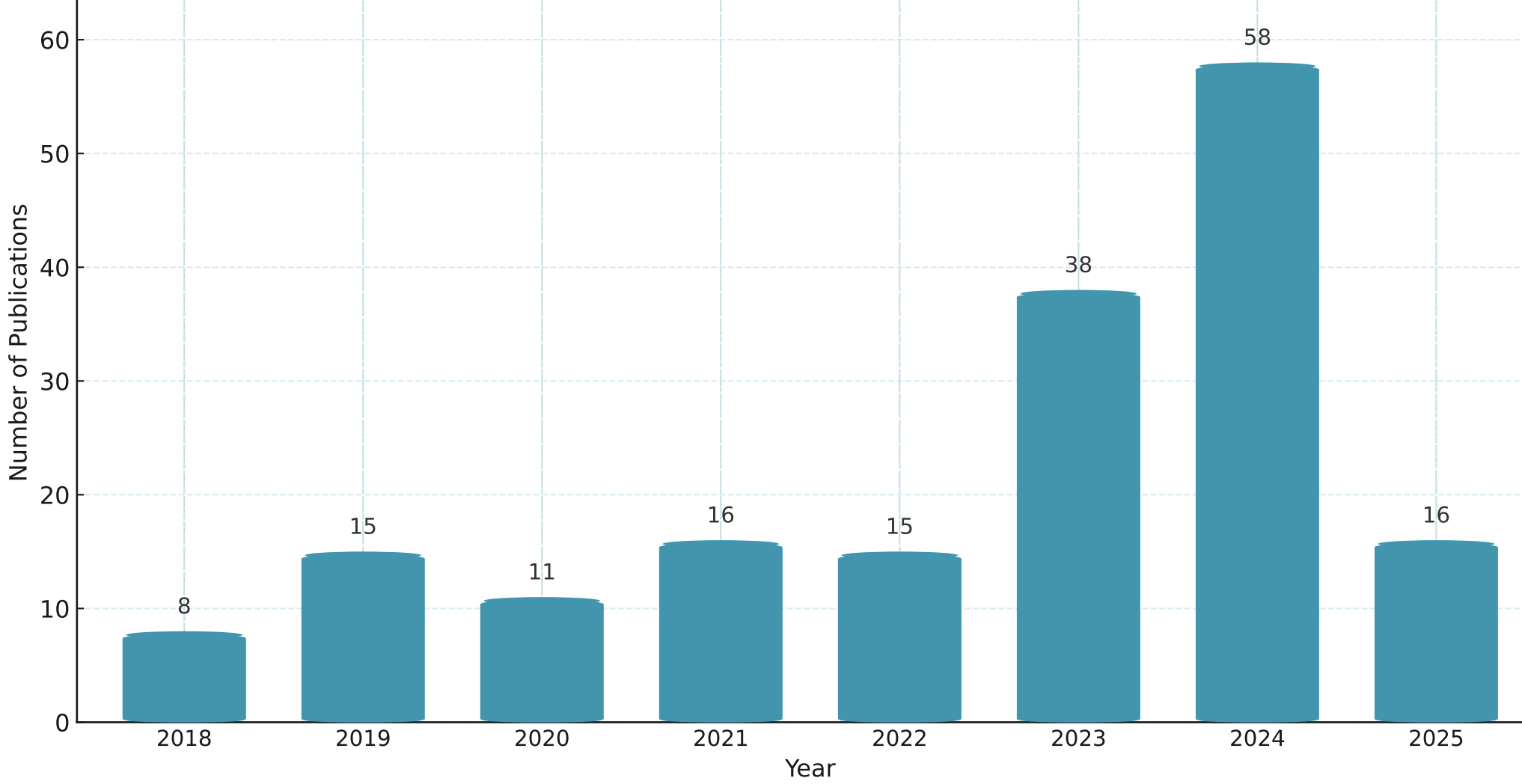
This is a vertical bar chart displaying the annual number of publications over an eight-year period, from 2018 to 2025. The chart shows a general upward trend with a significant peak in 2024, followed by a sharp decline in 2025.
### Components/Axes
* **X-Axis (Horizontal):** Labeled "Year". It contains eight categorical data points: 2018, 2019, 2020, 2021, 2022, 2023, 2024, and 2025.
* **Y-Axis (Vertical):** Labeled "Number of Publications". It is a linear scale starting at 0 and extending to 60, with major grid lines and labels at intervals of 10 (0, 10, 20, 30, 40, 50, 60).
* **Data Series:** A single series represented by teal-colored bars. There is no legend, as only one category of data is presented.
* **Data Labels:** Each bar has a numerical label placed directly above it, indicating the exact count for that year.
* **Grid:** Light blue, dashed horizontal grid lines are present at each major y-axis interval (10, 20, 30, etc.).
### Detailed Analysis
The chart presents the following exact data points, as labeled on each bar:
* **2018:** 8 publications
* **2019:** 15 publications
* **2020:** 11 publications
* **2021:** 16 publications
* **2022:** 15 publications
* **2023:** 38 publications
* **2024:** 58 publications
* **2025:** 16 publications
**Visual Trend Description:** The bar heights show a modest, fluctuating start from 2018 to 2022, with values ranging between 8 and 16. A dramatic upward shift begins in 2023, with the bar more than doubling in height from the previous year. This growth continues sharply into 2024, which is the tallest bar on the chart. The trend then reverses abruptly in 2025, with the bar height dropping back to a level comparable to 2021.
### Key Observations
1. **Peak Year:** The highest number of publications (58) occurred in 2024.
2. **Significant Growth Period:** The most substantial year-over-year increase occurred between 2022 (15) and 2023 (38), a rise of 23 publications (a ~153% increase).
3. **Sharp Decline:** The most dramatic decrease occurred between 2024 (58) and 2025 (16), a drop of 42 publications (a ~72% decrease).
4. **Plateau/Similarity:** The publication counts for 2019 (15), 2021 (16), and 2022 (15) are very similar, forming a plateau in the early part of the timeline.
5. **Initial Low:** The year with the fewest publications was the first year shown, 2018, with 8.
### Interpretation
The data suggests a research area or field that experienced a period of steady, low-level activity from 2018 to 2022. The explosive growth in 2023 and 2024 indicates a potential surge in interest, funding, or a breakthrough event that catalyzed a flurry of academic output. This could correlate with the release of a transformative technology, a major policy shift, or a global event that redirected research focus.
The precipitous drop in 2025 is the most notable anomaly. Without additional context, several interpretations are possible:
* **Data Incompleteness:** The year 2025 may be ongoing or recently concluded at the time the chart was created, meaning the data is partial and not final.
* **Cyclical Nature:** The field may have entered a consolidation or "cooling-off" period after a peak of activity.
* **External Factors:** A shift in priorities, funding cuts, or the resolution of the problem that spurred the 2023-2024 surge could explain the decline.
The chart effectively tells a story of emergence, rapid acceleration, and an abrupt change in trajectory, making the years 2023-2025 the critical period for further investigation.