\n
## Diagram: RAG Architecture Comparison
### Overview
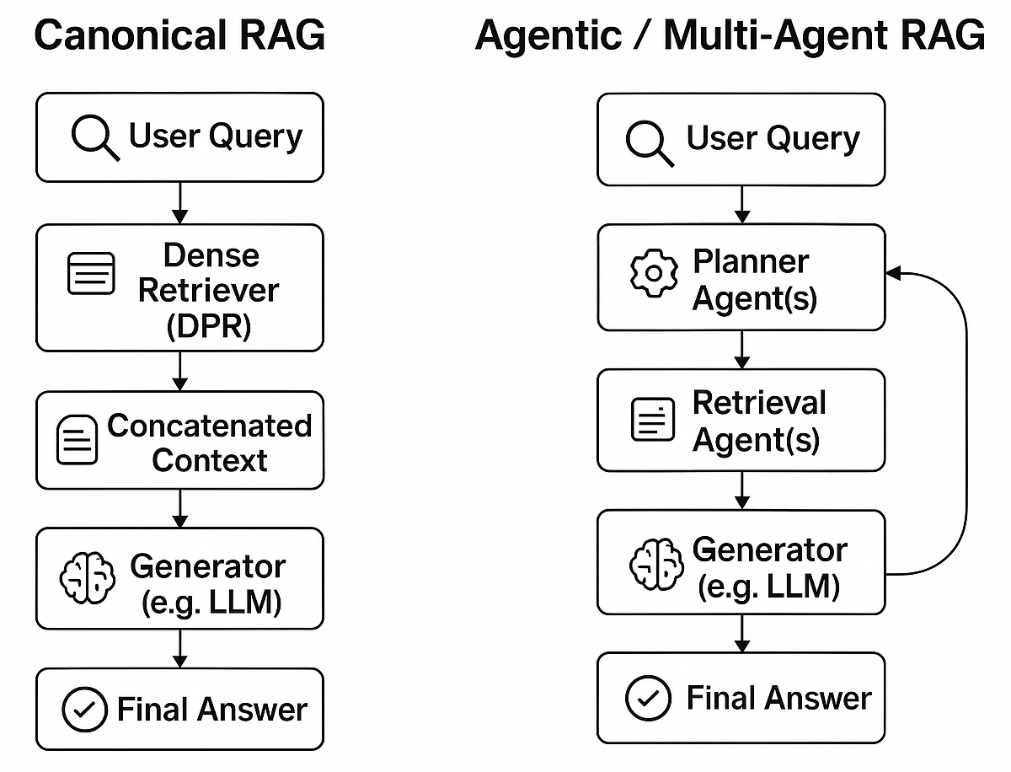
The image presents a comparative diagram illustrating two Retrieval-Augmented Generation (RAG) architectures: "Canonical RAG" and "Agentic / Multi-Agent RAG". The diagram visually depicts the flow of information in each architecture, highlighting the differences in their components and processes. Both diagrams share a similar overall structure, but the Agentic RAG introduces iterative loops and multiple agents.
### Components/Axes
The diagram consists of two main sections, one for each RAG architecture. Each section contains the following components, represented as rounded rectangles with icons:
* **User Query:** The initial input to the system.
* **Dense Retriever (DPR):** Used in the Canonical RAG to retrieve relevant information.
* **Planner Agent(s):** Used in the Agentic RAG to plan the retrieval process.
* **Retrieval Agent(s):** Used in the Agentic RAG to perform the retrieval.
* **Concatenated Context:** The combined information retrieved.
* **Generator (e.g. LLM):** The language model that generates the final answer.
* **Final Answer:** The output of the system.
Arrows indicate the flow of information between these components. The Agentic RAG diagram includes looping arrows between the "Planner Agent(s)", "Retrieval Agent(s)", and "Generator", indicating an iterative process.
### Detailed Analysis or Content Details
**Canonical RAG:**
1. **User Query** initiates the process.
2. The query is passed to the **Dense Retriever (DPR)**.
3. The DPR retrieves and passes information to **Concatenated Context**.
4. **Concatenated Context** is fed into the **Generator (e.g. LLM)**.
5. The **Generator** produces the **Final Answer**.
**Agentic / Multi-Agent RAG:**
1. **User Query** initiates the process.
2. The query is passed to **Planner Agent(s)**.
3. **Planner Agent(s)** directs the **Retrieval Agent(s)**.
4. **Retrieval Agent(s)** retrieves information and passes it to the **Generator (e.g. LLM)**.
5. The **Generator** produces the **Final Answer**.
6. A feedback loop exists between **Planner Agent(s)**, **Retrieval Agent(s)**, and **Generator**, indicating iterative refinement of the retrieval and generation process.
### Key Observations
The key difference between the two architectures is the introduction of agents and iterative loops in the Agentic RAG. The Canonical RAG follows a linear, sequential process, while the Agentic RAG allows for more dynamic and adaptive information retrieval and generation. The Agentic RAG appears to be more complex, potentially enabling more nuanced and accurate responses.
### Interpretation
The diagram illustrates the evolution of RAG architectures. The Canonical RAG represents a basic implementation, while the Agentic RAG demonstrates a more advanced approach leveraging the capabilities of multiple agents to improve the quality and relevance of the generated answers. The iterative loops in the Agentic RAG suggest a process of continuous refinement, where the agents collaborate to optimize the retrieval and generation steps. This architecture is likely designed to handle more complex queries and scenarios where a single retrieval pass may not be sufficient. The inclusion of "Planner Agent(s)" suggests a strategic approach to information retrieval, potentially involving breaking down the query into sub-queries or exploring different retrieval strategies. The diagram highlights a shift from a simple retrieval-generation pipeline to a more intelligent and adaptive system.