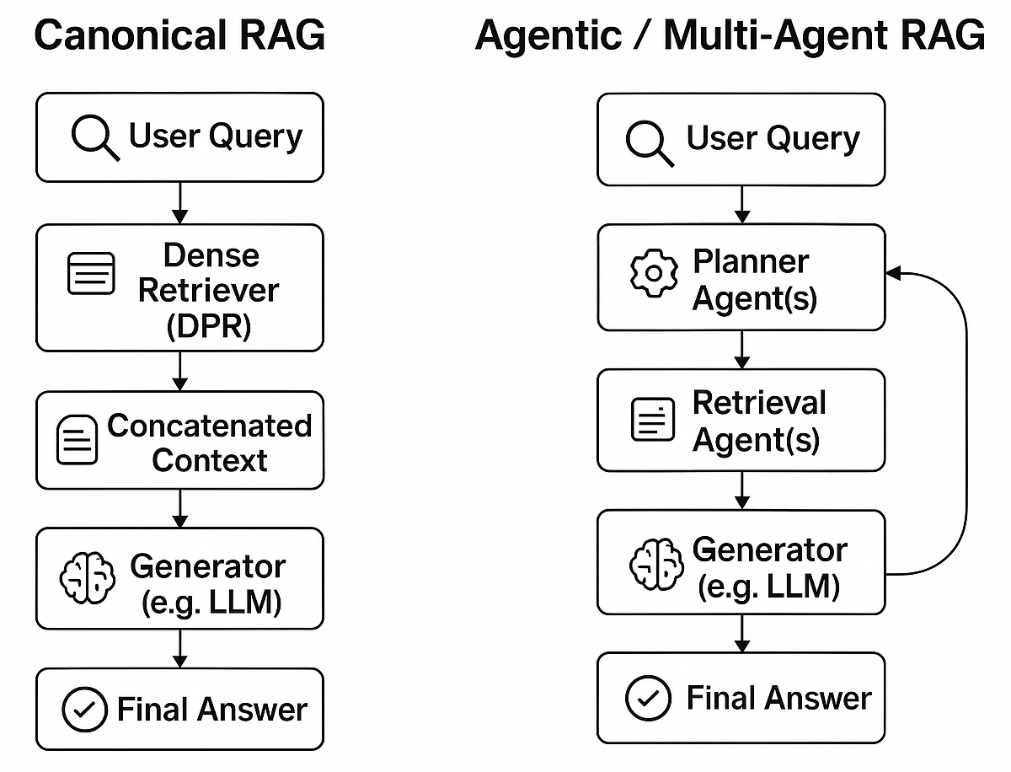
## Diagram: Comparison of Canonical RAG and Agentic/Multi-Agent RAG Systems
### Overview
The diagram illustrates two distinct architectures for Retrieval-Augmented Generation (RAG) systems. On the left, the **Canonical RAG** follows a linear pipeline, while the **Agentic/Multi-Agent RAG** employs a modular, iterative approach with specialized agents. Both systems begin with a **User Query** and produce a **Final Answer**, but their intermediate processes differ significantly.
---
### Components/Axes
#### Canonical RAG (Left Side)
1. **User Query** (Input)
2. **Dense Retriever (DPR)**
- Icon: Document with lines (text representation)
- Function: Converts queries into dense vectors for semantic search.
3. **Concatenated Context**
- Icon: Document with lines
- Function: Combines retrieved documents into a single context.
4. **Generator (e.g., LLM)**
- Icon: Brain
- Function: Processes context to generate a response.
5. **Final Answer** (Output)
#### Agentic/Multi-Agent RAG (Right Side)
1. **User Query** (Input)
2. **Planner Agent(s)**
- Icon: Gear
- Function: Decomposes the query into sub-tasks or retrieval strategies.
3. **Retrieval Agent(s)**
- Icon: Document with lines
- Function: Specialized agents for targeted document retrieval.
4. **Generator (e.g., LLM)**
- Icon: Brain
- Function: Synthesizes retrieved information into a response.
5. **Final Answer** (Output)
- Feedback loop: The Generator’s output may inform the Planner for iterative refinement.
---
### Detailed Analysis
- **Canonical RAG** follows a strict sequence: Query → Retrieval → Context → Generation → Answer.
- **Agentic RAG** introduces modularity:
- The **Planner Agent** orchestrates the process, potentially splitting complex queries into subtasks.
- **Retrieval Agent(s)** handle domain-specific or multi-step retrieval.
- The **Generator** integrates outputs from retrieval agents, with optional feedback to the Planner for refinement.
- Both systems use **LLMs** (Large Language Models) as generators, but the Agentic approach adds layers of specialization and control.
---
### Key Observations
1. **Modularity vs. Simplicity**:
- Canonical RAG is simpler but less flexible.
- Agentic RAG’s modular design allows for dynamic task decomposition and iterative refinement.
2. **Feedback Loop**:
- The Agentic system includes a feedback mechanism (Generator → Planner), enabling adaptive query handling.
3. **Specialization**:
- Retrieval agents in the Agentic system may focus on specific domains or retrieval strategies (e.g., keyword vs. semantic search).
---
### Interpretation
The diagram highlights a trade-off between simplicity and sophistication:
- **Canonical RAG** is ideal for straightforward, single-step retrieval tasks.
- **Agentic RAG** excels in complex scenarios requiring multi-step reasoning, domain-specific retrieval, or iterative refinement.
The feedback loop in the Agentic system suggests potential for self-correction, improving answer accuracy at the cost of increased computational overhead. This architecture aligns with trends in AI systems that prioritize modularity and adaptability over rigid pipelines.