## Diagram: Our Proposed Apollo Pipeline
### Overview
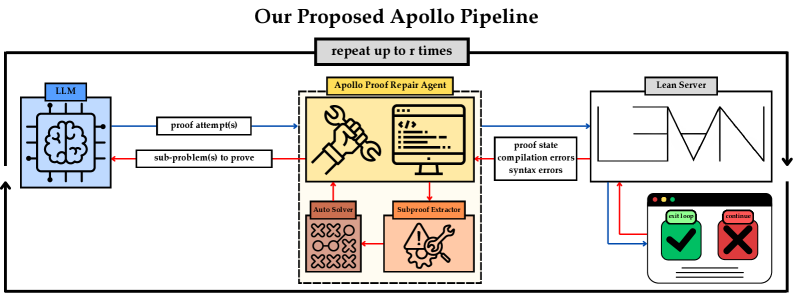
The image is a diagram illustrating the proposed Apollo Pipeline, a system likely designed for automated proof repair. The diagram shows the flow of information and processes between different components, including a Language Learning Model (LLM), an Apollo Proof Repair Agent, a Lean Server, and feedback loops.
### Components/Axes
* **Title:** Our Proposed Apollo Pipeline
* **Loop Control:** "repeat up to r times" (located at the top-center of the diagram)
* **LLM (Language Learning Model):** A blue box on the left containing an image of a brain.
* Output: "proof attempt(s)" (blue arrow going to Apollo Proof Repair Agent)
* Input: "sub-problem(s) to prove" (red arrow coming from Apollo Proof Repair Agent)
* **Apollo Proof Repair Agent:** A dashed-line box in the center, containing:
* A yellow box labeled "Apollo Proof Repair Agent" with an image of a wrench and code editor.
* A red box labeled "Auto Solver" with a tic-tac-toe board image.
* An orange box labeled "Subproof Extractor" with an image of a wrench and an exclamation point.
* **Lean Server:** A gray box on the right containing a graph that fluctuates up and down.
* Input: "proof state compilation errors syntax errors" (blue arrow from Apollo Proof Repair Agent)
* Output: Blue arrow to "continue" and red arrow to "exit loop"
* **Feedback Loop Control:** A window with a green checkmark labeled "exit loop" and a red X labeled "continue".
* The "continue" output loops back to the LLM.
### Detailed Analysis
* The LLM generates "proof attempt(s)" which are sent to the Apollo Proof Repair Agent.
* The Apollo Proof Repair Agent uses an "Auto Solver" and "Subproof Extractor" to process the proof attempts.
* The Apollo Proof Repair Agent sends "proof state compilation errors syntax errors" to the Lean Server.
* The Lean Server either exits the loop or continues, sending information back to the LLM.
* The entire process is repeated up to 'r' times.
### Key Observations
* The diagram illustrates a cyclical process, where the LLM generates proofs, the Apollo Proof Repair Agent attempts to repair them, and the Lean Server provides feedback.
* The "repeat up to r times" indicates that the process is iterative.
* The "exit loop" and "continue" options suggest that the process can either terminate successfully or continue with further attempts.
### Interpretation
The diagram presents a system for automated proof repair using a combination of an LLM, specialized repair agents, and a Lean Server. The iterative nature of the pipeline, controlled by the "repeat up to r times" loop, suggests that the system is designed to refine proofs over multiple attempts. The feedback loop, with "exit loop" and "continue" options, allows the system to adapt and improve its proof repair strategies. The Apollo Proof Repair Agent seems to be the central component, orchestrating the repair process using the Auto Solver and Subproof Extractor. The Lean Server provides crucial feedback on the proof state, guiding the repair process.