\n
## Diagram: Apollo Pipeline
### Overview
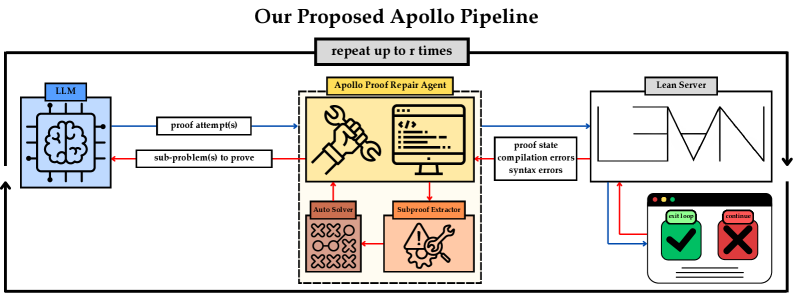
The image depicts a diagram illustrating the proposed "Apollo Pipeline," a system for automated proof repair. The pipeline consists of several components: a Large Language Model (LLM), an Apollo Proof Repair Agent, and a Lean Server. The process involves iterative attempts to generate and refine proofs, with feedback loops between the components.
### Components/Axes
The diagram is structured with three main components, arranged horizontally from left to right:
* **LLM:** (Leftmost) Represented by a blue box with a brain-like graphic.
* **Apollo Proof Repair Agent:** (Center) Represented by a yellow box containing a wrench and a computer screen. This box also contains two sub-components: "Auto Solver" and "Subproof Extractor".
* **Lean Server:** (Rightmost) Represented by a teal box with a stylized "Lean" text. This box contains a control panel with "exit loop" and "continue" buttons.
Arrows indicate the flow of information and control between these components. Text labels describe the data being passed between them. A loop is indicated above the pipeline with the text "repeat up to r times".
### Detailed Analysis or Content Details
1. **LLM to Apollo Proof Repair Agent:** An arrow labeled "proof attempt(s)" points from the LLM to the Apollo Proof Repair Agent. Another arrow labeled "sub-problem(s) to prove" also points from the LLM to the Apollo Proof Repair Agent.
2. **Apollo Proof Repair Agent to Lean Server:** An arrow labeled "proof state compilation errors syntax errors" points from the Apollo Proof Repair Agent to the Lean Server.
3. **Lean Server Feedback:** The Lean Server provides feedback via two arrows:
* A red arrow points from the Lean Server to the Apollo Proof Repair Agent.
* A green arrow points from the Lean Server to the Apollo Proof Repair Agent.
4. **Apollo Proof Repair Agent Sub-components:**
* **Auto Solver:** Depicted with interconnected circles and lines.
* **Subproof Extractor:** Depicted with a magnifying glass and a question mark.
5. **Lean Server Control Panel:** The control panel on the Lean Server has two buttons:
* "exit loop" with a green checkmark.
* "continue" with a red X.
6. **Loop Indicator:** The text "repeat up to r times" is positioned above the Apollo Proof Repair Agent, indicating an iterative process.
### Key Observations
The diagram highlights a closed-loop system where the LLM generates proof attempts, the Apollo Proof Repair Agent refines them, and the Lean Server provides feedback. The iterative nature of the process is emphasized by the "repeat up to r times" loop. The Lean Server acts as a validator and controller, determining whether to continue refining the proof or exit the loop. The sub-components within the Apollo Proof Repair Agent suggest a modular approach to proof repair, with dedicated modules for automated solving and subproof extraction.
### Interpretation
The Apollo Pipeline diagram illustrates a sophisticated approach to automated theorem proving. The LLM serves as the initial proof generator, leveraging its language understanding capabilities to formulate potential proofs. The Apollo Proof Repair Agent then acts as a specialized repair system, utilizing both automated solving techniques and subproof extraction to address errors and refine the proof. The Lean Server provides a formal verification layer, ensuring the correctness of the proof and controlling the iterative process.
The diagram suggests a system designed to overcome the limitations of purely LLM-based theorem proving by incorporating formal verification and specialized repair mechanisms. The iterative loop indicates a robust approach to handling complex proofs, allowing the system to refine its attempts until a valid proof is found or a maximum number of iterations is reached. The modular design of the Apollo Proof Repair Agent, with its Auto Solver and Subproof Extractor components, suggests a flexible and adaptable system capable of handling a wide range of proof challenges. The use of Lean as the formal verification system implies a focus on mathematical rigor and correctness.