## Diagram: Apollo Proof Repair Pipeline Flowchart
### Overview
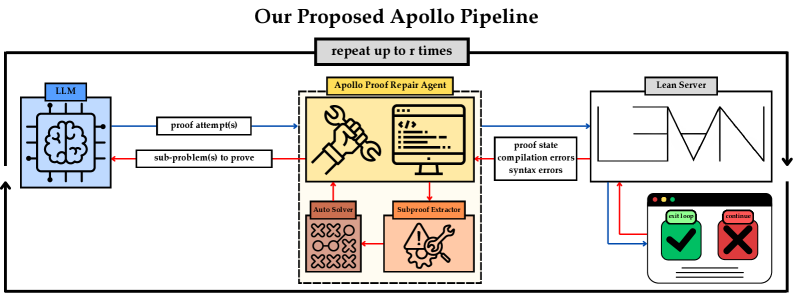
The image is a technical flowchart titled "Our Proposed Apollo Pipeline." It illustrates an iterative, automated system for repairing mathematical or logical proofs. The system combines a Large Language Model (LLM) with a specialized "Apollo Proof Repair Agent" and a formal verification server ("Lean Server") in a closed-loop process that repeats up to a specified number of times (`r`).
### Components/Axes
The diagram is organized into three main vertical sections connected by directional arrows, with a control loop indicated at the top.
**1. Left Section: LLM**
* **Component:** A blue box labeled **"LLM"** containing an icon of a brain with circuit connections.
* **Function:** Acts as the initial proof generator.
* **Outputs:** Sends **"proof attempt(s)"** (blue arrow) to the central repair agent.
* **Inputs:** Receives **"sub-problem(s) to prove"** (red arrow) back from the repair agent.
**2. Central Section: Apollo Proof Repair Agent**
* **Main Component:** A large, dashed-border box labeled **"Apollo Proof Repair Agent"**. It contains an icon of a wrench repairing a document with code symbols (`</>`).
* **Sub-Components:** Two smaller boxes feed into the main agent:
* **"Auto Solver"** (bottom-left, orange box with a grid/network icon).
* **"Subproof Extractor"** (bottom-right, orange box with a magnifying glass over a gear and exclamation mark).
* **Function:** Receives proof attempts, decomposes them, attempts automated solving, and coordinates repair.
* **Outputs:** Sends a **"proof state, compilation errors, syntax errors"** (blue arrow) to the Lean Server.
* **Inputs:** Receives error feedback from the Lean Server.
**3. Right Section: Lean Server & Control Flow**
* **Component:** A white box labeled **"Lean Server"** containing a stylized line graph icon.
* **Function:** A formal proof verification server (likely for the Lean theorem prover) that checks the proof state and returns errors.
* **Sub-Component:** Below the Lean Server is a smaller control box with two options:
* A green checkmark icon labeled **"exit loop"**.
* A red 'X' icon labeled **"continue"**.
* **Flow Control:** A large, overarching black arrow labeled **"repeat up to r times"** connects the output of this control box back to the input of the LLM, forming the main iterative loop.
### Detailed Analysis
The process flow is as follows:
1. The **LLM** generates an initial proof attempt.
2. This attempt is sent to the **Apollo Proof Repair Agent**.
3. The agent uses its **Subproof Extractor** and **Auto Solver** sub-components to analyze and attempt to fix the proof.
4. The current proof state (with any errors) is sent to the **Lean Server** for formal verification.
5. The Lean Server returns compilation and syntax errors.
6. Based on the result, the control flow decides to either **"exit loop"** (if the proof is valid) or **"continue"**.
7. If continuing, the system loops back, feeding sub-problems back to the LLM, and the process repeats for up to `r` iterations.
### Key Observations
* **Iterative Nature:** The pipeline is explicitly designed as a loop (`repeat up to r times`), indicating an iterative refinement process rather than a single-pass solution.
* **Hybrid Architecture:** It combines the generative capability of an **LLM** with the symbolic, rigorous checking of a **formal server (Lean)** and specialized repair modules (**Auto Solver, Subproof Extractor**).
* **Error-Driven Feedback:** The core feedback mechanism is based on formal **"compilation errors"** and **"syntax errors"** from the Lean Server, which guide the repair agent.
* **Bidirectional Communication:** There is a clear back-and-forth between the LLM and the Repair Agent (proof attempts vs. sub-problems), and between the Repair Agent and the Lean Server (proof state vs. errors).
### Interpretation
This diagram represents a sophisticated **neuro-symbolic system for automated theorem proving or formal verification**. The pipeline addresses a key limitation of LLMs in formal reasoning: their tendency to generate plausible but incorrect or incomplete proofs.
* **How it works:** The LLM acts as a creative but fallible "proposer." The Apollo Proof Repair Agent acts as a "mechanic" that breaks down the proof, tries to solve sub-parts automatically, and interfaces with the Lean Server, which acts as the infallible "judge" providing strict, formal feedback.
* **Why it matters:** This architecture could significantly improve the success rate of automated proof generation. By iteratively repairing proofs based on formal error messages, the system can converge on a correct solution that a single-pass LLM generation might miss. The `r` parameter controls the computational budget for this repair process.
* **Underlying Assumption:** The system assumes that formal error messages from Lean are actionable and can be used by the repair agent to guide the LLM's next attempt, effectively creating a dialogue between generative AI and formal verification.