## Flowchart: Our Proposed Apollo Pipeline
### Overview
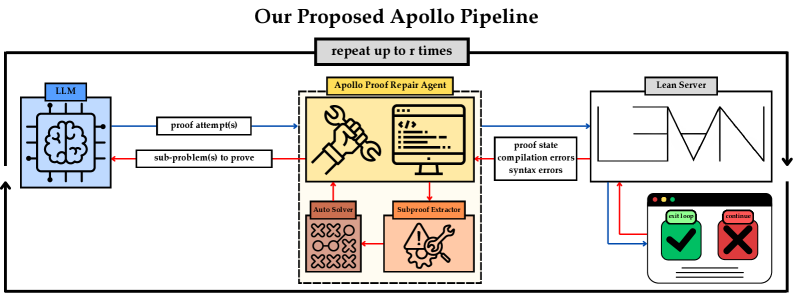
The diagram illustrates a multi-stage pipeline for automated proof generation and validation. It begins with a Language Learning Model (LLM), progresses through an Apollo Proof Repair Agent, and concludes with a Lean Server. The process includes iterative loops, error handling, and decision points for continuation or termination.
### Components/Axes
1. **Key Components**:
- **LLM (Language Learning Model)**: Generates proof attempts and sub-problems.
- **Apollo Proof Repair Agent**: Contains subcomponents:
- **Auto Solver**: Visualized with a wrench and gear icon.
- **Subproof Extractor**: Depicted with a warning triangle and wrench.
- **Lean Server**: Validates proof states and handles errors.
2. **Flow Arrows**:
- Blue arrows indicate primary data flow (e.g., "proof attempt(s)", "sub-problem(s) to prove").
- Red arrows denote error feedback (e.g., "compilation errors", "syntax errors").
3. **Decision Nodes**:
- Green checkmark ("exit loop") and red X ("continue") in the Lean Server output.
### Detailed Analysis
1. **LLM Output**:
- Produces "proof attempt(s)" and "sub-problem(s) to prove" (red arrow to Apollo Repair Agent).
2. **Apollo Repair Agent**:
- Processes inputs via Auto Solver and Subproof Extractor.
- Outputs "proof state" to Lean Server.
3. **Lean Server**:
- Validates "proof state" and identifies "compilation errors" or "syntax errors".
- Decision logic:
- Green checkmark ("exit loop") if validation succeeds.
- Red X ("continue") if errors persist.
4. **Iteration**:
- Loop repeats "up to r times" (gray box at the top).
### Key Observations
- **Iterative Design**: The pipeline emphasizes repeated attempts ("repeat up to r times") to refine proofs.
- **Error Handling**: Red arrows highlight error correction loops between components.
- **Validation Gatekeeping**: Lean Server acts as a final checkpoint with binary outcomes (success/failure).
### Interpretation
This pipeline automates formal proof generation and validation, leveraging an LLM for initial attempts and a repair agent for error resolution. The Lean Server ensures rigor by enforcing strict validation, while the iterative loop balances efficiency (limited retries) and reliability (error correction). The use of icons (e.g., brain for LLM, wrench for repair) simplifies understanding of abstract processes. The decision to "exit loop" or "continue" suggests a focus on resource optimization, avoiding infinite loops while maintaining proof quality.
**Note**: No numerical data or trends are present; the diagram focuses on process flow and component interactions.