## Claim Verification Diagram: Moisturizer Use
### Overview
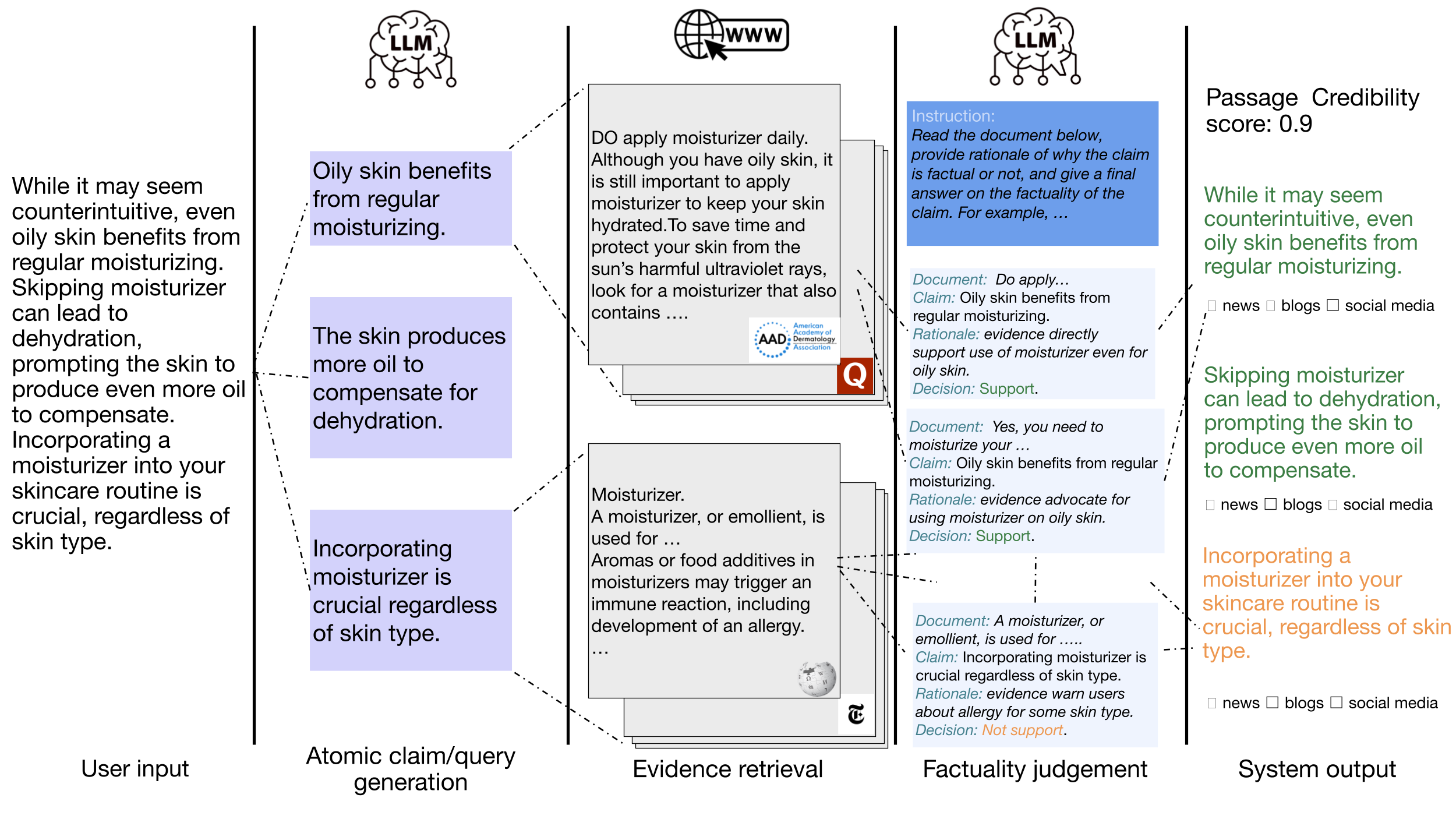
The image is a diagram illustrating a claim verification process related to the use of moisturizer. It shows the flow of information from user input to system output, involving atomic claim generation, evidence retrieval, and factuality judgment. The diagram includes text blocks representing claims, evidence, rationales, and decisions, along with icons representing different sources of information.
### Components/Axes
* **Header:** Contains icons labeled "LLM" (top-left and top-right) and "WWW" (top-center).
* **Columns:** The diagram is divided into five vertical columns:
* User input
* Atomic claim/query generation
* Evidence retrieval
* Factuality judgement
* System output
* **Text Blocks:** Each column contains text blocks with claims, evidence, rationales, and decisions.
* **Icons:** Icons representing news, blogs, and social media are present in the "System output" column.
* **Connectors:** Dashed lines connect the text blocks, indicating the flow of information.
### Detailed Analysis or ### Content Details
**1. User Input:**
* Text: "While it may seem counterintuitive, even oily skin benefits from regular moisturizing. Skipping moisturizer can lead to dehydration, prompting the skin to produce even more oil to compensate. Incorporating a moisturizer into your skincare routine is crucial, regardless of skin type."
**2. Atomic Claim/Query Generation:**
* "Oily skin benefits from regular moisturizing."
* "The skin produces more oil to compensate for dehydration."
* "Incorporating moisturizer is crucial regardless of skin type."
**3. Evidence Retrieval:**
* "DO apply moisturizer daily. Although you have oily skin, it is still important to apply moisturizer to keep your skin hydrated. To save time and protect your skin from the sun's harmful ultraviolet rays, look for a moisturizer that also contains..."
* Logo: American Academy of Dermatology Association (AAD)
* "Moisturizer. A moisturizer, or emollient, is used for... Aromas or food additives in moisturizers may trigger an immune reaction, including development of an allergy."
* Logo: The Times (T)
**4. Factuality Judgement:**
* **Instruction:** "Read the document below, provide rationale of why the claim is factual or not, and give a final answer on the factuality of the claim. For example, ..."
* **Document 1:** "Do apply..."
* Claim: "Oily skin benefits from regular moisturizing."
* Rationale: "evidence directly support use of moisturizer even for oily skin."
* Decision: "Support."
* **Document 2:** "Yes, you need to moisturize your..."
* Claim: "Oily skin benefits from regular moisturizing."
* Rationale: "evidence advocate for using moisturizer on oily skin."
* Decision: "Support."
* **Document 3:** "A moisturizer, or emollient, is used for..."
* Claim: "Incorporating moisturizer is crucial regardless of skin type."
* Rationale: "evidence warn users about allergy for some skin type."
* Decision: "Not support."
**5. System Output:**
* Passage Credibility score: 0.9
* Text: "While it may seem counterintuitive, even oily skin benefits from regular moisturizing."
* Icons: news, blogs, social media
* Text: "Skipping moisturizer can lead to dehydration, prompting the skin to produce even more oil to compensate."
* Icons: news, blogs, social media
* Text: "Incorporating a moisturizer into your skincare routine is crucial, regardless of skin type."
* Icons: news, blogs, social media
### Key Observations
* The diagram illustrates a system for verifying claims related to skincare, specifically the use of moisturizer.
* The system retrieves evidence from various sources (e.g., websites, documents) to support or refute the claims.
* The factuality judgment component provides a rationale and decision based on the evidence.
* The system output includes a passage credibility score and the original user input, potentially filtered or modified based on the claim verification process.
* The connections between the components show the flow of information and dependencies between them.
### Interpretation
The diagram depicts a claim verification system that assesses the credibility of statements about moisturizer use. The system takes user input, breaks it down into atomic claims, retrieves evidence from various sources, and judges the factuality of each claim. The final output includes a credibility score and potentially modified versions of the original input, reflecting the system's assessment. The system appears to support the claim that oily skin benefits from regular moisturizing, while it does not support the claim that incorporating moisturizer is crucial regardless of skin type, based on the evidence it retrieved. The inclusion of news, blogs, and social media icons suggests that the system considers these sources when evaluating the claims. The system aims to provide users with reliable information about skincare by verifying the claims they encounter.