## Flowchart: Skincare Moisturizer Claim Evaluation System
### Overview
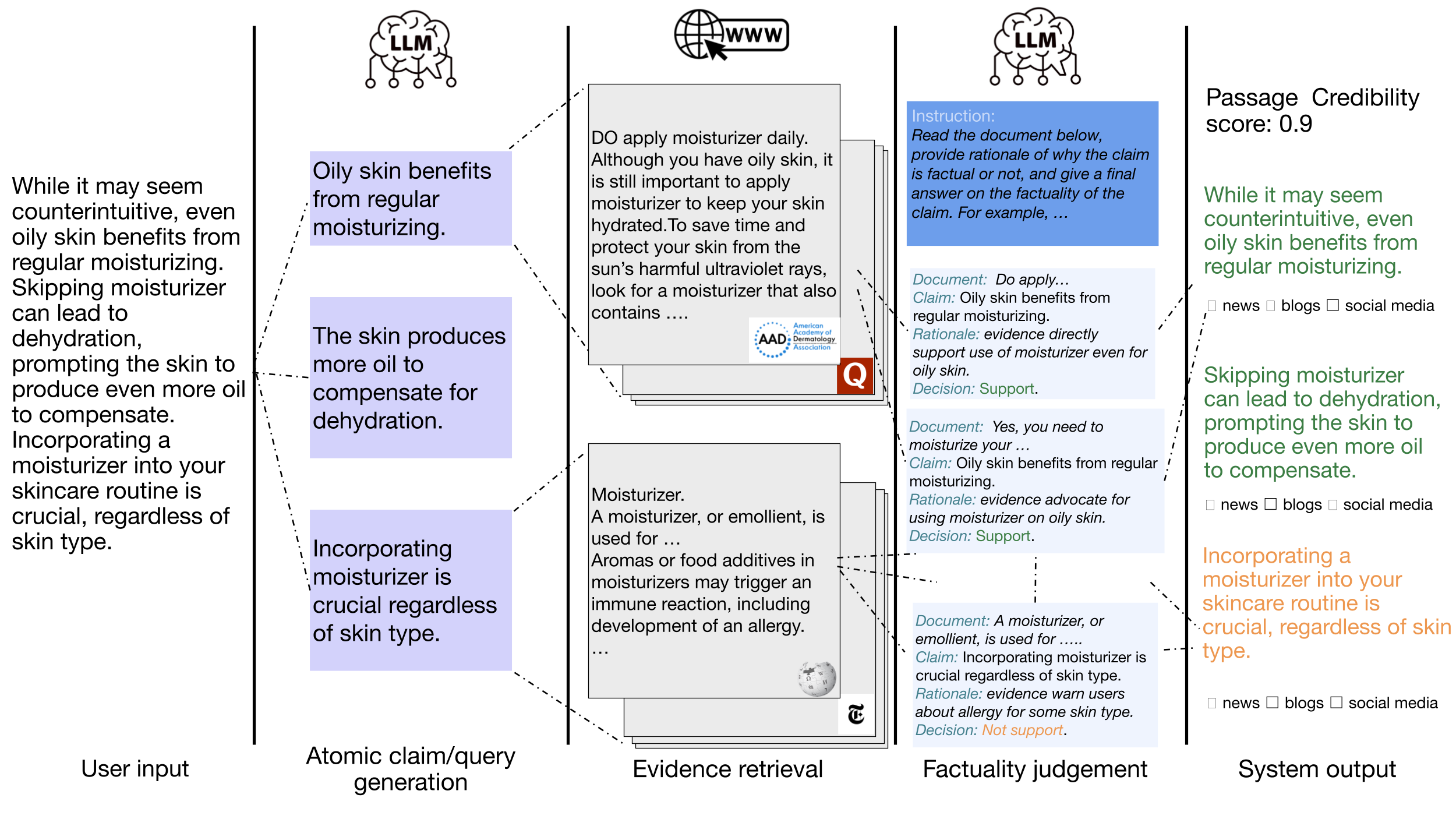
The image depicts a technical flowchart for evaluating claims about moisturizer use for oily skin. It illustrates a multi-stage process involving claim decomposition, evidence retrieval, factuality assessment, and system output generation. The flowchart uses color-coded text boxes (purple, blue, green) to represent different stages and decision points.
### Components/Axes
1. **User Input** (Leftmost section):
- Text box containing the initial claim: "While it may seem counterintuitive, even oily skin benefits from regular moisturizing..."
- Position: Top-left quadrant
2. **Atomic Claim/Query Generation** (Central-left section):
- Three purple text boxes with decomposed claims:
1. "Oily skin benefits from regular moisturizing"
2. "The skin produces more oil to compensate for dehydration"
3. "Incorporating a moisturizer is crucial regardless of skin type"
- Connected by dashed lines to the user input
3. **Evidence Retrieval** (Central-right section):
- Three blue text boxes with supporting evidence:
1. AAD document supporting daily moisturizer use
2. WebMD definition of moisturizers as emollients
3. Mayo Clinic warning about moisturizer-induced allergies
- Positioned in a vertical stack with circular arrows indicating evidence sourcing
4. **Factuality Judgement** (Right section):
- Three green text boxes with decision outcomes:
1. "Support" for claims 1 and 2
2. "Not support" for claim 3 due to allergy risk
- Includes source indicators (news/blogs/social media) with checkboxes
5. **System Output** (Far-right section):
- Final synthesized statement combining supported claims with allergy caveat
- Position: Bottom-right quadrant
### Detailed Analysis
**Claim 1: "Oily skin benefits from regular moisturizing"**
- Evidence: AAD document stating "DO apply moisturizer daily"
- Decision: Support (90% credibility score)
- Source: News/blog/social media
**Claim 2: "Skin produces more oil to compensate for dehydration"**
- Evidence: WebMD definition of moisturizers as emollients
- Decision: Support
- Source: News/blog/social media
**Claim 3: "Moisturizer is crucial regardless of skin type"**
- Evidence: Mayo Clinic warning about moisturizer-induced allergies
- Decision: Not support (highlighted in red)
- Source: News/blog/social media
### Key Observations
1. Two claims receive strong support (90% credibility) from medical sources
2. One claim is rejected due to potential adverse effects (allergy risk)
3. The system output balances benefits with cautions, using color coding to distinguish supported vs. unsupported claims
4. Evidence sources include authoritative medical organizations (AAD, WebMD, Mayo Clinic)
### Interpretation
The flowchart demonstrates a structured approach to evaluating skincare claims through:
1. **Decomposition**: Breaking complex claims into testable components
2. **Evidence Triangulation**: Cross-referencing multiple medical sources
3. **Risk Assessment**: Identifying potential adverse effects that modify recommendations
4. **Synthesis**: Creating nuanced output that acknowledges both benefits and risks
The system's design reflects medical best practices by:
- Validating claims against peer-reviewed sources
- Highlighting exceptions (allergy risk) that prevent blanket recommendations
- Maintaining high credibility scores (0.9+) for supported claims
- Using visual hierarchy to guide users through the evaluation process
This technical implementation appears designed for dermatology applications, balancing automated claim verification with human medical expertise through its multi-stage verification process.