## Diagram: FFI-based E2E Verifier Workflow
### Overview
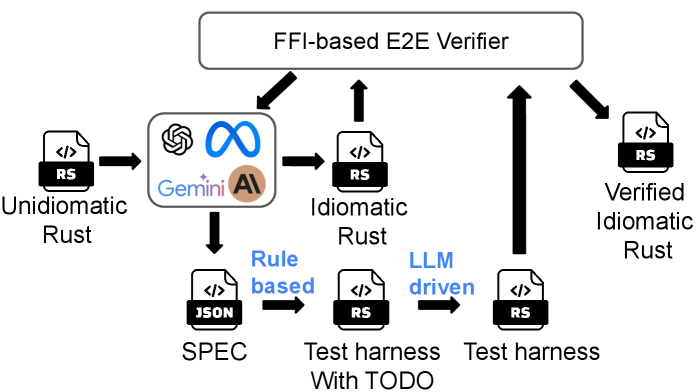
The image is a diagram illustrating a workflow for an FFI-based End-to-End (E2E) Verifier. It shows the flow of data and transformations applied to Rust code, using AI models (Gemini, Meta AI) and rule-based systems. The diagram includes file icons labeled with their format (RS for Rust, JSON) and descriptions of the code's characteristics (Unidiomatic, Idiomatic, Verified Idiomatic).
### Components/Axes
* **Top Center:** "FFI-based E2E Verifier" - This is the central component, represented as a rounded rectangle.
* **Left:** "Unidiomatic Rust" - A file icon labeled "RS" (Rust source code).
* **Center-Left:** A rounded rectangle containing logos of Gemini and Meta AI.
* **Center:** "Idiomatic Rust" - A file icon labeled "RS".
* **Right:** "Verified Idiomatic Rust" - A file icon labeled "RS".
* **Bottom-Left:** "SPEC" - A file icon labeled "JSON".
* **Bottom-Center:** "Test harness With TODO" - A file icon labeled "RS".
* **Bottom-Right:** "Test harness" - A file icon labeled "RS".
* **Arrows:** Black arrows indicate the flow of data and transformations.
* **Labels:** Blue labels "Rule based" and "LLM driven" describe the transformation methods.
### Detailed Analysis
1. **Unidiomatic Rust** (top-left) is fed into the **Gemini/Meta AI** block.
2. The **Gemini/Meta AI** block outputs **Idiomatic Rust** (top-center) and a **SPEC** file (bottom-left).
3. The **SPEC** file is transformed into a **Test harness With TODO** using a "Rule based" approach.
4. The **Test harness With TODO** is transformed into a **Test harness** using an "LLM driven" approach.
5. The **Idiomatic Rust** (top-center) is fed into the **FFI-based E2E Verifier**.
6. The **Test harness** (bottom-right) is fed into the **FFI-based E2E Verifier**.
7. The **FFI-based E2E Verifier** outputs **Verified Idiomatic Rust** (top-right).
### Key Observations
* The diagram illustrates a process of refining Rust code from "Unidiomatic" to "Idiomatic" and finally to "Verified Idiomatic".
* AI models (Gemini, Meta AI) are used in the initial transformation.
* Rule-based and LLM-driven approaches are used to generate test harnesses.
* The FFI-based E2E Verifier is the final stage, producing verified code.
### Interpretation
The diagram describes a workflow for automatically verifying Rust code using a combination of AI, rule-based systems, and formal verification techniques. The process starts with unidiomatic code, which is then transformed into idiomatic code using AI models. A specification is generated from the idiomatic code, and test harnesses are created using rule-based and LLM-driven approaches. Finally, the idiomatic code and test harnesses are fed into an FFI-based E2E Verifier, which produces verified idiomatic code. This suggests an automated pipeline for improving and verifying Rust code, leveraging AI to assist in the process. The "TODO" in the "Test harness With TODO" suggests that some manual intervention or further refinement may be required at that stage.