\n
## Diagram: Gemini AI-Powered Rust Verification Flow
### Overview
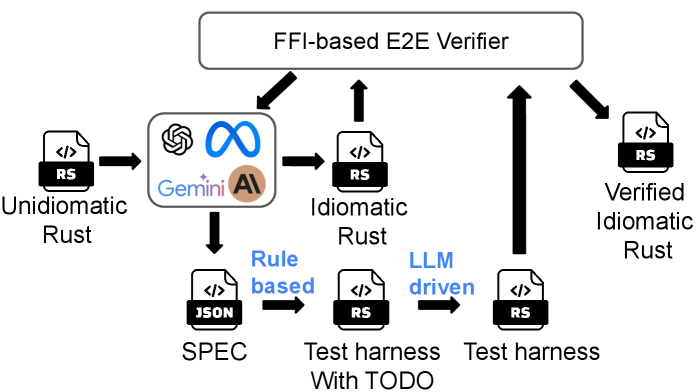
This diagram illustrates a workflow for verifying Rust code using Gemini AI and a Foreign Function Interface (FFI)-based End-to-End (E2E) verifier. The process begins with unidiomatic Rust code, transforms it through Gemini AI, and ultimately produces verified idiomatic Rust code. The diagram highlights the role of rule-based and LLM-driven test harnesses in the verification process.
### Components/Axes
The diagram consists of several key components connected by arrows indicating the flow of data/code:
* **Input:** "Unidiomatic Rust" (represented by a code block icon with "RS" inside)
* **Gemini AI:** A circular icon with the text "Gemini AI" and an infinity symbol.
* **Intermediate Code 1:** "Idiomatic Rust" (represented by a code block icon with "RS" inside)
* **Intermediate Code 2:** "SPEC" (represented by a code block icon with "JSON" inside)
* **Intermediate Code 3:** "Test harness With TODO" (represented by a code block icon with "RS" inside)
* **Intermediate Code 4:** "Test harness" (represented by a code block icon with "RS" inside)
* **Output:** "Verified Idiomatic Rust" (represented by a code block icon with "RS" inside)
* **FFI-based E2E Verifier:** A rectangular box at the top labeled "FFI-based E2E Verifier".
* **Arrows:** Black arrows indicate the primary flow.
* **Colored Arrows:** A purple arrow labeled "Rule based" connects "SPEC" to "Test harness With TODO". A cyan arrow labeled "LLM driven" connects "Test harness With TODO" to "Test harness".
### Detailed Analysis or Content Details
The diagram depicts a cyclical process:
1. **Unidiomatic Rust to Idiomatic Rust:** Unidiomatic Rust code is fed into Gemini AI, which transforms it into Idiomatic Rust code. This is indicated by a black arrow.
2. **Idiomatic Rust to SPEC & Test Harness:** The Idiomatic Rust code is then used to generate a "SPEC" (JSON format) and a "Test harness With TODO". This is indicated by a black arrow splitting into two.
3. **SPEC to Test Harness With TODO:** The "SPEC" is processed using a "Rule based" approach to create a "Test harness With TODO". This is indicated by a purple arrow.
4. **Test Harness With TODO to Test Harness:** The "Test harness With TODO" is processed using an "LLM driven" approach to create a "Test harness". This is indicated by a cyan arrow.
5. **Test Harness to Verified Idiomatic Rust:** The "Test harness" is used by the "FFI-based E2E Verifier" to produce "Verified Idiomatic Rust". This is indicated by a black arrow.
6. **Verification Loop:** The "Verified Idiomatic Rust" is then fed back into the "FFI-based E2E Verifier" to continue the verification process.
### Key Observations
* The diagram emphasizes the iterative nature of the verification process.
* Gemini AI plays a central role in transforming unidiomatic code into idiomatic code.
* The use of both rule-based and LLM-driven approaches for test harness generation suggests a hybrid verification strategy.
* The "TODO" in "Test harness With TODO" indicates that the test harness is not yet complete.
### Interpretation
The diagram illustrates a modern approach to Rust code verification leveraging the power of AI. Gemini AI acts as a translator, converting potentially complex or non-standard Rust code into a more standardized and verifiable form. The subsequent use of rule-based and LLM-driven test harness generation demonstrates a layered approach to ensuring code quality. The "FFI-based E2E Verifier" suggests that the verification process involves interacting with external systems or libraries. The cyclical nature of the diagram highlights the importance of continuous verification and refinement. The presence of "TODO" in the test harness indicates that this is an ongoing development process. The diagram suggests a system designed to automate and improve the reliability of Rust code, potentially reducing errors and vulnerabilities.