\n
## Diagram: FFI-based E2E Verifier System Architecture
### Overview
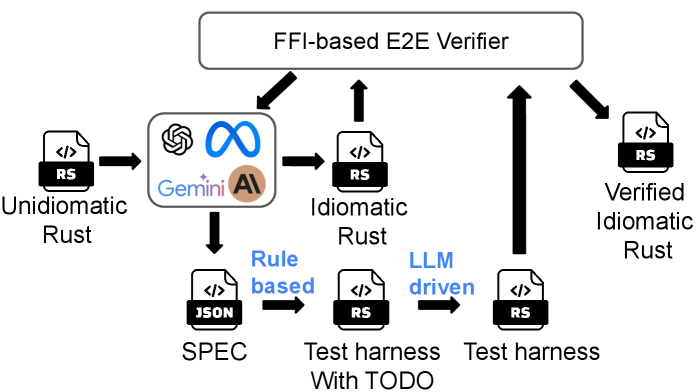
The image is a technical flowchart or system architecture diagram illustrating a process for transforming and verifying Rust code. The system uses a combination of Large Language Models (LLMs) and rule-based methods to convert "Unidiomatic Rust" into "Verified Idiomatic Rust" through an end-to-end verification process. The diagram shows two parallel pathways converging into a final verification step.
### Components/Axes
The diagram is composed of labeled boxes, file icons, directional arrows, and a central processing unit containing AI model logos. There are no traditional chart axes.
**Key Components & Labels (Spatially Organized):**
* **Top Center:** A large rectangular box labeled **"FFI-based E2E Verifier"**. This is the central verification component.
* **Center Left:** A rounded rectangle containing three logos/icons:
* A spiral logo (resembling the OpenAI logo).
* An infinity symbol (∞).
* The text **"Gemini"** next to a blue "G" logo.
* The text **"AI"** next to a brown circular icon.
* **Left Side:** A file icon labeled **"RS"** (Rust source file) with the text **"Unidiomatic Rust"** below it. An arrow points from this file to the central AI box.
* **Center:** A file icon labeled **"RS"** with the text **"Idiomatic Rust"** below it. An arrow points from the central AI box to this file. Another arrow points from this file up to the "FFI-based E2E Verifier".
* **Right Side:** A file icon labeled **"RS"** with the text **"Verified Idiomatic Rust"** below it. An arrow points from the "FFI-based E2E Verifier" down to this file.
* **Bottom Left:** A file icon labeled **"JSON"** with the text **"SPEC"** below it. An arrow points from the central AI box down to this file.
* **Bottom Center:** A file icon labeled **"RS"** with the text **"Test harness With TODO"** below it. An arrow labeled **"Rule based"** (in blue text) points from the "SPEC" file to this file.
* **Bottom Right:** A file icon labeled **"RS"** with the text **"Test harness"** below it. An arrow labeled **"LLM driven"** (in blue text) points from the "Test harness With TODO" file to this file. A large, thick arrow points from this "Test harness" file up to the "FFI-based E2E Verifier".
### Detailed Analysis
The diagram outlines a multi-stage pipeline:
1. **Input:** The process begins with **"Unidiomatic Rust"** code.
2. **AI-Powered Transformation:** This code is processed by a system represented by the central box containing **Gemini** and other AI logos. This step produces two outputs:
* **"Idiomatic Rust"** code.
* A **"SPEC"** (Specification) in JSON format.
3. **Test Harness Generation (Dual Path):**
* **Path A (Rule-based):** The JSON **SPEC** is used via a **"Rule based"** process to generate an initial **"Test harness With TODO"**.
* **Path B (LLM-driven):** The initial test harness is then refined or completed via an **"LLM driven"** process to produce a final **"Test harness"**.
4. **End-to-End Verification:** The **"FFI-based E2E Verifier"** takes two primary inputs:
* The **"Idiomatic Rust"** code (from step 2).
* The final **"Test harness"** (from step 3).
5. **Output:** The verifier's successful output is the final **"Verified Idiomatic Rust"**.
### Key Observations
* **Hybrid Approach:** The system explicitly combines **"Rule based"** and **"LLM driven"** techniques for test generation, suggesting a strategy to leverage the strengths of both methods (determinism and flexibility).
* **Central AI Role:** The AI component (Gemini et al.) is pivotal, responsible for both code transformation (to idiomatic style) and specification generation.
* **Verification Focus:** The ultimate goal is not just transformation but *verification*, as emphasized by the final output being "Verified" and the central role of the "E2E Verifier".
* **Flow Direction:** The primary data flow is from left to right (Unidiomatic -> Idiomatic -> Verified). A secondary, supporting flow runs along the bottom for test generation (SPEC -> Test harnesses), which then feeds upward into the verifier.
* **Uncertainty:** The exact nature of the "FFI-based" verifier is not detailed; it likely involves Foreign Function Interface testing to ensure the Rust code interacts correctly with other systems or languages.
### Interpretation
This diagram represents a sophisticated, AI-augmented software development pipeline focused on code quality and correctness. It addresses the common challenge of transforming legacy or poorly written ("Unidiomatic") Rust code into a standardized, maintainable form.
The process is **Peircean** in its investigative logic:
* **Abduction:** The AI infers the intended structure and rules (the **SPEC**) from the unidiomatic code.
* **Deduction:** The **Rule based** system applies those inferred rules to generate a structured test harness.
* **Induction:** The **LLM driven** refinement and the **E2E Verifier** test the hypothesis that the transformed code is correct, using the generated tests to induce confidence in the final "Verified" output.
The system's value lies in automating two labor-intensive and error-prone tasks: refactoring code to idioms and creating comprehensive test suites. By linking them through a shared specification and a final verifier, it aims to create a closed-loop system where transformation and validation are tightly integrated, potentially increasing both the efficiency and reliability of software modernization efforts. The inclusion of both rule-based and LLM-driven steps for test creation is a notable design choice, likely intended to balance the precision of rules with the adaptability of AI for handling complex or ambiguous cases.