TECHNICAL ASSET FINGERPRINT
09cad09b81cf9cf5dd8757bf
Click to view fullscreen
Press ESC or click to close
FOUND IN PAPERS
EXPERT: healer-alpha-free VERSION 1
RUNTIME: free/openrouter/healer-alpha
INTEL_VERIFIED
## Diagram: Mayan Hieroglyphic Tablets and Decipherment
### Overview
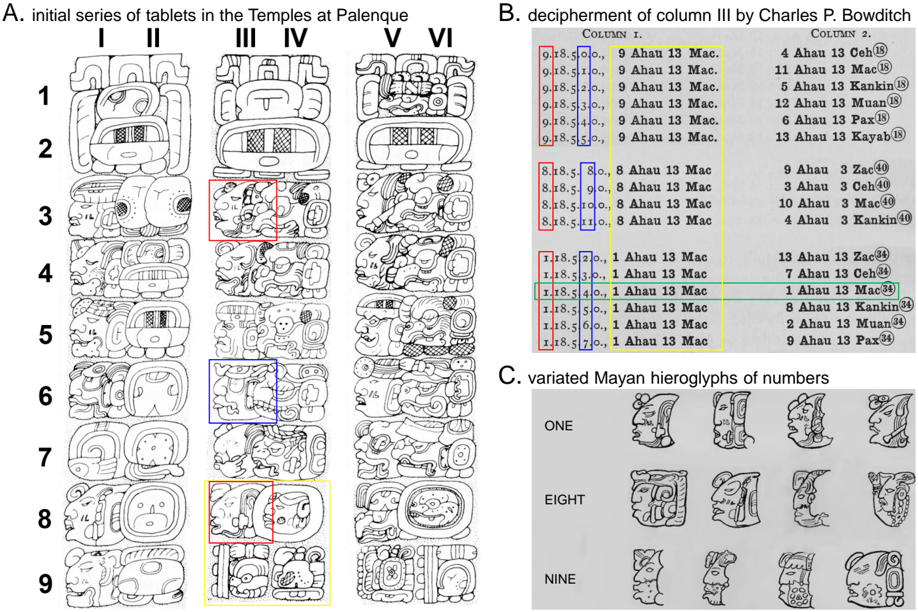
The image is a composite technical illustration divided into three labeled sections (A, B, C) that document the analysis of Mayan hieroglyphic inscriptions from the Temples at Palenque. It presents the original glyphs, a scholarly decipherment, and a reference for number glyphs.
### Components/Axes
The image is segmented into three distinct panels:
* **Panel A (Left):** Titled "A. initial series of tablets in the Temples at Palenque". It displays a grid of Mayan hieroglyphs arranged in six vertical columns labeled with Roman numerals (I, II, III, IV, V, VI) and nine horizontal rows labeled with Arabic numerals (1 through 9). Specific glyphs are highlighted with colored rectangular boxes (red, blue, yellow).
* **Panel B (Top Right):** Titled "B. decipherment of column III by Charles P. Bowditch". It presents a tabular decipherment of the glyphs from Column III of Panel A. The table has two main columns labeled "COLUMN T." and "COLUMN 2." Each contains sequences of numbers and Mayan calendar terms (e.g., "Ahau", "Mac", "Ceh"). Corresponding colored boxes (red, blue, yellow, green) link specific entries in this table back to the highlighted glyphs in Panel A.
* **Panel C (Bottom Right):** Titled "C. variated Mayan hieroglyphs of numbers". It shows three rows of glyphic variations for the numbers ONE, EIGHT, and NINE. Each row contains four distinct graphical representations of the respective number.
### Detailed Analysis
**Panel A: Glyph Grid**
* **Structure:** A 9-row by 6-column grid. Each cell contains a complex, stylized Mayan hieroglyph drawn in black line art on a white background.
* **Highlighted Glyphs:**
* **Red Box:** Encloses the glyph in cell **A3-III** (Row 3, Column III).
* **Blue Box:** Encloses the glyph in cell **A6-III** (Row 6, Column III).
* **Yellow Box:** Encloses the glyph in cell **A8-III** (Row 8, Column III).
* A second, larger **red box** encloses the glyph in cell **A8-IV** (Row 8, Column IV).
**Panel B: Decipherment Table**
* **Structure:** Two-column table. The left column ("COLUMN T.") lists Long Count dates and their corresponding Calendar Round dates. The right column ("COLUMN 2.") lists additional Calendar Round dates.
* **Transcription of Text:**
* **COLUMN T.**
* `9.18.5.0.0. 9 Ahau 13 Mac.` (This line is repeated 6 times, with the first instance highlighted by a **red box**).
* `8.18.5.0.0. 8 Ahau 13 Mac.` (This line is repeated 4 times, with the first instance highlighted by a **blue box**).
* `1.18.5.0.0. 1 Ahau 13 Mac.` (This line is repeated 6 times. The first instance is highlighted by a **yellow box**. The fourth instance is highlighted by a **green box**).
* **COLUMN 2.**
* `4 Ahau 13 Ceh¹⁸`
* `11 Ahau 13 Mac¹⁸`
* `5 Ahau 13 Kankin¹⁸`
* `12 Ahau 13 Muan¹⁸`
* `6 Ahau 13 Pax¹⁸`
* `13 Ahau 13 Kayab¹⁸`
* `9 Ahau 3 Zac⁴⁰`
* `3 Ahau 3 Ceh⁴⁰`
* `10 Ahau 3 Mac⁴⁰`
* `4 Ahau 3 Kankin⁴⁰`
* `13 Ahau 13 Zac³⁴`
* `7 Ahau 13 Ceh³⁴`
* `1 Ahau 13 Mac³⁴` (This line is highlighted by a **green box**).
* `8 Ahau 13 Kankin³⁴`
* `2 Ahau 13 Muan³⁴`
* `9 Ahau 13 Pax³⁴`
* **Color-Coded Cross-Reference:**
* The **red box** in Panel B (around `9.18.5.0.0. 9 Ahau 13 Mac.`) corresponds to the **red box** glyph in Panel A (cell A3-III).
* The **blue box** in Panel B (around `8.18.5.0.0. 8 Ahau 13 Mac.`) corresponds to the **blue box** glyph in Panel A (cell A6-III).
* The **yellow box** in Panel B (around `1.18.5.0.0. 1 Ahau 13 Mac.`) corresponds to the **yellow box** glyph in Panel A (cell A8-III).
* The **green box** in Panel B (around `1 Ahau 13 Mac³⁴`) does not have a directly corresponding colored box in Panel A, but its position in the sequence is noted.
**Panel C: Number Glyph Variations**
* **Structure:** Three rows, each labeled with an English number word.
* **Content:**
* **Row 1 (ONE):** Shows four distinct hieroglyphs representing the number one.
* **Row 2 (EIGHT):** Shows four distinct hieroglyphs representing the number eight.
* **Row 3 (NINE):** Shows four distinct hieroglyphs representing the number nine.
### Key Observations
1. **Systematic Decipherment:** Panel B demonstrates a direct, systematic correlation between specific pictographic glyphs (Panel A) and a calendrical notation system involving Long Count dates (`9.18.5.0.0.`) and Calendar Round dates (`9 Ahau 13 Mac`).
2. **Repetition and Pattern:** The decipherment in Panel B shows significant repetition (e.g., the same Long Count date listed multiple times), suggesting a pattern or sequence within the original inscription.
3. **Glyphic Variation:** Panel C explicitly shows that a single numerical concept (e.g., "EIGHT") can be represented by multiple, visually distinct hieroglyphs, highlighting the complexity and non-phonetic nature of the writing system.
4. **Spatial Organization:** The colored boxes provide a crucial spatial and conceptual link between the raw archaeological artifact (Panel A) and its scholarly interpretation (Panel B).
### Interpretation
This image is a technical document from the field of epigraphy (the study of inscriptions). It serves as a visual proof or working sheet for deciphering Mayan script.
* **What it demonstrates:** It shows the process of translating a specific series of glyphs from the Palenque temples into a known calendrical system. The repetition in Panel B likely represents a list of consecutive or related dates recorded on the monument.
* **Relationship between elements:** Panel A is the primary source data. Panel B is the analytical output, mapping glyphs to meaning. Panel C is a supporting reference, illustrating the variability in glyphic forms that an epigrapher must account for.
* **Notable patterns:** The highlighted sequences in Panel B (`9.18.5.0.0.`, `8.18.5.0.0.`, `1.18.5.0.0.`) are separated by exactly 1.0.0.0.0. (a "hotun" or 5-year period in the Long Count). This suggests the inscription may be recording a series of period-ending ceremonies or commemorations at regular intervals. The green box highlights a specific Calendar Round date (`1 Ahau 13 Mac`) that appears in both columns of the decipherment, possibly indicating a date of particular significance within the sequence.
**Language Note:** The primary language of the explanatory text and labels is English. The calendrical terms (Ahau, Mac, Ceh, Kankin, Muan, Pax, Kayab, Zac) are transcribed Mayan words and are not translated.
DECODING INTELLIGENCE...