## Chart/Diagram Type: Archaeological and Epigraphic Analysis of Mayan Artifacts
### Overview
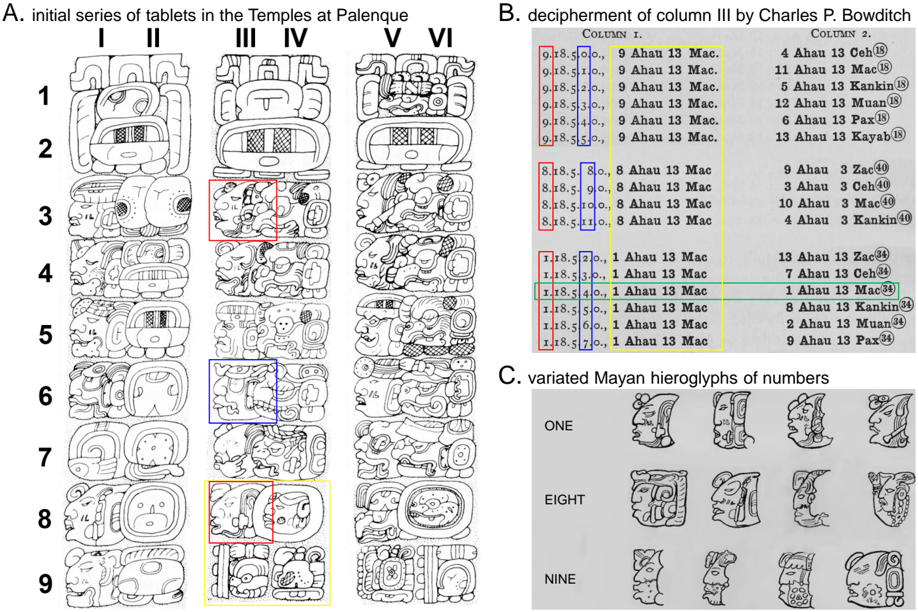
The image presents three distinct sections (A, B, C) analyzing Mayan artifacts and epigraphic data. Section A shows a series of carved tablets from the Temples at Palenque, organized in columns I–VI and rows 1–9. Section B is a decipherment table of Column III by Charles P. Bowditch, with color-coded annotations. Section C displays varied Mayan hieroglyphs representing numbers.
---
### Components/Axes
#### Section A: Initial Series of Tablets
- **Structure**:
- **Columns**: I, II, III, IV, V, VI (labeled at the top).
- **Rows**: 1–9 (labeled on the left).
- **Content**: Each cell contains intricate Mayan carvings, including faces, symbols, and geometric patterns.
- **Highlighted Areas**:
- **Red Boxes**: III.3, III.6 (column III, rows 3 and 6).
- **Blue Boxes**: IV.3, IV.6 (column IV, rows 3 and 6).
- **Yellow Boxes**: V.3, V.6 (column V, rows 3 and 6).
#### Section B: Decipherment of Column III
- **Table Structure**:
- **Columns**:
- **Column I**: Dates (e.g., "9.18.5.0.0", "9.18.5.1.0") with annotations like "9 Ahau 13 Mac."
- **Column II**: Numerical values (e.g., "4 Ahau 13 Ceh", "11 Ahau 13 Mac") with annotations like "4 Ahau 13 Ceh" and "11 Ahau 13 Mac."
- **Color-Coded Boxes**:
- **Red**: Entries like "9.18.5.0.0" and "9 Ahau 13 Mac" (Column I).
- **Blue**: Entries like "8.18.5.0.0" and "8 Ahau 13 Mac" (Column I).
- **Green**: Entries like "1.18.5.2.0" and "1 Ahau 13 Mac" (Column I).
- **Yellow**: Entries like "1.18.5.7.0" and "1 Ahau 13 Mac" (Column I).
#### Section C: Varied Mayan Hieroglyphs of Numbers
- **Rows**:
- **Row 1**: Labeled "ONE" with 4 glyphs.
- **Row 8**: Labeled "EIGHT" with 4 glyphs.
- **Row 9**: Labeled "NINE" with 4 glyphs.
- **Content**: Stylized Mayan hieroglyphs representing numbers, with variations in facial features and symbolic elements.
---
### Detailed Analysis
#### Section A: Tablets at Palenque
- **Structure**: The tablets are arranged in a grid, with columns I–VI and rows 1–9. Each cell contains unique carvings, suggesting a systematic categorization (e.g., by date, deity, or ritual).
- **Highlighted Cells**:
- **Red Boxes (III.3, III.6)**: May indicate significant dates or symbols (e.g., "9 Ahau 13 Mac" in Column III).
- **Blue Boxes (IV.3, IV.6)**: Could represent transitional or secondary elements in the sequence.
- **Yellow Boxes (V.3, V.6)**: Possibly highlight key ritual or calendrical markers.
#### Section B: Decipherment Table
- **Date and Numerical Entries**:
- **Column I**: Dates follow the Mayan Long Count format (e.g., "9.18.5.0.0" = 9 baktuns, 18 katuns, 5 tuns, 0 uinals, 0 kins).
- **Column II**: Numerical values (e.g., "4 Ahau 13 Ceh") correspond to Mayan calendar days, with "Ahau" (sun god) and "Ceh" (jaguar) as day signs.
- **Color-Coding**:
- **Red**: Likely denotes critical or foundational dates (e.g., "9 Ahau 13 Mac").
- **Blue**: May indicate intermediate or secondary entries (e.g., "8 Ahau 13 Mac").
- **Green/Yellow**: Could represent variations or corrections in the decipherment process.
#### Section C: Hieroglyphs of Numbers
- **Glyph Variations**:
- **Row 1 (ONE)**: Glyphs show minimal variation, suggesting a standardized representation.
- **Row 8 (EIGHT)**: More complex glyphs with additional symbolic elements (e.g., headdresses, jewelry).
- **Row 9 (NINE)**: Highly stylized, with intricate details, possibly indicating higher numerical significance.
---
### Key Observations
1. **Section A**: The highlighted cells (red, blue, yellow) may correlate with specific ritual or calendrical events, though no explicit labels confirm this.
2. **Section B**: The color-coded entries in Column III suggest a layered decipherment process, with red and blue boxes possibly indicating primary and secondary interpretations.
3. **Section C**: The increasing complexity of glyphs from Row 1 to Row 9 implies a progression in numerical representation, though no explicit numerical values are provided.
---
### Interpretation
- **Section A**: The tablets likely document a sequence of events or rituals, with highlighted cells marking pivotal moments. The absence of explicit labels leaves interpretation open, but the structured layout suggests a calendrical or historical record.
- **Section B**: The decipherment table by Bowditch uses color to differentiate interpretations, with red and blue boxes possibly reflecting confidence levels or alternative readings. The entries align with Mayan calendar systems, emphasizing the importance of dates in Mayan culture.
- **Section C**: The hieroglyphs demonstrate the diversity of Mayan numerical representation, with higher numbers (e.g., 8, 9) showing greater stylistic complexity, possibly reflecting their cultural or mathematical significance.
**Note**: The image lacks explicit numerical data or textual explanations beyond the labels and annotations. The analysis relies on contextual knowledge of Mayan epigraphy and calendar systems.