## Textual Document: Algorithm Definitions
### Overview
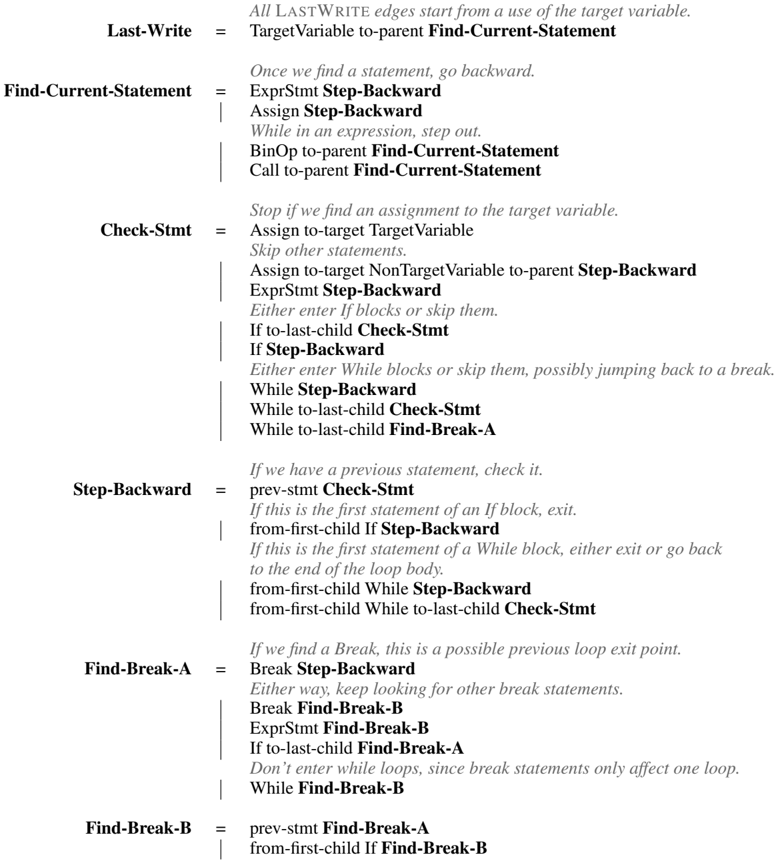
The image presents a set of definitions for components of an algorithm, likely related to static analysis or program understanding. The definitions are expressed using a symbolic notation, where terms are defined in terms of other terms, and operations are indicated by keywords like "Step-Backward" and "to-parent". The definitions appear to describe a process of traversing code backwards from a given point, potentially to identify variable usage or control flow.
### Components/Axes
There are no axes or traditional chart components. The document consists of a series of equations, each defining a term on the left-hand side in terms of other terms and operations on the right-hand side. The terms are:
* Last-Write
* Find-Current-Statement
* Check-Stmt
* Step-Backward
* Find-Break-A
* Find-Break-B
### Detailed Analysis or Content Details
Here's a transcription of each definition:
**Last-Write =** All LASTWRITE edges start from a use of the target variable.
TargetVariable to-parent Find-Current-Statement
**Find-Current-Statement =** Once we find a statement, go backward.
ExprStmt Step-Backward
Assign Step-Backward
While in an expression, step out.
BinOp to-parent Find-Current-Statement
Call to-parent Find-Current-Statement
**Check-Stmt =** Stop if we find an assignment to the target variable.
Assign to-target TargetVariable
Skip other statements.
Assign to-target NonTargetVariable to-parent Step-Backward
ExprStmt Step-Backward
Either enter If blocks or skip them.
If to-last-child Check-Stmt
If Step-Backward
Either enter While blocks or skip them, possibly jumping back to a break.
While Step-Backward
While to-last-child Check-Stmt
While to-last-child Find-Break-A
**Step-Backward =** If we have a previous statement, check it.
prev-stmt Check-Stmt
If this is the first statement of an If block, exit.
from-first-child If Step-Backward
If this is the first statement of a While block, either exit or go back to the end of the loop body.
from-first-child While Step-Backward
from-first-child While to-last-child Check-Stmt
**Find-Break-A =** If we find a Break, this is a possible previous loop exit point.
Break Step-Backward
Either way, keep looking for other break statements.
Break Find-Break-B
ExprStmt Find-Break-B
If to-last-child Find-Break-A
Don't enter while loops, since break statements only affect one loop.
While Find-Break-B
**Find-Break-B =** prev-stmt Find-Break-A
from-first-child If Find-Break-B
### Key Observations
The definitions are recursive, with terms referencing each other. The "Step-Backward" operation appears central, as it's used in multiple definitions. The definitions related to "Find-Break-A" and "Find-Break-B" suggest a specific focus on handling `break` statements within loops. The use of "to-parent" and "to-last-child" indicates a tree-like structure being traversed, likely representing the Abstract Syntax Tree (AST) of the code.
### Interpretation
This document outlines an algorithm for analyzing code, likely to determine data dependencies or control flow. The algorithm starts from a "Last-Write" to a variable and traces backwards to find the "Current-Statement". It then checks for assignments to the target variable ("Check-Stmt") and steps backward through the code ("Step-Backward"), handling conditional ("If") and loop ("While") structures. The "Find-Break-A" and "Find-Break-B" definitions suggest a specific handling of `break` statements to correctly identify loop exit points.
The algorithm appears designed to be robust to complex control flow, as it explicitly handles entering and exiting blocks and skipping statements. The recursive nature of the definitions suggests that the algorithm is designed to handle nested structures. The use of terms like "to-parent" and "to-last-child" strongly suggests that the algorithm operates on the AST of the code.
The overall purpose seems to be to identify the origin of a variable's value, tracing back through the code to find the statement that last assigned a value to it, while correctly handling control flow constructs. This is a common task in static analysis tools used for debugging, optimization, and security analysis.