## Flowchart: Pseudocode for Variable Decompilation Process
### Overview
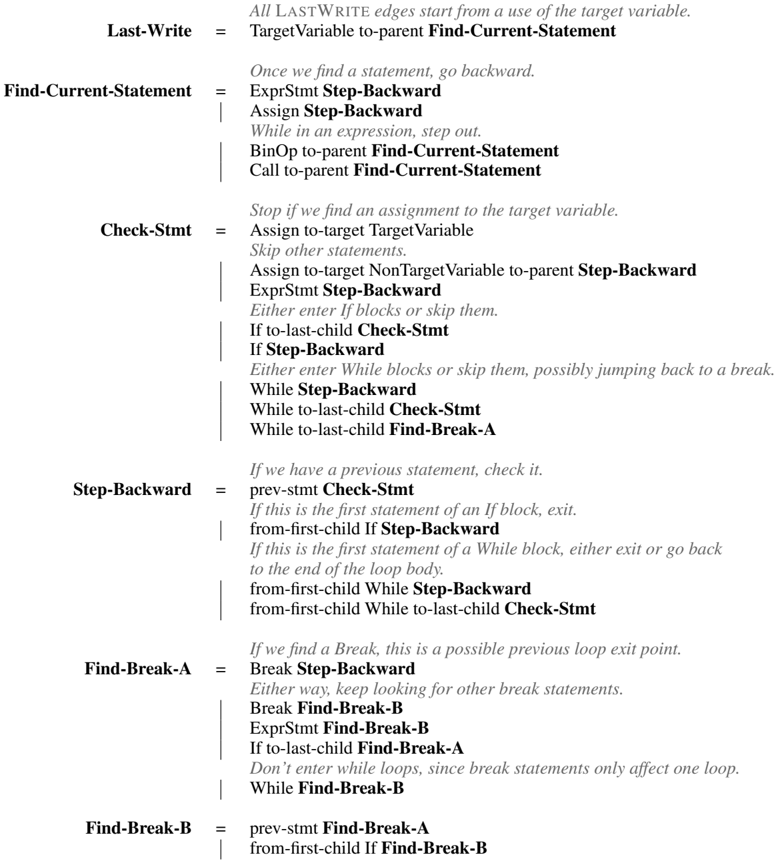
The image depicts a flowchart outlining a recursive algorithm for tracing the origin of a target variable's value in code. It starts from the last use of the variable and steps backward through the code, handling control structures like loops and conditionals.
### Components/Axes
- **Blocks**: Rectangular nodes representing functions/steps (e.g., "Last-Write", "Find-Current-Statement").
- **Arrows**: Directed edges indicating control flow between blocks.
- **Text**: Descriptive instructions within each block (e.g., "Assign Step-Backward", "While in an expression, step out").
### Detailed Analysis
1. **Last-Write**
- Title: "Last-Write"
- Text: "All LASTWRITE edges start from a use of the target variable."
- Action: TargetVariable →-parent-→ Find-Current-Statement
2. **Find-Current-Statement**
- Title: "Find-Current-Statement"
- Text: "Once we find a statement, go backward."
- Substeps:
- ExprStmt Step-Backward
- Assign Step-Backward
- While in an expression, step out
- BinOp →-parent-→ Find-Current-Statement
- Call →-parent-→ Find-Current-Statement
3. **Check-Stmt**
- Title: "Check-Stmt"
- Text: "Stop if we find an assignment to the target variable."
- Substeps:
- Assign →-target-→ TargetVariable → Step-Backward
- ExprStmt Step-Backward
- If →-last-child-→ Check-Stmt
- If Step-Backward →-last-child-→ Check-Stmt
- While Step-Backward →-last-child-→ Check-Stmt
- While →-last-child-→ Find-Break-A
4. **Step-Backward**
- Title: "Step-Backward"
- Text: "If we have a previous statement, check it."
- Substeps:
- prev-stmt Check-Stmt
- If first If-block → Step-Backward
- If first While-block → Step-Backward or exit loop
- from-first-child →-last-child-→ Check-Stmt
5. **Find-Break-A**
- Title: "Find-Break-A"
- Text: "If we find a Break, this is a possible previous loop exit point."
- Substeps:
- Break Step-Backward
- Break Find-Break-B
- ExprStmt Find-Break-B
- If →-last-child-→ Find-Break-A
- While Find-Break-B
6. **Find-Break-B**
- Title: "Find-Break-B"
- Text: "prev-stmt Find-Break-A"
- Substeps:
- from-first-child If Find-Break-B
### Key Observations
- **Recursive Flow**: The process repeatedly steps backward through code, prioritizing assignments to the target variable.
- **Control Structure Handling**:
- Loops (While) and conditionals (If) are traversed backward, with special handling for `break` statements.
- `break` statements only affect the innermost loop, requiring separate tracking (Find-Break-A vs. Find-Break-B).
- **Termination**: Stops when an assignment to the target variable is found.
### Interpretation
This flowchart represents a **decompilation algorithm** for reverse-engineering code to trace variable origins. It systematically navigates backward through the code, accounting for nested control structures. The separation of `Find-Break-A` and `Find-Break-B` ensures accurate handling of loop exits, as `break` statements only terminate the nearest enclosing loop. The algorithm’s recursive nature allows it to resolve complex code paths, making it useful for tasks like debugging or understanding obfuscated code.
**Note**: No numerical data or visual trends are present; the focus is on procedural logic and control flow.