\n
## Screenshot: AI Thought Process for ASCII Art Generation
### Overview
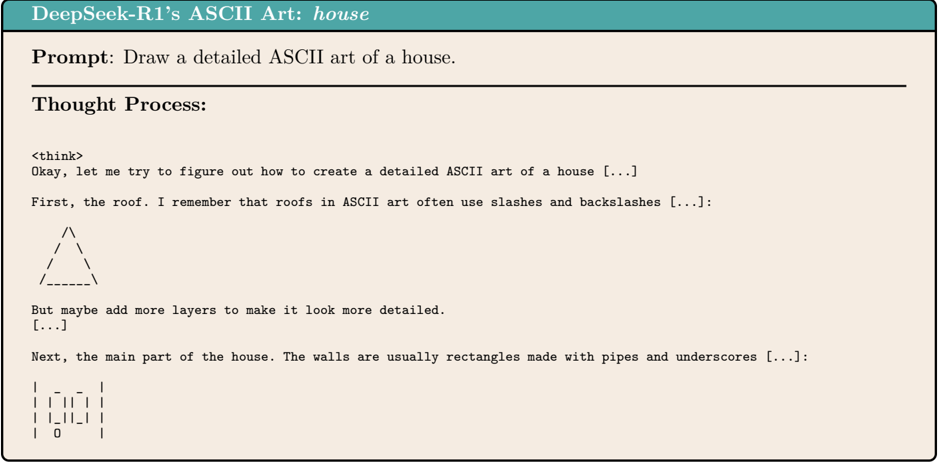
The image is a screenshot of a text-based interface displaying a structured thought process for generating ASCII art. It shows a prompt given to an AI (DeepSeek-R1) and the subsequent step-by-step reasoning for creating a detailed ASCII representation of a house. The interface uses a monospaced font on a light beige background, with a teal header bar.
### Components/Axes
1. **Header Bar**: A solid teal bar at the top containing the title text in white.
2. **Prompt Section**: A line of text below the header, stating the user's request.
3. **Thought Process Section**: A labeled section containing the AI's internal reasoning, enclosed in `<think>` tags. This section includes both descriptive text and embedded ASCII art examples.
### Content Details
**Header Text (Top, Teal Bar):**
`DeepSeek-R1's ASCII Art: house`
**Prompt (Below header, left-aligned):**
`Prompt: Draw a detailed ASCII art of a house.`
**Thought Process Label (Bold, left-aligned):**
`Thought Process:`
**Content within `<think>` tags (Monospaced font):**
The text describes a methodical approach to constructing the ASCII art.
1. **Initial Reasoning**: The process begins with a general statement of intent.
`Okay, let me try to figure out how to create a detailed ASCII art of a house [...]`
(The ellipsis `[...]` indicates the text is truncated or summarized in this view.)
2. **Component 1 - The Roof**: The reasoning focuses first on the roof, noting common ASCII conventions.
`First, the roof. I remember that roofs in ASCII art often use slashes and backslashes [...]:`
An example of a simple, triangular roof is provided:
```
/\
/ \
/____\
```
The thought continues, suggesting an iterative improvement.
`But maybe add more layers to make it look more detailed. [...]`
3. **Component 2 - The Walls**: The focus then shifts to the main structure.
`Next, the main part of the house. The walls are usually rectangles made with pipes and underscores [...]:`
An example of a wall section with potential windows and a door is shown:
```
| _ _ |
| | | | | |
| |_| |_| |
| O |
```
(The `O` likely represents a door or a central window.)
### Key Observations
* **Structured Approach**: The thought process is decomposed into logical, sequential components (roof, then walls).
* **Use of Conventions**: The reasoning references established ASCII art techniques (slashes for roofs, pipes/underscores for walls).
* **Iterative Design**: The text implies a process of starting with a simple form and planning to add complexity ("add more layers").
* **Truncation**: The frequent use of `[...]` indicates this is a condensed or highlighted view of a longer, more detailed internal monologue.
### Interpretation
This image provides a meta-view into the problem-solving process of an AI tasked with a creative, visual generation task. It demonstrates how a complex output (a detailed ASCII house) is broken down into manageable, conventional sub-components. The "thought process" acts as a bridge between the abstract prompt ("draw a house") and the concrete, character-based execution.
The examples serve as proof-of-concept for each component before final assembly. The presence of the `<think>` tags suggests this is a window into the model's internal reasoning chain, which is typically hidden from the end-user. The document's purpose is likely educational or demonstrative, showing how an AI approaches procedural, rule-based art creation. The key takeaway is the translation of a visual concept into a sequence of textual, symbolic decisions.