## System Diagram: Xylo HDK Audio Processing
### Overview
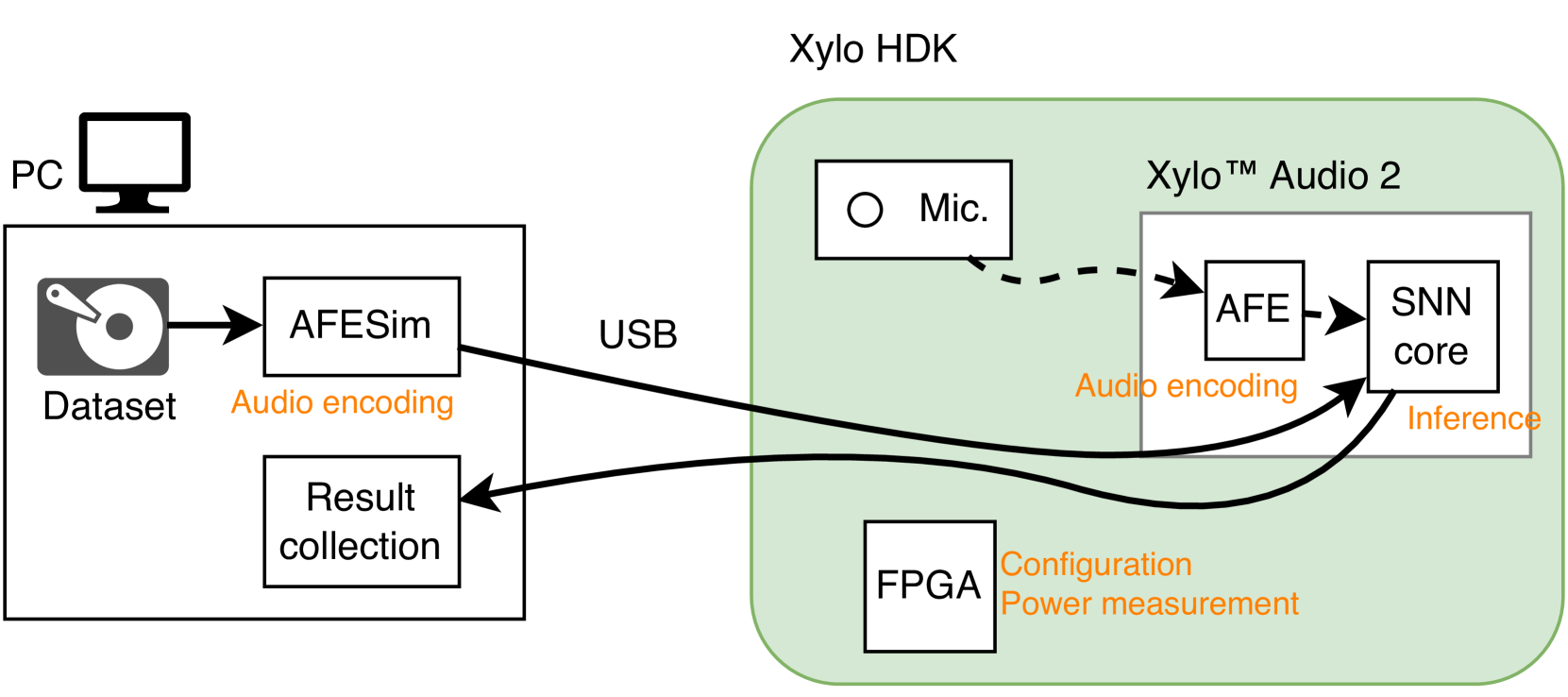
The image is a system diagram illustrating the data flow and processing steps within the Xylo HDK (Hardware Development Kit) for audio processing. It shows the interaction between a PC, the Xylo HDK, and its internal components, including audio encoding, inference, configuration, and power measurement.
### Components/Axes
* **PC:** Represents a personal computer, the starting point of the data flow.
* **Dataset:** A storage location on the PC, containing the audio data.
* **AFESim:** A software component on the PC, likely responsible for simulating or processing audio features.
* **Result collection:** A component on the PC that collects the results of the audio processing.
* **Xylo HDK:** The hardware development kit, encompassing the audio processing unit.
* **Xylo™ Audio 2:** A sub-component within the Xylo HDK, responsible for audio processing.
* **Mic.:** Microphone, the initial input device for audio.
* **AFE:** Analog Front End, a component within Xylo™ Audio 2.
* **SNN core:** Spiking Neural Network core, a component within Xylo™ Audio 2.
* **FPGA:** Field-Programmable Gate Array, a component within the Xylo HDK.
* **USB:** Connection between the PC and the Xylo HDK.
* **Audio encoding:** Process of encoding audio data.
* **Inference:** Process of making predictions based on the audio data.
* **Configuration:** Setting up the FPGA.
* **Power measurement:** Measuring the power consumption of the FPGA.
### Detailed Analysis or ### Content Details
1. **Data Flow from PC to Xylo HDK:**
* The "Dataset" on the PC feeds data to "AFESim" via an arrow.
* "AFESim" performs "Audio encoding" (indicated by orange text).
* The "AFESim" sends data to the "SNN core" within "Xylo™ Audio 2" via a solid black arrow and the "USB" connection.
* The "SNN core" performs "Inference" (indicated by orange text).
* The "SNN core" sends data back to the "Result collection" on the PC via a solid black arrow.
2. **Data Flow within Xylo HDK:**
* Audio input from "Mic." to "AFE" via a dashed black arrow.
* "AFE" to "SNN core" via a solid black arrow.
* "AFE" performs "Audio encoding" (indicated by orange text).
* The "FPGA" connects to the "SNN core" via a solid black arrow.
* The "FPGA" is responsible for "Configuration" and "Power measurement" (indicated by orange text).
### Key Observations
* The diagram illustrates a closed-loop system where audio data originates from a PC, is processed by the Xylo HDK, and the results are returned to the PC.
* The Xylo HDK utilizes an FPGA for configuration and power measurement, suggesting it plays a crucial role in the hardware setup and monitoring.
* The audio processing within the Xylo™ Audio 2 involves an Analog Front End (AFE) and a Spiking Neural Network (SNN) core, indicating a sophisticated audio processing pipeline.
### Interpretation
The diagram depicts the architecture and data flow of an audio processing system using the Xylo HDK. The PC acts as the data source and result collector, while the Xylo HDK performs the core audio processing tasks. The use of an SNN core suggests that the system is designed for advanced audio analysis or recognition tasks. The FPGA's role in configuration and power measurement highlights the importance of hardware control and optimization in this system. The system appears to be designed for both simulated audio processing (via AFESim) and real-time audio processing (via the microphone input).