\n
## Diagram: Audio Processing System Block Diagram
### Overview
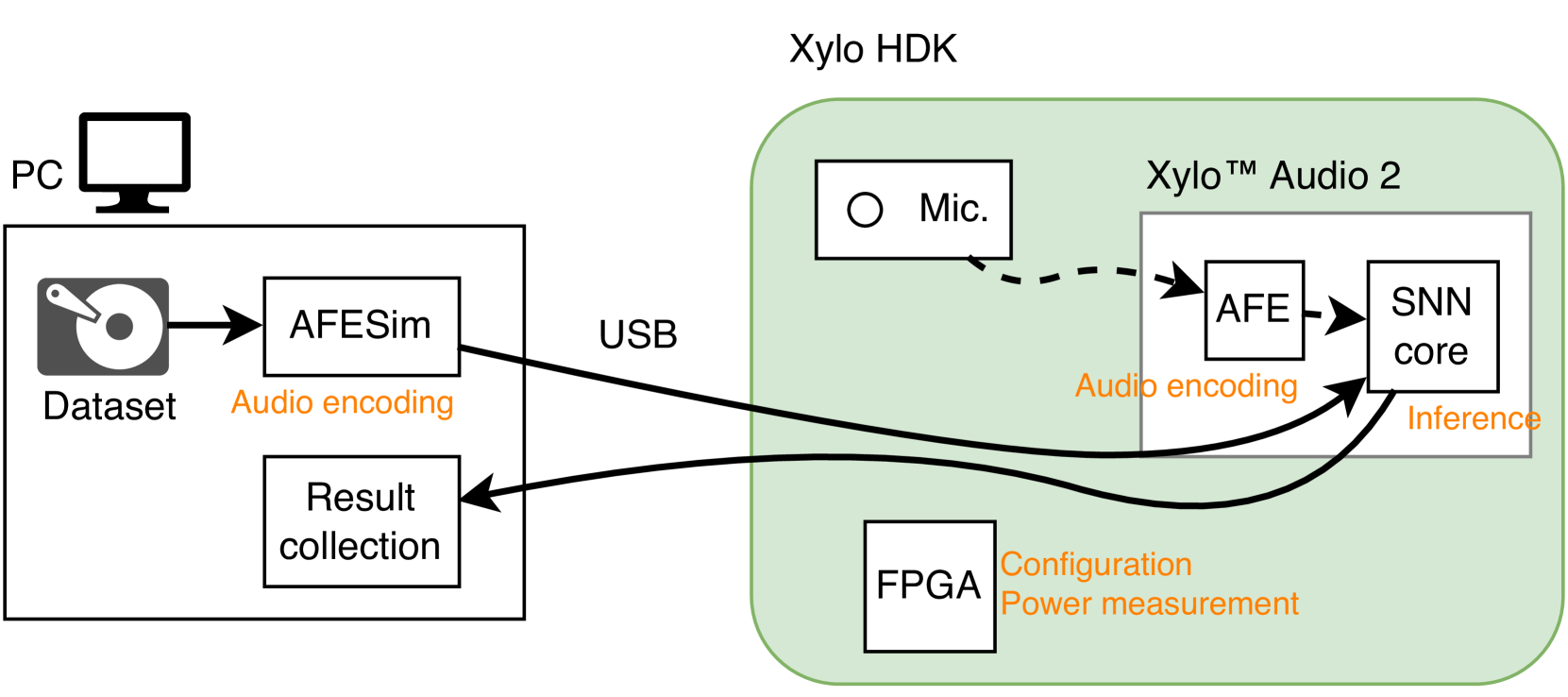
This diagram illustrates an audio processing system involving a PC, a dataset, AFESim software, a Xylo HDK, and Xylo™ Audio 2 components, including an AFE and an SNN core. The diagram depicts the flow of audio data and control signals between these components.
### Components/Axes
The diagram consists of the following components:
* **PC:** A computer with a monitor.
* **Dataset:** A data source represented by a memory card icon.
* **AFESim:** Audio Frontend Simulation software.
* **Result collection:** A module for gathering results.
* **Xylo HDK:** A hardware development kit.
* **Xylo™ Audio 2:** An audio processing module within the Xylo HDK.
* **Mic.:** Microphone.
* **AFE:** Audio Frontend.
* **SNN core:** Spiking Neural Network core.
* **FPGA:** Field-Programmable Gate Array.
* **USB:** Universal Serial Bus connection.
The diagram also includes labels for data/signal flow:
* "Audio encoding" (from Dataset to AFESim, and from AFE to SNN core)
* "Configuration" (from FPGA to Xylo™ Audio 2)
* "Power measurement" (from FPGA to Xylo™ Audio 2)
* "Inference" (from SNN core)
* A dashed line labeled with no text (from Mic. to AFE)
### Detailed Analysis or Content Details
The diagram shows the following data flow:
1. **Dataset to AFESim:** A dataset is fed into the AFESim software via an arrow labeled "Audio encoding".
2. **AFESim to Result collection:** AFESim processes the dataset and sends results to the "Result collection" module.
3. **AFESim to Xylo HDK (via USB):** AFESim also sends data to the Xylo HDK via a USB connection.
4. **Xylo HDK - Mic. to AFE:** The microphone (Mic.) within the Xylo HDK sends audio data to the AFE via a dashed line.
5. **AFE to SNN core:** The AFE processes the audio and sends it to the SNN core, labeled "Audio encoding".
6. **SNN core to Output:** The SNN core performs inference and outputs the result.
7. **FPGA to Xylo™ Audio 2:** The FPGA sends configuration and power measurement data to the Xylo™ Audio 2 module.
8. **Xylo™ Audio 2 to SNN core:** The Xylo™ Audio 2 module sends data to the SNN core.
9. **Result collection to Xylo HDK (via USB):** The Result collection module sends data to the Xylo HDK via a USB connection.
### Key Observations
The diagram highlights a system for audio processing, likely for machine learning or signal analysis. The use of an SNN core suggests a focus on low-power or event-driven processing. The FPGA is used for configuration and power measurement, indicating a hardware-level control and monitoring aspect. The dashed line from the microphone to the AFE suggests an optional or less critical data path.
### Interpretation
The diagram represents a complete audio processing pipeline, from data acquisition (Dataset, Mic.) to analysis and inference (AFESim, SNN core). The Xylo HDK serves as a platform for deploying and testing the audio processing algorithms. The inclusion of the FPGA suggests a focus on hardware acceleration and power optimization. The system appears designed for research and development, allowing for both software simulation (AFESim) and hardware implementation (Xylo HDK). The USB connection between the PC and the Xylo HDK facilitates data transfer and control. The diagram suggests a closed-loop system where the FPGA can configure the Xylo™ Audio 2 and monitor its power consumption during operation. The dashed line from the microphone indicates that the system can operate with either pre-recorded data (Dataset) or live audio input (Mic.).