# Technical Diagram Analysis: Xylo HDK System Architecture
## Diagram Overview
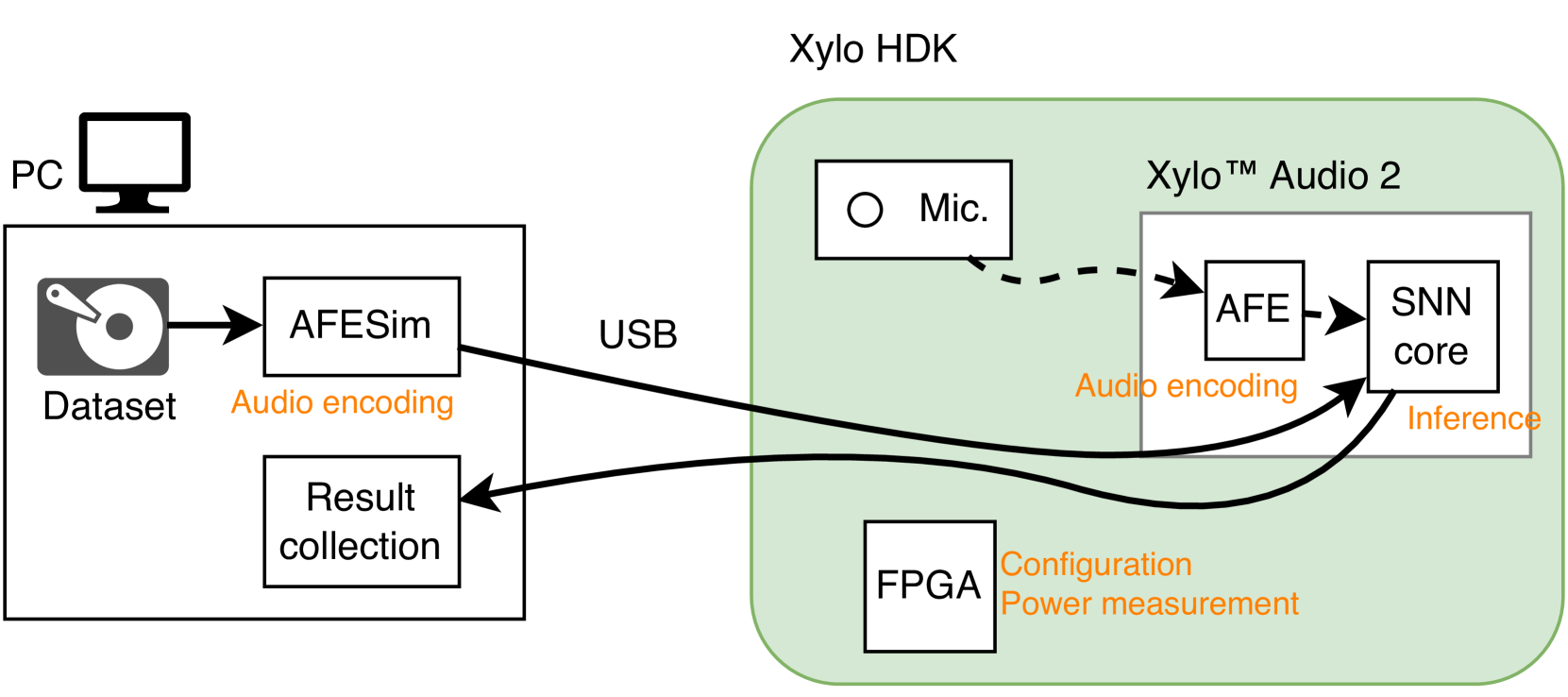
This flowchart illustrates the data flow and processing pipeline between a PC and Xylo HDK hardware components. The diagram uses two primary color-coded regions:
- **White background**: PC-side processing
- **Light green background**: Xylo HDK hardware components
## PC-Side Processing (White Region)
1. **Dataset** (Floppy disk icon)
- Represents input data source
- Connected via USB to AFESim
2. **AFESim** (Text box)
- Processes dataset through "Audio encoding"
- Outputs to "Result collection"
3. **Result collection** (Text box)
- Receives processed data from AFESim
## Xylo HDK Hardware (Green Region)
1. **Microphone (Mic.)** (Circle icon)
- Connected via dashed line to AFE
- Represents audio input source
2. **AFE (Analog Front End)** (Text box)
- Performs "Audio encoding"
- Connected to both:
- SNN core (via solid line)
- FPGA (via dashed line)
3. **SNN core (Spiking Neural Network)** (Text box)
- Receives encoded audio from AFE
- Performs "Inference" processing
4. **FPGA (Field-Programmable Gate Array)** (Text box)
- Handles "Configuration" and "Power measurement"
- Connected to AFE via dashed line
## Data Flow Pathways
1. **Primary Path (Solid Lines)**
- PC → Dataset → AFESim → Audio encoding → Result collection
- Xylo HDK: Mic. → AFE → Audio encoding → SNN core → Inference
2. **Secondary Path (Dashed Lines)**
- AFESim ↔ FPGA (Configuration/Power measurement)
- AFE ↔ FPGA (Configuration)
## Key Technical Components
- **Audio encoding**: Appears in both PC and Xylo HDK paths
- **Inference**: Exclusive to SNN core processing
- **Power measurement**: FPGA-specific function
- **Configuration**: Dual-purpose (AFE-FPGA and AFESim-FPGA)
## Spatial Component Relationships
- PC components form a linear left-to-right flow
- Xylo HDK components arranged in a functional block diagram
- USB connection serves as the primary data bridge between systems
- Dashed lines indicate bidirectional/configuration relationships
## Process Flow Logic
1. Data originates in PC Dataset
2. Processed through AFESim (audio encoding)
3. Results collected and sent to Xylo HDK
4. Xylo HDK processes real-time audio through:
- AFE encoding
- SNN core inference
- FPGA configuration/power monitoring
## Technical Constraints
- No numerical data or chart elements present
- All connections use either solid (data flow) or dashed (configuration) lines
- No legend elements required due to consistent iconography
- Color coding strictly differentiates system boundaries
## System Integration Points
1. USB interface between PC and Xylo HDK
2. AFE-FPGA configuration link
3. AFESim-FPGA bidirectional communication
4. SNN core as central inference processor
This architecture demonstrates a hybrid system combining software processing (PC) with hardware-accelerated neural network inference (Xylo HDK), utilizing FPGA for low-level configuration and power management.