## Diagram: XAI Techniques
### Overview
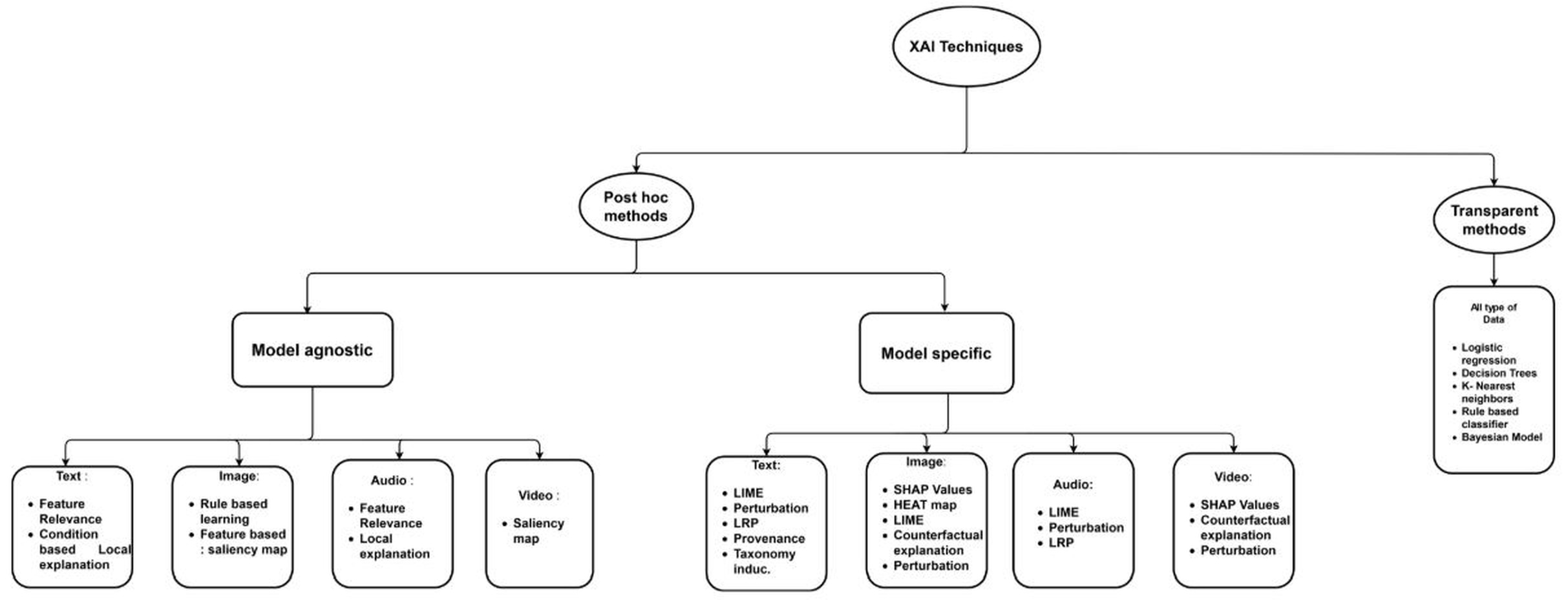
This diagram illustrates a hierarchical classification of Explainable Artificial Intelligence (XAI) techniques. The techniques are categorized based on whether they are "Post hoc methods" or "Transparent methods," and further subdivided by their applicability (model agnostic vs. model specific) and data type (Text, Image, Audio, Video).
### Components/Axes
The diagram is structured as a tree diagram, branching from a central title "XAI Techniques". The main branches are "Post hoc methods" and "Transparent methods". "Post hoc methods" further branches into "Model agnostic" and "Model specific". Each of these branches then subdivides based on data type: Text, Image, Audio, and Video.
### Detailed Analysis or Content Details
**1. XAI Techniques (Top Level)**
- Title: "XAI Techniques" - positioned at the very top center.
**2. Post hoc methods**
- Branching from the top center.
- Sub-branches: "Model agnostic" and "Model specific".
**3. Transparent methods**
- Branching from the top right.
- Sub-branch: "All type of Data"
**4. Model agnostic**
- Positioned to the left of "Model specific".
- Data type sub-branches:
- **Text:**
- Feature Relevance
- Condition based explanation
- Local explanation
- **Image:**
- Rule based learning
- Feature based saliency map
- **Audio:**
- Feature Relevance
- Local explanation
- **Video:**
- Saliency map
**5. Model specific**
- Positioned to the right of "Model agnostic".
- Data type sub-branches:
- **Text:**
- LIME
- Perturbation
- LRP
- Provenance
- Taxonomy induc.
- **Image:**
- SHAP Values
- HEAT map
- LIME
- Counterfactual explanation
- Perturbation
- **Audio:**
- LIME
- Perturbation
- LRP
- **Video:**
- SHAP Values
- Counterfactual explanation
- Perturbation
**6. Transparent methods**
- Positioned on the right side of the diagram.
- Data type sub-branch: "All type of Data"
- Logistic regression
- Decision Trees
- K-Nearest neighbors
- Rule based classifier
- Bayesian Model
### Key Observations
- The diagram clearly distinguishes between methods applied *after* model training ("Post hoc") and methods that are inherently interpretable due to their structure ("Transparent").
- "Model agnostic" methods can be applied to any model, while "Model specific" methods are tailored to particular model architectures.
- The variety of techniques available differs across data types, with Text and Image having the most extensive lists.
- LIME, Perturbation, and LRP appear in multiple branches, suggesting their versatility across different data types.
### Interpretation
The diagram provides a useful overview of the landscape of XAI techniques. It highlights the trade-offs between model flexibility (agnostic vs. specific) and interpretability (post hoc vs. transparent). The categorization by data type is practical, as the best XAI approach often depends on the nature of the data being analyzed. The repetition of certain techniques (LIME, Perturbation, LRP) suggests they are foundational methods with broad applicability. The diagram suggests that while transparent methods are available, they are limited to certain model types, making post-hoc methods crucial for understanding complex, black-box models. The diagram does not provide any quantitative data or performance metrics; it is purely a structural classification.