## Diagram Type: Flowchart
### Overview
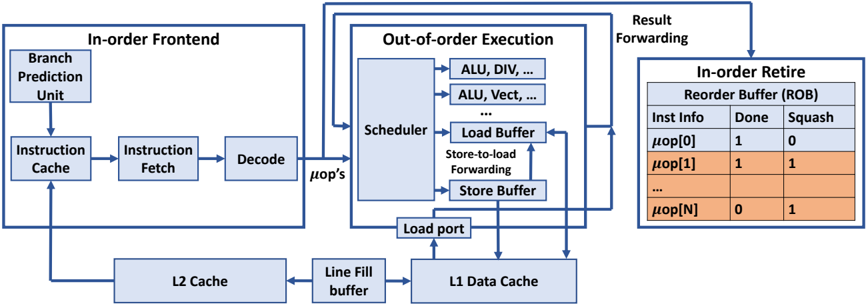
The image is a flowchart that illustrates the architecture of a computer processor. It shows the different components and their interactions within the processor, including the instruction cache, L2 cache, L1 data cache, load port, scheduler, reorder buffer (ROB), and ALU (Arithmetic Logic Unit).
### Components/Axes
- **In-order Frontend**: This section includes the branch prediction unit, instruction cache, instruction fetch, decode, and L2 cache.
- **Out-of-order Execution**: This section includes the scheduler, ALU, vector, load buffer, store-to-load forwarding, store buffer, load port, and L1 data cache.
- **In-order Retire**: This section includes the reorder buffer (ROB) and a table that shows the status of instructions (μop[0], μop[1], ..., μop[N]) with columns for "Done" and "Squash".
### Detailed Analysis or ### Content Details
The flowchart shows the flow of instructions from the instruction cache to the L2 cache, then to the L1 data cache. The scheduler manages the execution of instructions, and the reorder buffer (ROB) keeps track of the order in which instructions were issued. The ALU performs arithmetic and logical operations on the data.
### Key Observations
- The branch prediction unit predicts the outcome of branch instructions to improve performance.
- The instruction fetch and decode stages prepare the instructions for execution.
- The scheduler manages the execution of instructions in the correct order.
- The reorder buffer (ROB) ensures that instructions are executed in the correct order.
- The ALU performs the necessary calculations.
### Interpretation
The flowchart demonstrates the architecture of a modern computer processor, including the different components and their interactions. The branch prediction unit and instruction fetch and decode stages are crucial for improving performance by predicting and preparing instructions for execution. The scheduler and reorder buffer (ROB) ensure that instructions are executed in the correct order, and the ALU performs the necessary calculations. The diagram provides a clear understanding of the processor's architecture and how it works.