## Diagram: Kernel State Merging and Consolidation
### Overview
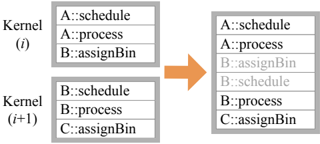
This image is a diagram illustrating the process of merging or consolidating operations/states from two sequential kernel versions, labeled "Kernel (i)" and "Kernel (i+1)", into a single, combined list. The diagram highlights which operations remain active (black text) and which are potentially superseded or inactive (light gray text) in the merged view.
### Components/Axes
The diagram consists of three main rectangular blocks, each containing a list of text entries, and a large orange arrow connecting the left-side blocks to the right-side block.
* **Left-Top Block:** Labeled "Kernel (i)" on its left side.
* It contains three lines of black text:
* "A::schedule"
* "A::process"
* "B::assignBin"
* **Left-Bottom Block:** Labeled "Kernel (i+1)" on its left side, positioned directly below the "Kernel (i)" block.
* It contains three lines of black text:
* "B::schedule"
* "B::process"
* "C::assignBin"
* **Central Arrow:** A thick, right-pointing orange arrow is positioned to the right of the two "Kernel" blocks, indicating a transformation or merging process.
* **Right Block:** A single, larger rectangular block positioned to the right of the arrow. This block represents the result of the merging process.
* It contains six lines of text, some in black and some in light gray:
* "A::schedule" (black text)
* "A::process" (black text)
* "B::assignBin" (light gray text)
* "B::schedule" (light gray text)
* "B::process" (black text)
* "C::assignBin" (black text)
### Detailed Analysis
The diagram visually represents a consolidation of operations or states from two distinct kernel versions.
1. **Kernel (i) Operations:** The first kernel version includes operations related to components 'A' and 'B'. Specifically, it lists "A::schedule", "A::process", and "B::assignBin".
2. **Kernel (i+1) Operations:** The subsequent kernel version includes operations related to components 'B' and 'C'. Specifically, it lists "B::schedule", "B::process", and "C::assignBin".
3. **Merged List:** The orange arrow signifies a process that combines the operations from "Kernel (i)" and "Kernel (i+1)" into a single, ordered list in the right block. The order of items in the merged list appears to be a direct concatenation, with all items from "Kernel (i)" listed first, followed by all items from "Kernel (i+1)".
* The first two items, "A::schedule" and "A::process", originate from "Kernel (i)" and are displayed in black text.
* The third item, "B::assignBin", also originates from "Kernel (i)" but is displayed in light gray text.
* The fourth item, "B::schedule", originates from "Kernel (i+1)" and is displayed in light gray text.
* The fifth item, "B::process", originates from "Kernel (i+1)" and is displayed in black text.
* The sixth item, "C::assignBin", originates from "Kernel (i+1)" and is displayed in black text.
### Key Observations
* The right block is a union of all unique operations/states present in both Kernel (i) and Kernel (i+1).
* The ordering in the merged list is sequential: all items from Kernel (i) first, then all items from Kernel (i+1).
* The use of light gray text for some entries in the merged list is a key visual cue, indicating a distinction from the black text entries.
* For component 'A', operations "A::schedule" and "A::process" are present only in Kernel (i) and appear in black in the merged list.
* For component 'C', operation "C::assignBin" is present only in Kernel (i+1) and appears in black in the merged list.
* For component 'B', operations are present in both kernels: "B::assignBin" in Kernel (i), and "B::schedule" and "B::process" in Kernel (i+1). In the merged list, "B::assignBin" (from Kernel (i)) and "B::schedule" (from Kernel (i+1)) are gray, while "B::process" (from Kernel (i+1)) is black.
### Interpretation
This diagram likely illustrates a mechanism for managing or tracking operations/states across different versions or iterations of a system, possibly within a kernel or a software component.
The graying out of certain entries in the merged list suggests that these operations or states are either:
1. **Superseded/Inactive:** They are present in the historical record (Kernel (i)) or even the current kernel (Kernel (i+1)), but are no longer the primary or active state for that component in the combined, current view. For instance, "B::assignBin" from Kernel (i) is gray, implying it's superseded by a newer 'B' operation.
2. **Less Significant/Intermediate:** In the case of component 'B', both "B::schedule" and "B::process" are from Kernel (i+1). "B::schedule" is gray, while "B::process" is black. This could imply that "B::process" represents the final or most critical state/operation for component 'B' in Kernel (i+1), while "B::schedule" might be an intermediate step or a less active aspect.
3. **Historical Context:** The merged list provides a comprehensive view of all operations, with the gray text serving to differentiate between currently active/primary operations and those that are historical or less relevant in the current consolidated context.
The overall process demonstrates how a system might maintain a consolidated view of its components' states or operations across iterations, distinguishing between what is currently active and what has been superseded or is of secondary importance. This could be relevant in areas like dependency management, state tracking in concurrent systems, or version control for system components. The diagram effectively communicates a transition or consolidation logic where the most recent and active states are prioritized (black text), while older or less active states are retained for context but visually de-emphasized (gray text).