## Diagram: Kernel Task Scheduling
### Overview
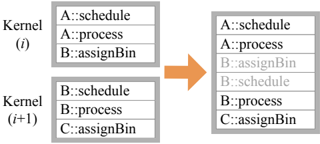
The image illustrates a change in task scheduling between two kernel iterations, labeled `Kernel (i)` and `Kernel (i+1)`. An orange arrow indicates the transition from the initial state to the final state, where some tasks are removed and others are added or remain.
### Components/Axes
* **Kernel (i):** Represents the initial state of the kernel.
* Tasks:
* `A::schedule`
* `A::process`
* `B::assignBin`
* **Kernel (i+1):** Represents the subsequent state of the kernel.
* Tasks:
* `B::schedule`
* `B::process`
* `C::assignBin`
* **Transition Arrow:** An orange arrow pointing from the initial kernel states to the final kernel state, indicating the change in task scheduling.
* **Final State:** Represents the combined tasks from both kernels, with some tasks grayed out, indicating they are no longer active.
* Tasks:
* `A::schedule`
* `A::process`
* `B::assignBin`
* `B::schedule`
* `B::process`
* `C::assignBin`
### Detailed Analysis
The diagram shows the tasks present in `Kernel (i)` and `Kernel (i+1)` and how they are represented in the final state after the transition.
* **Kernel (i):** Contains tasks `A::schedule`, `A::process`, and `B::assignBin`.
* **Kernel (i+1):** Contains tasks `B::schedule`, `B::process`, and `C::assignBin`.
* **Final State:**
* `A::schedule` and `A::process` from `Kernel (i)` are present but grayed out, indicating they are no longer active.
* `B::assignBin` from `Kernel (i)` is also grayed out.
* `B::process` and `C::assignBin` from `Kernel (i+1)` are present and active.
* `B::schedule` from `Kernel (i+1)` is present but grayed out.
### Key Observations
* Tasks `A::schedule`, `A::process`, and `B::assignBin` are present in `Kernel (i)` but are inactive in the final state.
* Tasks `B::schedule`, `B::process`, and `C::assignBin` are present in `Kernel (i+1)`, with `B::process` and `C::assignBin` remaining active in the final state.
* The final state represents a combination of tasks from both kernel iterations, with some tasks being deactivated.
### Interpretation
The diagram illustrates a task scheduling change between two kernel iterations. The transition shows that certain tasks from the initial kernel (`Kernel (i)`) are no longer active in the final state, while tasks from the subsequent kernel (`Kernel (i+1)`) become active. This suggests a dynamic task scheduling mechanism where tasks are added, removed, or remain active based on the kernel iteration. The grayed-out tasks in the final state indicate that these tasks were present in the initial state but are no longer relevant or have been completed in the subsequent state.