\n
## Line Chart: Accuracy vs. Number of Solutions
### Overview
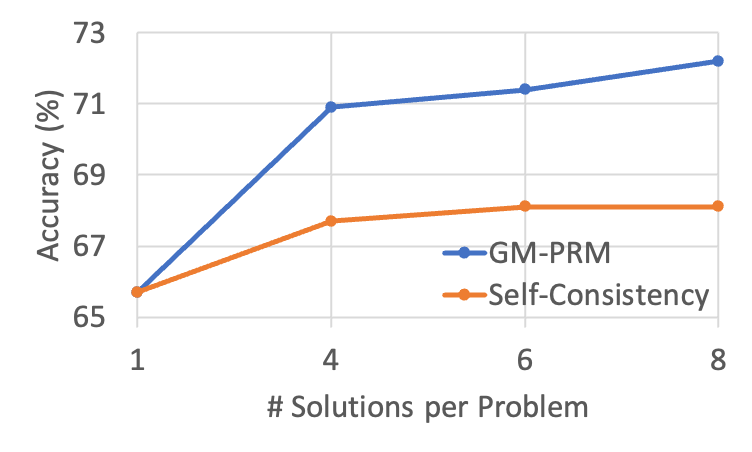
This line chart depicts the relationship between the number of solutions generated per problem and the resulting accuracy for two different methods: GM-PRM and Self-Consistency. The chart shows how accuracy changes as the number of solutions increases.
### Components/Axes
* **X-axis:** "# Solutions per Problem" with markers at 1, 4, 6, and 8.
* **Y-axis:** "Accuracy (%)" with a scale ranging from 65 to 73.
* **Data Series 1:** GM-PRM (represented by a blue line with circular markers).
* **Data Series 2:** Self-Consistency (represented by an orange line with circular markers).
* **Legend:** Located in the top-right corner, associating colors with the methods.
### Detailed Analysis
**GM-PRM (Blue Line):**
The GM-PRM line slopes upward, indicating increasing accuracy with more solutions.
* At 1 solution, accuracy is approximately 66%.
* At 4 solutions, accuracy jumps to approximately 71%.
* At 6 solutions, accuracy is approximately 71.5%.
* At 8 solutions, accuracy reaches approximately 72.5%.
**Self-Consistency (Orange Line):**
The Self-Consistency line shows a slight upward trend, but is much flatter than the GM-PRM line.
* At 1 solution, accuracy is approximately 66%.
* At 4 solutions, accuracy increases to approximately 68%.
* At 6 solutions, accuracy remains around 68%.
* At 8 solutions, accuracy is approximately 68%.
### Key Observations
* GM-PRM consistently outperforms Self-Consistency across all numbers of solutions.
* The accuracy improvement for GM-PRM is most significant between 1 and 4 solutions. After 4 solutions, the gains diminish.
* Self-Consistency shows minimal improvement in accuracy as the number of solutions increases.
* Both methods start with similar accuracy at 1 solution.
### Interpretation
The data suggests that the GM-PRM method benefits significantly from generating multiple solutions per problem, with the largest gains observed when increasing from 1 to 4 solutions. This indicates that exploring a wider solution space improves the accuracy of GM-PRM. In contrast, the Self-Consistency method appears to be less sensitive to the number of solutions generated, suggesting that its performance plateaus quickly. This could be due to the inherent limitations of the Self-Consistency approach or the specific problem domain being evaluated. The difference in performance between the two methods highlights the importance of solution diversity and exploration in achieving higher accuracy. The diminishing returns of GM-PRM after 4 solutions suggest an optimal point beyond which additional solutions do not contribute significantly to accuracy gains.