## Fact-Check Analysis: Saltwater Solution for Insect Pests & Contact Tracing in Schools
### Overview
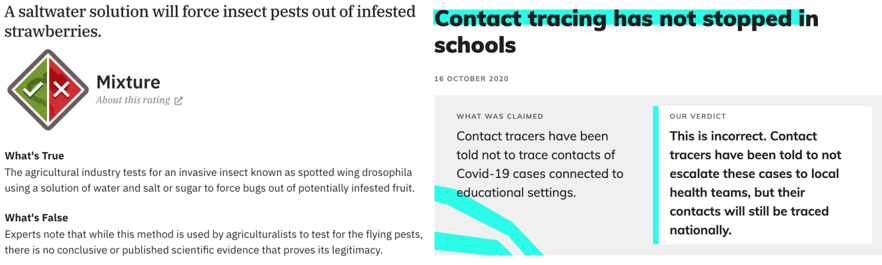
The image presents two separate fact-checking analyses. The first examines the claim that a saltwater solution will force insect pests out of infested strawberries, rating it as a "Mixture." The second addresses the claim that contact tracing has stopped in schools, labeling it as incorrect.
### Components/Axes
**Left Side: Saltwater Solution Fact-Check**
* **Claim:** "A saltwater solution will force insect pests out of infested strawberries."
* **Rating:** "Mixture" - Indicated by a combined green checkmark and red "X" icon.
* **"What's True":** The agricultural industry uses saltwater or sugar solutions to test for spotted wing drosophila in fruit.
* **"What's False":** There is no conclusive scientific evidence proving the method's legitimacy.
**Right Side: Contact Tracing Fact-Check**
* **Headline:** "Contact tracing has not stopped in schools"
* **Date:** 16 OCTOBER 2020
* **"WHAT WAS CLAIMED":** "Contact tracers have been told not to trace contacts of Covid-19 cases connected to educational settings."
* **"OUR VERDICT":** "This is incorrect. Contact tracers have been told to not escalate these cases to local health teams, but their contacts will still be traced nationally."
### Detailed Analysis or Content Details
**Saltwater Solution Fact-Check:**
* The "Mixture" rating suggests that the claim has elements of both truth and falsehood.
* The "What's True" section confirms the practice exists.
* The "What's False" section highlights the lack of scientific validation.
**Contact Tracing Fact-Check:**
* The headline asserts that contact tracing continues in schools.
* The "WHAT WAS CLAIMED" section presents the opposing argument.
* The "OUR VERDICT" section refutes the claim, clarifying that contact tracing continues nationally, even if local escalation is limited.
### Key Observations
* The image presents two distinct fact-checking scenarios.
* The saltwater solution claim is nuanced, acknowledged as a practice but lacking scientific proof.
* The contact tracing claim is directly refuted, with clarification provided.
### Interpretation
The image illustrates the process of fact-checking, where claims are investigated and assessed for accuracy. The "Mixture" rating for the saltwater solution highlights the complexity of some claims, where partial truth exists alongside a lack of conclusive evidence. The contact tracing fact-check demonstrates the importance of clarifying information to prevent misinterpretations, emphasizing that while local escalation may be limited, national contact tracing efforts continue.