\n
## Illustration: Historical Sailing Ship
### Overview
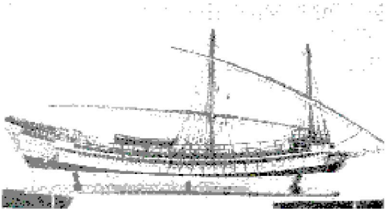
The image is a black and white illustration of a historical sailing ship, viewed from the port side. The style is reminiscent of a technical drawing or engraving. There are no axes, legends, or numerical data present. The image primarily serves as a visual representation of the ship's design.
### Components/Axes
There are no axes or legends. The image depicts the following components:
* **Hull:** The main body of the ship, elongated and curved.
* **Masts:** Three vertical structures supporting the sails.
* **Sails:** Represented as shaded areas between the masts.
* **Deck:** The horizontal surface of the ship.
* **Railing:** A barrier along the edge of the deck.
* **Stern:** The rear of the ship.
* **Bow:** The front of the ship.
### Detailed Analysis or Content Details
The ship appears to be a galleon or a similar type of sailing vessel from the 16th or 17th century. The ship is approximately 5 times longer than it is tall. The masts are of varying heights, with the main mast being the tallest. The sails are partially unfurled, suggesting the ship is underway or preparing to sail. The hull is relatively narrow and streamlined. The illustration does not provide any specific dimensions or details about the ship's construction.
There is text at the bottom of the image, which is partially obscured and difficult to read. It appears to say: "Fig. 3. Side view of a Spanish Galleon."
### Key Observations
The image is a simplified representation of a complex vessel. The lack of detail suggests it is intended as a general illustration rather than a precise technical drawing. The ship's design is characteristic of the era of exploration and trade.
### Interpretation
The image likely serves as an illustrative example of a Spanish Galleon, a type of ship commonly used during the Age of Exploration. Galleons were known for their combination of speed and cargo capacity, making them ideal for long-distance voyages. The illustration provides a visual understanding of the ship's basic structure and features. The text at the bottom confirms the ship's identity and purpose as a visual aid for understanding historical naval architecture. The image is a historical artifact in itself, providing insight into how ships were depicted and understood in the past. The lack of precise data suggests the image is intended for general educational or illustrative purposes rather than detailed technical analysis.