## Technical Diagram: Traditional Sailing Ship
### Overview
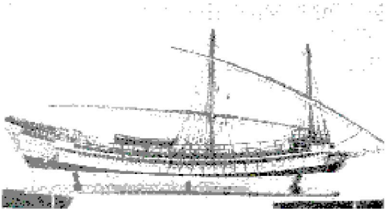
The image is a black-and-white line drawing of a traditional sailing ship, depicted in profile view. It emphasizes the ship's structural components, including the hull, masts, sails, deck, and rigging. No textual labels, legends, or numerical data are present.
### Components/Axes
- **Hull**: The elongated, tapered body of the ship, shown with a central keel and side planking.
- **Masts**: Two vertical masts are positioned along the ship's centerline, with rigging lines connecting them to the hull.
- **Sails**: Multiple triangular sails are attached to the masts, with lines extending to the deck for control.
- **Deck**: A flat surface spanning the ship's width, with a small cabin structure near the stern.
- **Rigging**: Horizontal and diagonal lines connecting masts to the hull, indicating structural support.
### Detailed Analysis
- **Hull**: The hull is divided into sections by horizontal lines, suggesting deck levels or structural reinforcement.
- **Masts**: The masts are evenly spaced, with the main mast slightly taller than the foremast.
- **Sails**: Sails are depicted with dotted lines, possibly indicating furling mechanisms or sail folds.
- **Rigging**: Rigging lines are shown in parallel and crisscross patterns, emphasizing their role in stabilizing the masts.
### Key Observations
- The ship's design prioritizes symmetry, with masts and sails evenly distributed along the centerline.
- No text, scale, or annotations are present to provide context (e.g., ship name, dimensions, or historical period).
- The absence of color or shading limits interpretation of material properties (e.g., wood grain, sail fabric).
### Interpretation
This diagram likely serves an educational or engineering purpose, illustrating the basic anatomy of a traditional sailing vessel. The lack of textual details suggests it may be a schematic for instructional use, focusing on structural relationships rather than specific historical or operational data. The simplicity of the line drawing implies it could be used to teach principles of naval architecture or sailing mechanics.
## Notes
- **Language**: English (no non-English text detected).
- **Data Absence**: No numerical values, trends, or categorical data present.
- **Spatial Grounding**: All elements are centered in the image, with no legends or axis markers to indicate spatial relationships beyond the ship's own structure.