## Diagram: Continual Learning Methods Hierarchy
### Overview
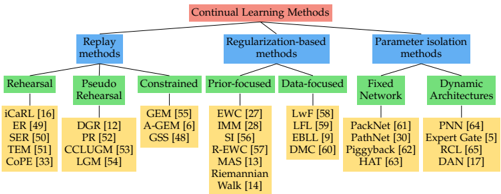
The image presents a hierarchical diagram illustrating different categories and subcategories of continual learning methods. The diagram starts with the broad category "Continual Learning Methods" at the top and branches down into various sub-methods, each represented by colored boxes.
### Components/Axes
* **Top-Level Category:** "Continual Learning Methods" (Red box)
* **Second-Level Categories:**
* "Replay methods" (Blue box)
* "Regularization-based methods" (Blue box)
* "Parameter isolation methods" (Blue box)
* **Third-Level Categories (under "Replay methods"):**
* "Rehearsal" (Green box)
* "Pseudo Rehearsal" (Green box)
* "Constrained" (Green box)
* **Third-Level Categories (under "Regularization-based methods"):**
* "Prior-focused" (Green box)
* "Data-focused" (Green box)
* **Third-Level Categories (under "Parameter isolation methods"):**
* "Fixed Network" (Green box)
* "Dynamic Architectures" (Green box)
* **Fourth-Level Categories:** Each third-level category has a list of specific methods associated with it, enclosed in yellow boxes. Each method is followed by a bracketed number, presumably a citation or reference number.
### Detailed Analysis
* **Replay methods:**
* **Rehearsal:**
* iCaRL [16]
* ER [49]
* SER [50]
* TEM [51]
* CoPE [33]
* **Pseudo Rehearsal:**
* DGR [12]
* PR [52]
* CCLUGM [53]
* LGM [54]
* **Constrained:**
* GEM [55]
* A-GEM [6]
* GSS [48]
* **Regularization-based methods:**
* **Prior-focused:**
* EWC [27]
* IMM [28]
* SI [56]
* R-EWC [57]
* MAS [13]
* Riemannian Walk [14]
* **Data-focused:**
* LwF [58]
* LFL [59]
* EBLL [9]
* DMC [60]
* **Parameter isolation methods:**
* **Fixed Network:**
* PackNet [61]
* PathNet [30]
* Piggyback [62]
* HAT [63]
* **Dynamic Architectures:**
* PNN [64]
* Expert Gate [5]
* RCL [65]
* DAN [17]
### Key Observations
* The diagram is structured as a tree, with the root node being "Continual Learning Methods."
* Each branch represents a different approach to continual learning.
* The yellow boxes list specific algorithms or techniques within each sub-category.
* The numbers in brackets likely refer to citations or references in a related document.
### Interpretation
The diagram provides a taxonomy of continual learning methods, categorizing them based on their underlying principles. "Replay methods" involve replaying past experiences, "Regularization-based methods" use regularization techniques to prevent forgetting, and "Parameter isolation methods" isolate parameters to avoid interference between tasks. The diagram is useful for understanding the landscape of continual learning research and identifying specific methods within each category. The citation numbers suggest that this diagram is part of a larger research paper or survey.