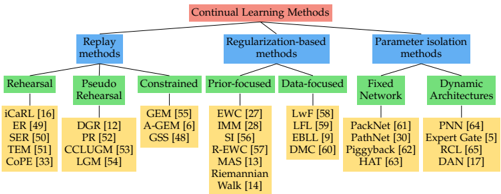
## Diagram: Taxonomy of Continual Learning Methods
### Overview
The image is a hierarchical tree diagram that categorizes various approaches to "Continual Learning Methods." The diagram is structured top-down, starting from a central root node and branching into three primary categories, which are further subdivided into specific sub-categories and lists of associated algorithms, each accompanied by a citation index.
### Components/Axes
The diagram uses a consistent color-coding scheme to denote the hierarchy:
* **Red Box (Top):** The root category ("Continual Learning Methods").
* **Blue Boxes (Level 1):** The three primary methodological categories.
* **Green Boxes (Level 2):** Sub-categories within each primary category.
* **Yellow Boxes (Level 3):** Specific algorithms or methods, with citation numbers in square brackets.
### Detailed Analysis
#### Branch 1: Replay methods (Blue, Left)
This branch is divided into three sub-categories (Green):
* **Rehearsal:**
* iCaRL [16]
* ER [49]
* SER [50]
* TEM [51]
* CoPE [33]
* **Pseudo Rehearsal:**
* DGR [12]
* PR [52]
* CCLUGM [53]
* LGM [54]
* **Constrained:**
* GEM [55]
* A-GEM [6]
* GSS [48]
#### Branch 2: Regularization-based methods (Blue, Center)
This branch is divided into two sub-categories (Green):
* **Prior-focused:**
* EWC [27]
* IMM [28]
* SI [56]
* R-EWC [57]
* MAS [13]
* Riemannian Walk [14]
* **Data-focused:**
* LwF [58]
* LFL [59]
* EBLL [9]
* DMC [60]
#### Branch 3: Parameter isolation methods (Blue, Right)
This branch is divided into two sub-categories (Green):
* **Fixed Network:**
* PackNet [61]
* PathNet [30]
* Piggyback [62]
* HAT [63]
* **Dynamic Architectures:**
* PNN [64]
* Expert Gate [5]
* RCL [65]
* DAN [17]
### Key Observations
* **Structural Balance:** The diagram is relatively balanced, with three primary branches. Replay methods contain the most sub-categories (three), while the others contain two each.
* **Citation Density:** The citation numbers (e.g., [16], [55], [64]) indicate that this diagram is likely derived from a comprehensive survey or review paper on the state of continual learning research.
* **Categorization Logic:** The taxonomy groups methods based on their fundamental strategy for mitigating catastrophic forgetting:
* *Replay:* Storing or generating past data.
* *Regularization:* Modifying the loss function to protect important weights.
* *Parameter Isolation:* Dedicating specific network parameters to specific tasks.
### Interpretation
This diagram serves as a high-level roadmap for the field of Continual Learning (also known as Lifelong Learning). It demonstrates that the field is not monolithic but rather divided into three distinct philosophical approaches to solving the problem of "catastrophic forgetting"—where a neural network loses previously learned information when trained on new data.
* **Replay methods** are generally the most intuitive, attempting to keep the model "reminded" of past data either by storing raw samples (Rehearsal) or generating synthetic data (Pseudo Rehearsal).
* **Regularization-based methods** are mathematically driven, attempting to constrain the optimization process so that new learning does not drastically alter the weights that were critical for previous tasks.
* **Parameter isolation methods** are structural, attempting to physically partition the neural network so that different tasks do not interfere with one another.
The inclusion of specific algorithms like EWC (Elastic Weight Consolidation) and iCaRL (Incremental Classifier and Representation Learning) confirms this is a standard academic taxonomy used to classify modern deep learning research.