## Diagram: Task Generalization and Transformations
### Overview
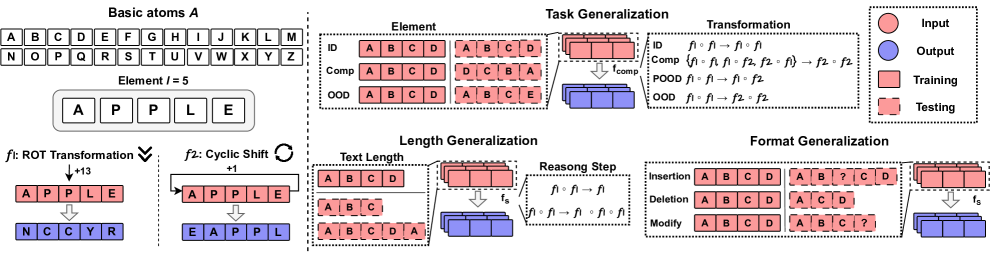
The image presents a diagram illustrating different types of generalization and transformations applied to a basic set of elements. It shows how a sequence of letters (e.g., "APPLE") can be transformed using operations like ROT transformation and cyclic shift, and how these transformations are generalized across tasks, lengths, and formats. The diagram uses color-coding to distinguish between input, output, training, and testing data.
### Components/Axes
* **Basic atoms A:** A set of letters from A to Z.
* **Element l = 5:** An example element "APPLE" with a length of 5.
* **f1: ROT Transformation +13:** A transformation that rotates each letter by 13 positions in the alphabet.
* **f2: Cyclic Shift +1:** A transformation that shifts each letter by 1 position in the alphabet.
* **Element:** Shows ID, Comp, and OOD (Out-of-Distribution) examples of the element "ABCD".
* **Task Generalization:** Generalization of tasks using ID, Comp, POOD, and OOD examples.
* **Transformation:** Shows the transformations applied to ID, Comp, POOD, and OOD.
* **Length Generalization:** Generalization based on text length.
* **Format Generalization:** Generalization based on format, including insertion, deletion, and modification.
* **Legend:**
* Red circle: Input
* Blue circle: Output
* Red rectangle: Training
* Dashed red rectangle: Testing
### Detailed Analysis
**1. Basic Atoms and Element Transformations:**
* The diagram starts with a set of basic atoms, the letters A through Z.
* An example element "APPLE" of length 5 is given.
* Two transformations are applied to "APPLE":
* **f1: ROT Transformation +13:** "APPLE" becomes "NCCYR".
* **f2: Cyclic Shift +1:** "APPLE" becomes "EAPPL".
**2. Element Examples:**
* **ID:** The element "ABCD" is shown.
* **Comp:** The element "ABCD" is shown.
* **OOD:** The element "ABCD" is shown.
**3. Task Generalization:**
* The diagram shows how tasks are generalized using ID, Comp, POOD, and OOD examples.
* The input data (red rectangles) is transformed into output data (blue rectangles) using a function *fcomp*.
* The transformations are:
* ID: f1 o f1 -> f1
* Comp: {f1 o f1 -> f2, f2 o f2 o f1} -> f2 o f2
* POOD: f1 o f1 -> f2
* OOD: f1 o f1 -> f2
**4. Length Generalization:**
* The diagram shows how the length of the text is generalized.
* Examples of text lengths are "ABCD", "ABC", and "ABCDA".
* The input data (red rectangles) is transformed into output data (blue rectangles) using a function *fs*.
* The reasoning step is f1 o f1 -> f1 and f1 o f1 -> f1 o f1 o f1.
**5. Format Generalization:**
* The diagram shows how the format of the text is generalized.
* Examples of format generalizations are insertion, deletion, and modification.
* The input data (red rectangles) is transformed into output data (blue rectangles) using a function *fs*.
* Insertion: "ABCD" -> "AB?CD"
* Deletion: "ABCD" -> "ACD"
* Modify: "ABC?" -> "ABC?"
### Key Observations
* The diagram uses color-coding to clearly distinguish between input, output, training, and testing data.
* The transformations are applied to the elements to generate new elements.
* The diagram shows how the transformations are generalized across tasks, lengths, and formats.
### Interpretation
The diagram illustrates a system for generalizing transformations on sequences of letters. It demonstrates how simple transformations (ROT, Cyclic Shift) can be applied and then generalized across different tasks, text lengths, and formats. The use of ID, Comp, POOD, and OOD examples suggests a focus on handling both in-distribution and out-of-distribution scenarios. The functions *fcomp* and *fs* represent the underlying mechanisms for these generalizations. The diagram highlights the importance of considering different aspects of generalization when designing systems that operate on sequential data.