## Diagram: Conceptual Framework for Generalization in Sequence Transformation
### Overview
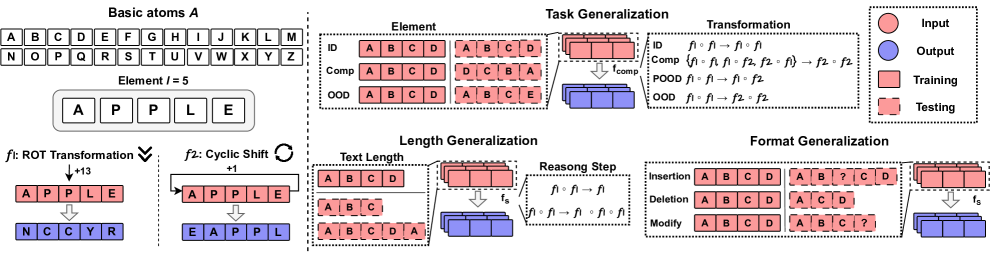
The image presents a structured conceptual framework for evaluating the generalization capabilities of a system (likely an AI model or algorithmic processor) regarding sequence transformation tasks. It defines foundational "atoms" and transformation functions, then categorizes generalization into three distinct domains: **Task Generalization**, **Length Generalization**, and **Format Generalization**. The diagram utilizes a color-coded legend to distinguish between input/output data and training/testing sets.
### Components/Axes
**Legend (Top Right):**
* **Red Circle:** Input
* **Blue Circle:** Output
* **Solid Red Box:** Training
* **Dashed Red Box:** Testing
**Foundational Elements (Left Column):**
* **Basic atoms A:** A grid containing the alphabet from A to Z.
* **Element l = 5:** A sequence of 5 boxes containing the letters "A P P L E".
* **$f1$: ROT Transformation:** A transformation function denoted by a double-check icon. It applies a "+13" shift to the input "A P P L E" (red), resulting in "N C C Y R" (blue).
* **$f2$: Cyclic Shift:** A transformation function denoted by a circular arrow icon. It applies a "+1" shift to the input "A P P L E" (red), resulting in "E A P P L" (blue).
### Detailed Analysis
#### 1. Task Generalization (Top Right)
This section evaluates how the system handles different types of task distributions.
**Element Table:**
| Category | Input | Output |
| :--- | :--- | :--- |
| **ID (In-Distribution)** | "A B C D" (solid red) | "A B C D" (solid red) |
| **Comp (Compositional)** | "A B C D" (solid red) | "D C B A" (dashed red) |
| **OOD (Out-of-Distribution)** | "A B C D" (solid red) | "A B C E" (dashed red) |
**Transformation Table:**
| Category | Transformation Logic |
| :--- | :--- |
| **ID** | $f1 \circ f1 \rightarrow f1 \circ f1$ |
| **Comp** | $\{f1 \circ f1 \circ f2, f2 \circ f2\} \rightarrow f2 \circ f2$ |
| **POOD** | $f1 \circ f1 \rightarrow f1 \circ f2$ |
| **OOD** | $f1 \circ f1 \rightarrow f2 \circ f2$ |
* **Visual Flow:** A set of red boxes (Training) is processed via $f_{comp}$ to produce blue boxes (Output).
#### 2. Length Generalization (Bottom Center)
This section evaluates the system's ability to handle sequences of varying lengths.
* **Text Length:**
* Input "A B C D" (solid red) is the base.
* Testing inputs include "A B C" (dashed red) and "A B C D A" (dashed red).
* **Reasoning Step:**
* $f1 \circ f1 \rightarrow f1$
* $f1 \circ f1 \rightarrow f1 \circ f1 \circ f1$
* **Visual Flow:** Red boxes (Training) are processed via $f_s$ to produce blue boxes (Output).
#### 3. Format Generalization (Bottom Right)
This section evaluates robustness against structural changes in the input.
* **Insertion:** Input "A B C D" (solid red) vs. Testing "A B ? C D" (dashed red).
* **Deletion:** Input "A B C D" (solid red) vs. Testing "A C D" (dashed red).
* **Modify:** Input "A B C D" (solid red) vs. Testing "A B C ?" (dashed red).
* **Visual Flow:** Red boxes (Training) are processed via $f_s$ to produce blue boxes (Output).
### Key Observations
* **Training vs. Testing:** The diagram consistently uses solid red boxes for training data and dashed red boxes for testing data, indicating a clear separation between seen and unseen scenarios.
* **Compositionality:** The "Task Generalization" section explicitly uses mathematical notation ($f1 \circ f1$) to represent the composition of functions, suggesting the system is being tested on its ability to combine learned operations.
* **OOD/POOD:** The inclusion of "POOD" (Presumably "Partial Out-of-Distribution") and "OOD" indicates a focus on systematic generalization—testing if the model can perform tasks that are structurally different from the training set.
### Interpretation
This diagram outlines a rigorous testing protocol for symbolic reasoning or sequence-to-sequence models.
* **Systematic Generalization:** The core intent is to determine if a model has learned the *underlying logic* (the functions $f1$ and $f2$) or if it has merely memorized specific input-output pairs. By testing on "Compositional" and "OOD" tasks, the framework probes whether the model can recombine known functions in novel ways.
* **Robustness:** The "Format Generalization" section is a stress test for input noise. It checks if the model's internal representation of the sequence is flexible enough to handle missing, inserted, or corrupted characters (the "?" symbol).
* **Peircean Investigative Perspective:** The diagram functions as a taxonomy of failure modes. By isolating Task, Length, and Format, the researchers can pinpoint exactly *where* a model fails. For example, if a model succeeds at "Task Generalization" but fails at "Length Generalization," it suggests the model has learned the logic but is overfitted to specific sequence lengths (a common issue in positional encoding in Transformers).