## Diagram: Computational Generalization Framework
### Overview
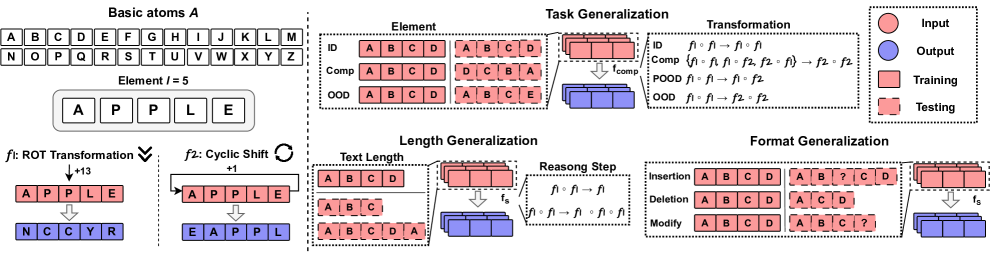
The diagram illustrates a framework for text element generalization, showcasing transformations, task adaptation, length handling, and format modifications. It uses color-coded blocks (red, blue, pink) to represent input, output, training, and testing phases, with arrows indicating data flow and transformations.
### Components/Axes
1. **Basic Atoms**:
- A 5x5 grid of uppercase letters (A-Z) labeled "Basic atoms A".
- Example element: "APPLE" split into individual letters (A, P, P, L, E).
2. **Transformations**:
- **f₁: ROT Transformation**: Shifts letters by +13 positions (e.g., A→N, P→C).
- **f₂: Cyclic Shift**: Rotates letters right by +1 position (e.g., APPLE→EAPPLE).
3. **Task Generalization**:
- Components: ID, Comp, POOD, OOD.
- Transformations:
- ID: `f₁ → f₁`
- Comp: `{f₁, f₁, f₁, f₁, f₂} → f₂`
- POOD: `f₁ → f₁`
- OOD: `f₁ → f₂`
4. **Length Generalization**:
- Text lengths: 5, 4, 5 characters.
- Example: "ABCD" → "ABCDA" via insertion.
5. **Format Generalization**:
- Operations: Insertion, Deletion, Modify.
- Example: "ABCD" → "ABC?D" (insertion of "?").
6. **Legend**:
- Red: Input
- Blue: Output
- Pink: Training (solid) / Testing (dashed)
### Detailed Analysis
- **Basic Atoms**: The 5x5 grid represents foundational text units (e.g., letters).
- **Transformations**:
- ROT13 (f₁) and cyclic shifts (f₂) alter letter positions.
- Example: "APPLE" → "NC CYR" (f₁) → "EAPPLE" (f₂).
- **Task Generalization**:
- Tasks (ID, Comp, POOD, OOD) apply transformations to generalize across domains.
- Comp task combines multiple f₁/f₂ operations.
- **Length Generalization**: Handles variable text lengths (e.g., 4→5 characters via insertion).
- **Format Generalization**: Modifies text structure (insertion, deletion, modification).
### Key Observations
- **Color Consistency**:
- Red blocks (Input) align with legend.
- Blue blocks (Output) match legend.
- Pink blocks: Solid (Training) and dashed (Testing) phases.
- **Flow Direction**: Arrows indicate sequential processing (e.g., Input → Training → Output).
- **Transformation Logic**:
- f₁ and f₂ are applied iteratively or combined (e.g., Comp task).
- OOD task shifts from f₁ to f₂, suggesting adaptation to new domains.
### Interpretation
The diagram demonstrates how a model generalizes text processing across tasks, lengths, and formats. Transformations (f₁, f₂) enable adaptability, while task generalization (ID, Comp, POOD, OOD) shows domain-specific adjustments. The Training/Testing phases (pink blocks) highlight evaluation strategies. The framework emphasizes modularity, with components like length and format generalization addressing specific challenges. The use of color coding and structured flow clarifies the relationship between input manipulation and output generation, suggesting a pipeline for robust text processing systems.