## Diagram: Diffractive Optical Neural Network (DONN) Architecture and Comparison with Electronic Neural Networks
### Overview
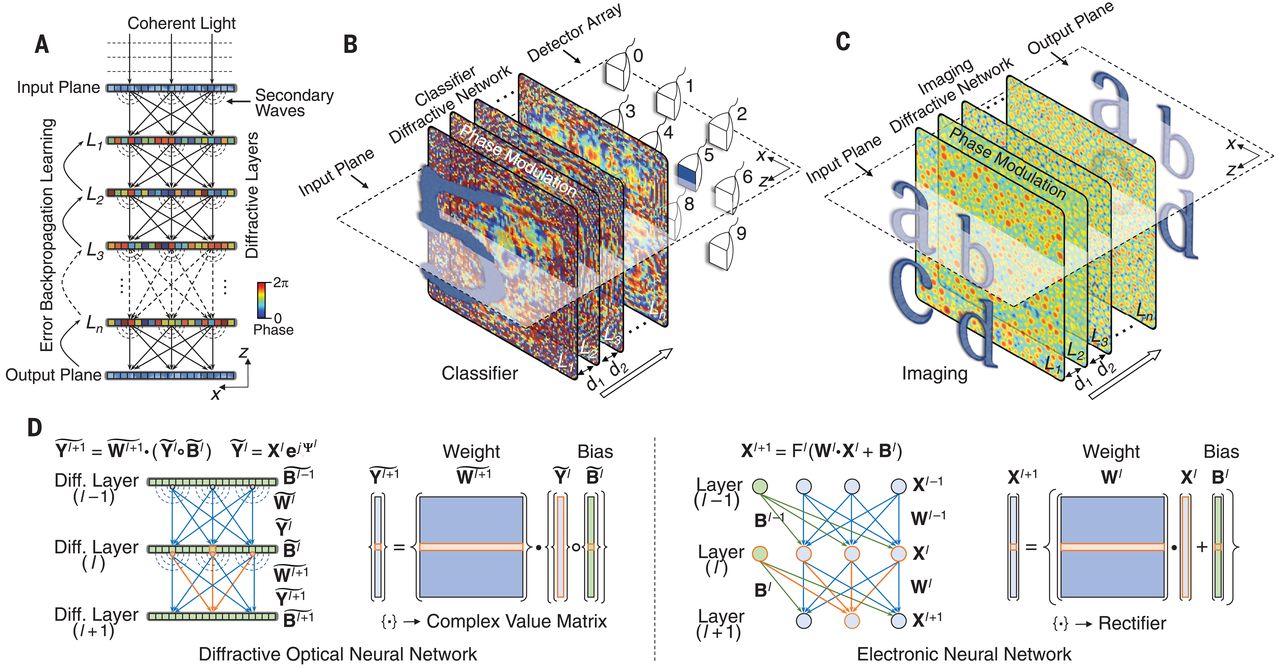
The image presents a technical breakdown of a diffractive optical neural network (DONN) architecture, its components, and a comparison with traditional electronic neural networks. It includes layered optical structures, mathematical formulations, and functional mappings between optical and electronic systems.
---
### Components/Axes
#### Section A: Coherent Light and Diffractive Layers
- **Input Plane**: Labeled as the starting point for coherent light.
- **Secondary Waves**: Represented by intersecting lines, indicating wave propagation.
- **Diffractive Layers (L₁ to Lₙ)**: Stacked layers with color-coded patterns (e.g., red, blue, green) to denote phase modulation.
- **Output Plane**: Final plane after light propagation through diffractive layers.
- **Error Backpropagation Learning**: Arrows indicate feedback loops for training the network.
- **Phase Representation**: Color gradient (0 to 2π) maps phase values to colors.
#### Section B: 3D DONN Structure
- **Input Plane**: Entry point for data.
- **Diffractive Network**: Composed of multiple layers with "Classifier" and "Detector Array" components.
- **Phase Modulation**: Colorful patterns (e.g., blue, red) represent phase shifts.
- **Detector Array**: 3D grid with coordinates (x, y, z) for spatial resolution.
- **Classifier**: Outputs processed data (e.g., labels like "a, b, c, d").
#### Section C: Imaging Network
- **Input Plane**: Data entry.
- **Imaging Network**: Includes "Phase Modulation" layers with green/yellow patterns.
- **Output Plane**: Final output with spatial coordinates (x', y', z').
- **Labels (a, b, c, d)**: Represent processed features or classes.
#### Section D: Mathematical Formulations
- **Diffractive Optical Neural Network (DONN)**:
- Equations:
- \( \tilde{Y}^{i+1} = W^{i+1} \cdot (\tilde{Y}^i \cdot \tilde{B}^i) \)
- \( \tilde{Y}^i = X^i / e^{j\phi^i} \)
- Components: Diffractive layers with weight matrices (\( W \)) and bias vectors (\( B \)).
- Operations: Complex value matrix multiplications and phase adjustments.
- **Electronic Neural Network**:
- Equations:
- \( X^{i+1} = F(W^i \cdot X^i + B^i) \)
- Components: Layers with weights (\( W \)), biases (\( B \)), and rectifiers.
- Operations: Rectified linear unit (ReLU) activation.
---
### Key Observations
1. **Layered Structure**: DONNs use diffractive layers (L₁ to Lₙ) to manipulate light phases, while electronic networks use sequential matrix operations.
2. **Phase Modulation**: Color gradients in Sections A and B correlate with phase values (0 to 2π), critical for light manipulation.
3. **Feedback Mechanism**: Error backpropagation in Section A suggests DONNs can be trained similarly to electronic networks.
4. **Mathematical Parallelism**: DONN equations mirror electronic network operations but use complex numbers and phase shifts instead of rectifiers.
---
### Interpretation
The diagram illustrates how DONNs leverage optical properties (e.g., diffraction, phase modulation) to process information, contrasting with electronic networks' reliance on electrical signals and rectifiers. Key insights:
- **Optical Efficiency**: DONNs may enable faster, energy-efficient computation by exploiting light's parallelism.
- **Training Similarity**: Error backpropagation in DONNs implies compatibility with standard machine learning frameworks.
- **Hybrid Potential**: The comparison in Section D highlights opportunities for integrating optical and electronic components in neuromorphic systems.
This architecture could revolutionize AI hardware by combining the speed of light with the precision of neural networks, though challenges in phase calibration and detector array design remain.