## Chart: Cost vs. Expected Usage Count
### Overview
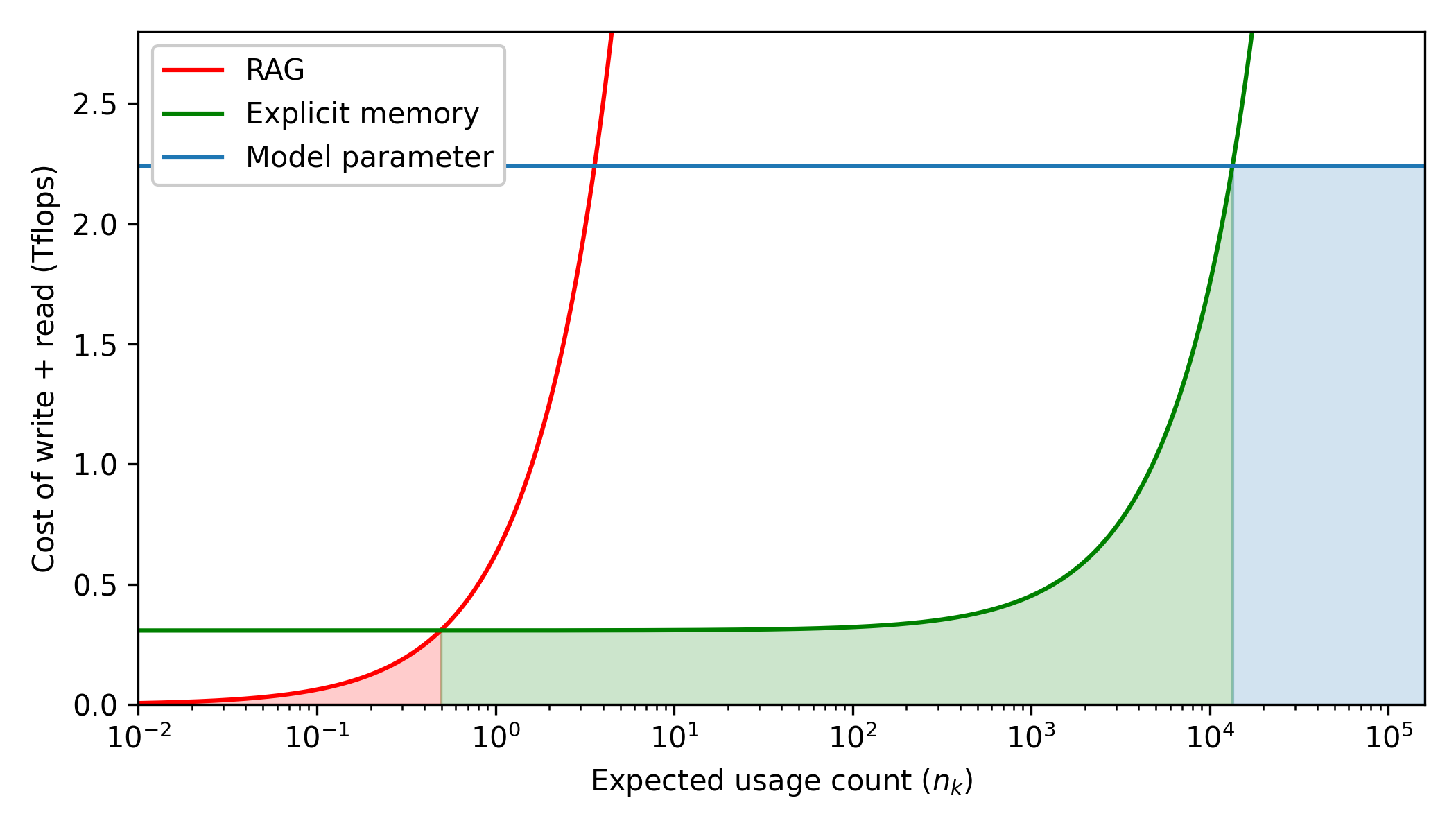
The image is a line chart comparing the cost of write + read (in Tflops) against the expected usage count (nk) for three different methods: RAG (Retrieval-Augmented Generation), Explicit memory, and Model parameter. The x-axis is logarithmic, ranging from 10^-2 to 10^5. The y-axis represents the cost in Tflops, ranging from 0.0 to 2.5. The chart also includes shaded regions indicating the areas where each method is most cost-effective.
### Components/Axes
* **X-axis:** Expected usage count (nk), logarithmic scale from 10^-2 to 10^5.
* **Y-axis:** Cost of write + read (Tflops), linear scale from 0.0 to 2.5.
* **Legend (top-left):**
* Red line: RAG
* Green line: Explicit memory
* Blue line: Model parameter
### Detailed Analysis
* **RAG (Red Line):** The cost of RAG starts near 0 at low usage counts and increases exponentially as the expected usage count increases.
* At nk = 10^-2, cost ≈ 0.01 Tflops
* At nk = 10^-1, cost ≈ 0.03 Tflops
* At nk = 10^0, cost ≈ 0.3 Tflops
* At nk = 10^1, cost ≈ 1.0 Tflops
* **Explicit Memory (Green Line):** The cost of explicit memory is relatively constant at low usage counts, then increases sharply around nk = 10^4.
* From nk = 10^-2 to nk = 10^3, cost ≈ 0.3 Tflops
* At nk = 10^4, cost ≈ 1.5 Tflops
* At nk = 10^5, cost ≈ 2.7 Tflops
* **Model Parameter (Blue Line):** The cost of the model parameter is constant across all usage counts.
* Cost ≈ 2.25 Tflops
* **Shaded Regions:**
* Light red shading: RAG is most cost-effective for nk < approximately 0.7.
* Light green shading: Explicit memory is most cost-effective for approximately 0.7 < nk < 10^4.
* Light blue shading: Model parameter is most cost-effective for nk > 10^4.
### Key Observations
* RAG is cost-effective for very low usage counts.
* Explicit memory is cost-effective for moderate usage counts.
* Model parameter is cost-effective for high usage counts.
* The cost of RAG increases much faster than explicit memory as usage count increases.
* The cost of the model parameter is constant, regardless of usage count.
### Interpretation
The chart illustrates the trade-offs between different methods for handling data based on the expected usage count. RAG is suitable for infrequently accessed data due to its low initial cost, but its cost quickly escalates with increased usage. Explicit memory offers a stable cost for moderate usage levels, making it a good choice for frequently accessed data up to a certain point. The model parameter method, with its constant cost, becomes the most economical option for very high usage counts, despite its higher initial cost. The shaded regions visually represent the optimal usage ranges for each method, providing a clear guideline for selecting the most cost-effective approach based on the anticipated usage patterns.