## Diagram: The RWKV Family Ecosystem
### Overview
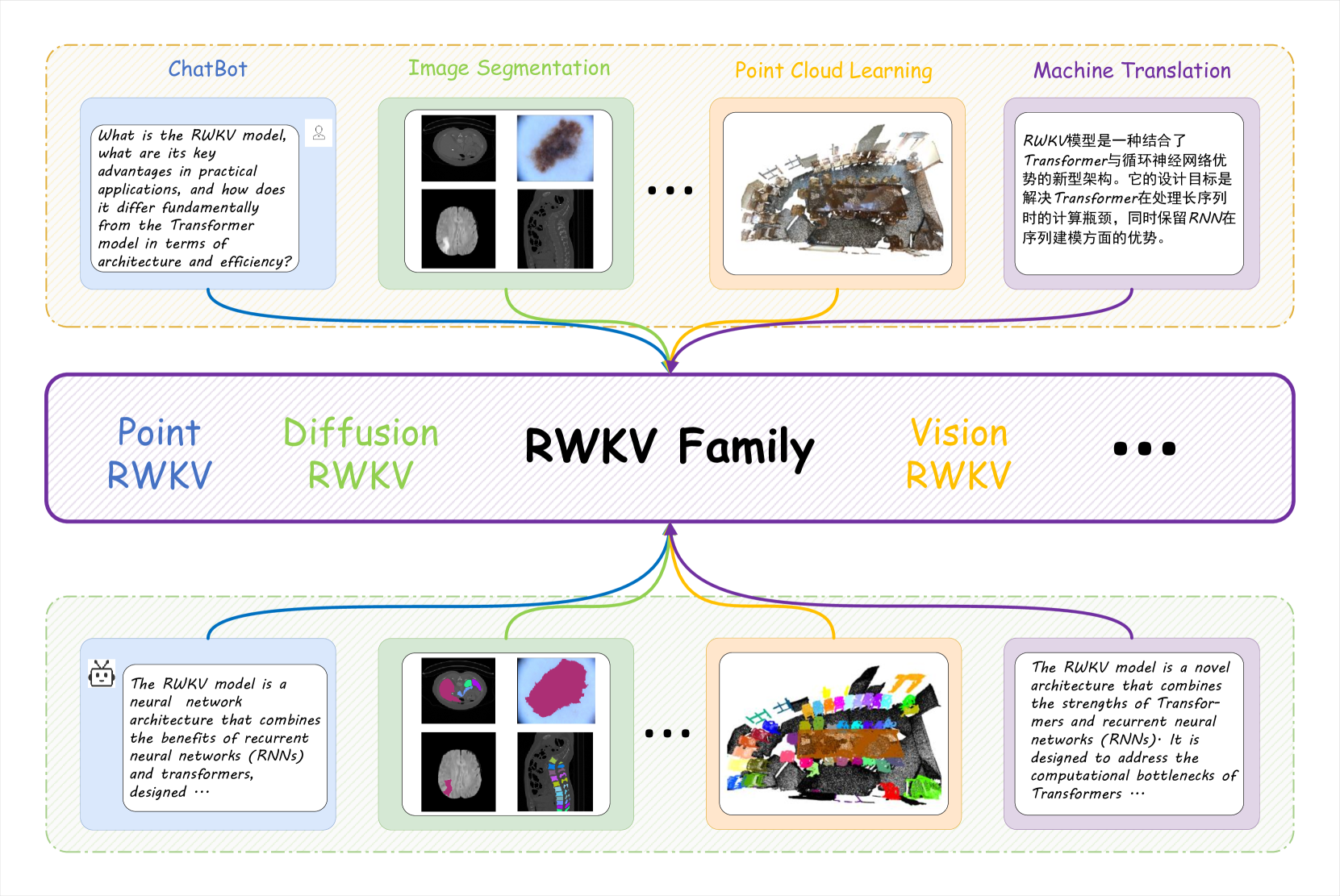
This diagram illustrates the versatility and application scope of the "RWKV Family" of neural network architectures. The image is structured as a central hub ("RWKV Family") connected to two rows of panels. The top row represents general application domains (ChatBot, Image Segmentation, Point Cloud Learning, Machine Translation), while the bottom row represents the specific implementation or output of the RWKV architecture applied to those same domains.
### Components/Axes
The diagram is divided into three horizontal sections:
1. **Top Row (General Application Domains):** Four distinct panels representing different AI tasks.
2. **Central Hub (The Core Architecture):** A large, rounded rectangular box labeled "RWKV Family" containing specific model variants.
3. **Bottom Row (RWKV Implementations):** Four panels showing the results or specific applications of the RWKV model corresponding to the top row.
**Color-Coded Connections:**
* **Blue:** Connects the ChatBot panels (top-left and bottom-left) to the central hub.
* **Green:** Connects the Image Segmentation panels (top-middle-left and bottom-middle-left) to the central hub.
* **Yellow:** Connects the Point Cloud Learning panels (top-middle-right and bottom-middle-right) to the central hub.
* **Purple:** Connects the Machine Translation panels (top-right and bottom-right) to the central hub.
### Detailed Analysis
#### 1. Central Hub ("RWKV Family")
* **Position:** Center of the image.
* **Content:**
* "Point RWKV" (Left)
* "Diffusion RWKV" (Middle-Left)
* "RWKV Family" (Center, large text)
* "Vision RWKV" (Middle-Right)
* "..." (Right, indicating further variants)
#### 2. Top Row (General Tasks)
* **ChatBot (Far Left):** Contains a text box with a user icon.
* *Text:* "What is the RWKV model, what are its key advantages in practical applications, and how does it differ fundamentally from the Transformer model in terms of architecture and efficiency?"
* **Image Segmentation (Middle-Left):** Contains four grayscale medical imaging scans (MRI/CT style).
* **Point Cloud Learning (Middle-Right):** Contains a 3D visualization of a room/scene in grayscale.
* **Machine Translation (Far Right):** Contains a text box with Chinese text.
* *Chinese Text:* "RWKV模型是一种结合了Transformer与循环神经网络优势的新型架构。它的设计目标是解决Transformer在处理长序列时的计算瓶颈,同时保留RNN在序列建模方面的优势。"
* *English Translation:* "The RWKV model is a new architecture that combines the advantages of Transformers and recurrent neural networks. Its design goal is to solve the computational bottleneck of Transformers when processing long sequences, while retaining the advantages of RNNs in sequence modeling."
#### 3. Bottom Row (RWKV Implementations)
* **ChatBot (Far Left):** Contains a text box with a TV/monitor icon.
* *Text:* "The RWKV model is a neural network architecture that combines the benefits of recurrent neural networks (RNNs) and transformers, designed ..."
* **Image Segmentation (Middle-Left):** Contains four medical imaging scans, now with colored segmentation masks overlaid (e.g., red, blue, green regions).
* **Point Cloud Learning (Middle-Right):** Contains the same 3D scene as the top row, but with colored segmentation clusters applied to the objects.
* **Machine Translation (Far Right):** Contains a text box with English text.
* *Text:* "The RWKV model is a novel architecture that combines the strengths of Transformers and recurrent neural networks (RNNs). It is designed to address the computational bottlenecks of Transformers ..."
### Key Observations
* **Symmetry:** The diagram uses vertical symmetry to demonstrate the "Problem -> Solution" flow. The top row represents the input or the general task, and the bottom row represents the RWKV-processed output.
* **Visual Transformation:** In the Image Segmentation and Point Cloud Learning columns, the transition from the top row to the bottom row clearly demonstrates the model's ability to perform semantic segmentation (adding color/labels to raw data).
* **Multilingualism:** The inclusion of Chinese text in the top-right and English in the bottom-right suggests the model's capability to handle multilingual inputs or that the documentation is intended for a global audience.
### Interpretation
The data demonstrates that the RWKV architecture is not limited to standard Large Language Model (LLM) tasks like ChatBots. By positioning "RWKV Family" at the center, the diagram argues that this architecture is a unified backbone capable of handling diverse modalities:
1. **Textual/Sequential:** ChatBot and Translation.
2. **Visual/Spatial:** Image Segmentation and 3D Point Cloud Learning.
The diagram effectively communicates that RWKV is a "Transformer-killer" or "Transformer-alternative" that solves the specific computational bottlenecks (likely quadratic complexity) associated with standard Transformers, while maintaining the efficiency of RNNs. The visual progression from raw data (top) to segmented/processed data (bottom) serves as proof of the model's efficacy in computer vision tasks.